
Not all lifetime deal platforms are created equal, and picking the wrong one can mean paying once for a tool that gets abandoned six months later, or worse, wading through 40 mediocre listings to find one worth buying.
That’s the real cost of choosing carelessly: wasted money, wasted time, or both.
This comparison is built for the people who actually buy lifetime deals regularly, including freelancers stretching a tight budget, agencies stacking tools for clients, startups avoiding recurring SaaS bills, and marketers hunting for an edge without a monthly commitment.
If you’ve ever typed “AppSumo alternative” into Google wondering whether Dealify is worth your time, this is for you.
Short version: one platform wins on sheer selection and track record, the other wins on curation and deal quality, and depending on what kind of buyer you are, that distinction matters more than price alone.
To get there, we dug into what most comparisons skip: vendor quality, how easy refunds actually are to claim in practice, vetting standards, and whether deals still deliver value months after purchase, not just headline discounts.
That’s what actually determines whether a lifetime deal was worth it.
AppSumo vs Dealify at a Glance
Before diving into the details, here’s how the two platforms stack up side by side. Use this table as your quick-reference cheat sheet, then read on for the sections that matter most to your buying decision.
| Category | AppSumo | Dealify |
|---|---|---|
| Founded | 2010 by Noah Kagan | 2018 by Tom van den Heuvel, based in Eindhoven, Netherlands |
| Number of deals | 100+ active listings at any given time, new drops weekly | Just 3–5 new deals per week – a deliberately small catalog |
| Software categories | Marketing automation, SEO, AI tools, productivity software, and more | AI content/marketing, email marketing and CRM, SEO monitoring, and developer/automation tools |
| Exclusive deals | Frequent exclusive launches, often the first stop for new SaaS tools | Fast approval process surfaces genuinely new tools early, including bring-your-own-key AI products |
| Refund period | 60 days on most deals | 30 days standard, extended to 60 days for Dealify Plus members |
| Membership requirements | None required; AppSumo Plus ($99/year) is optional for extra discounts | Dealify+ ($99/year) is optional, adding 10% off every deal, member-only flash sales, and a longer 60-day return window |
| Average pricing | $49–$79 typical, up to $299 for larger tools | $39–$99 typical, ranging up to $220 for complex platforms |
| Marketplace size | Millions of registered users, industry’s largest LTD platform | 50,000+ customers served – smaller but established |
| Customer support | Support team plus large self-serve help center | Praised on Trustpilot for a responsive, human support team that mediates if a vendor disappears or a tool underdelivers |
| Community | Large public community, YouTube roundups, active forums | Community-driven deal sharing among members, plus editorial curation from the Dealify team |
| Best for | Buyers who want maximum choice across every category | Buyers who want a shorter, pre-vetted list focused on growth and technical tools |
What Is AppSumo?
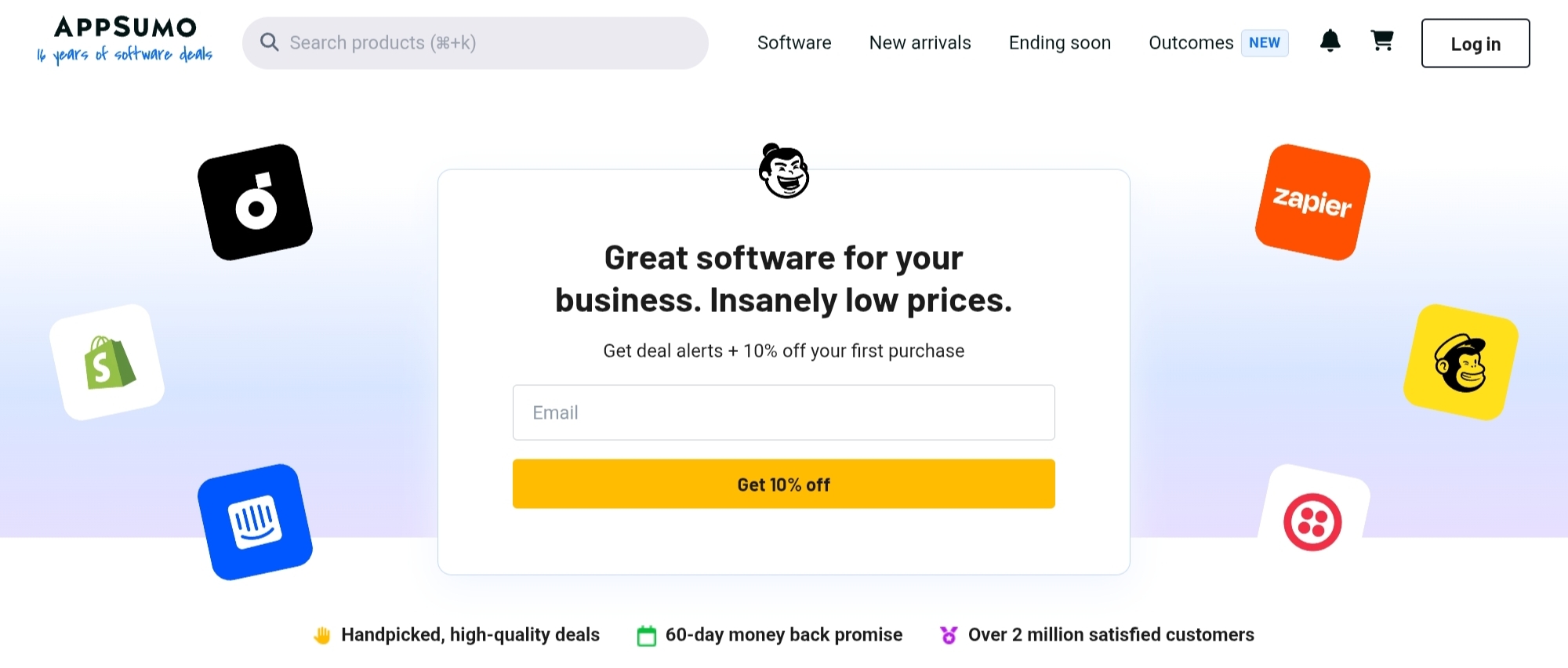
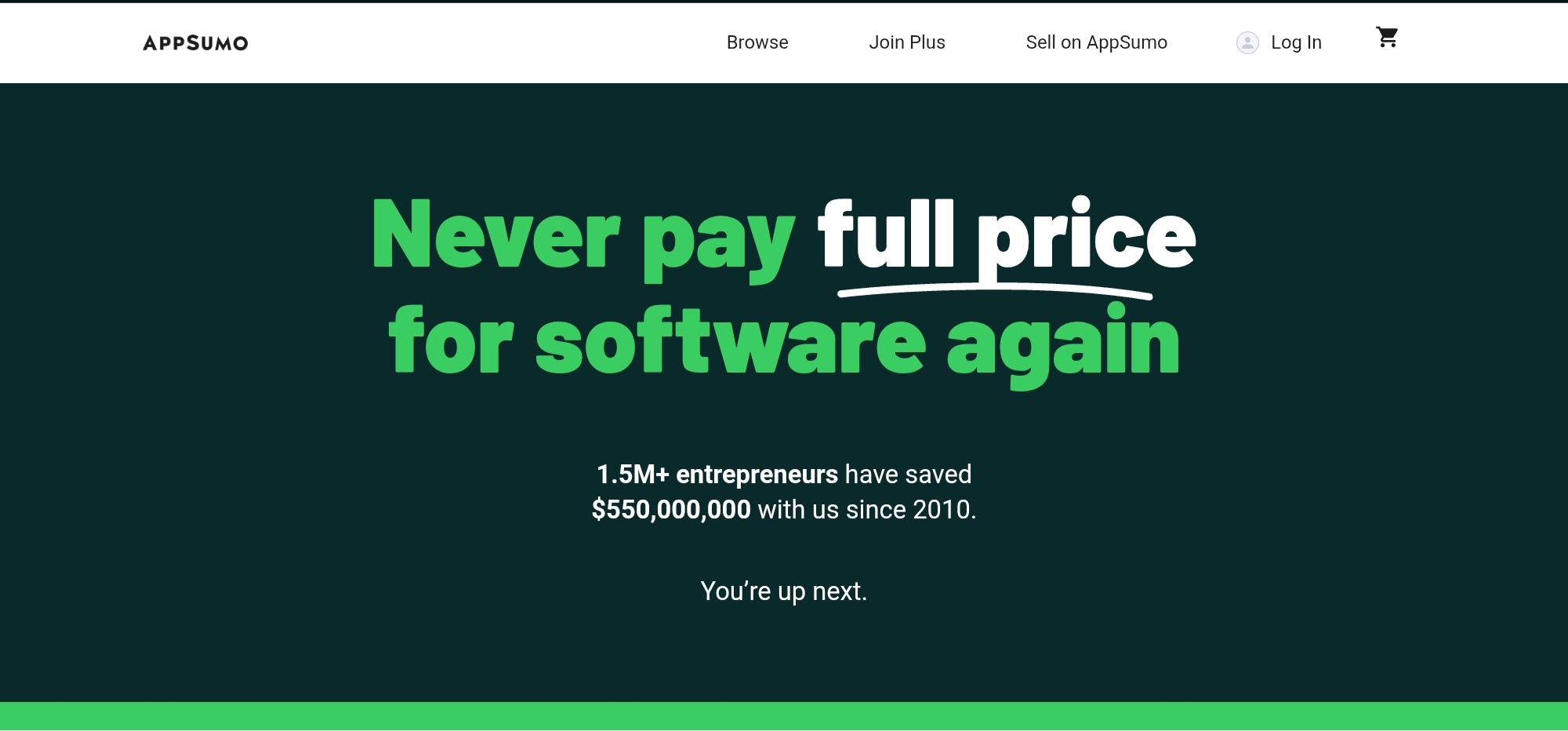
Founded in 2010 by Noah Kagan, AppSumo has grown into the largest lifetime deal marketplace, helping over a million entrepreneurs save more than $500 million by swapping subscriptions for one-time payments.
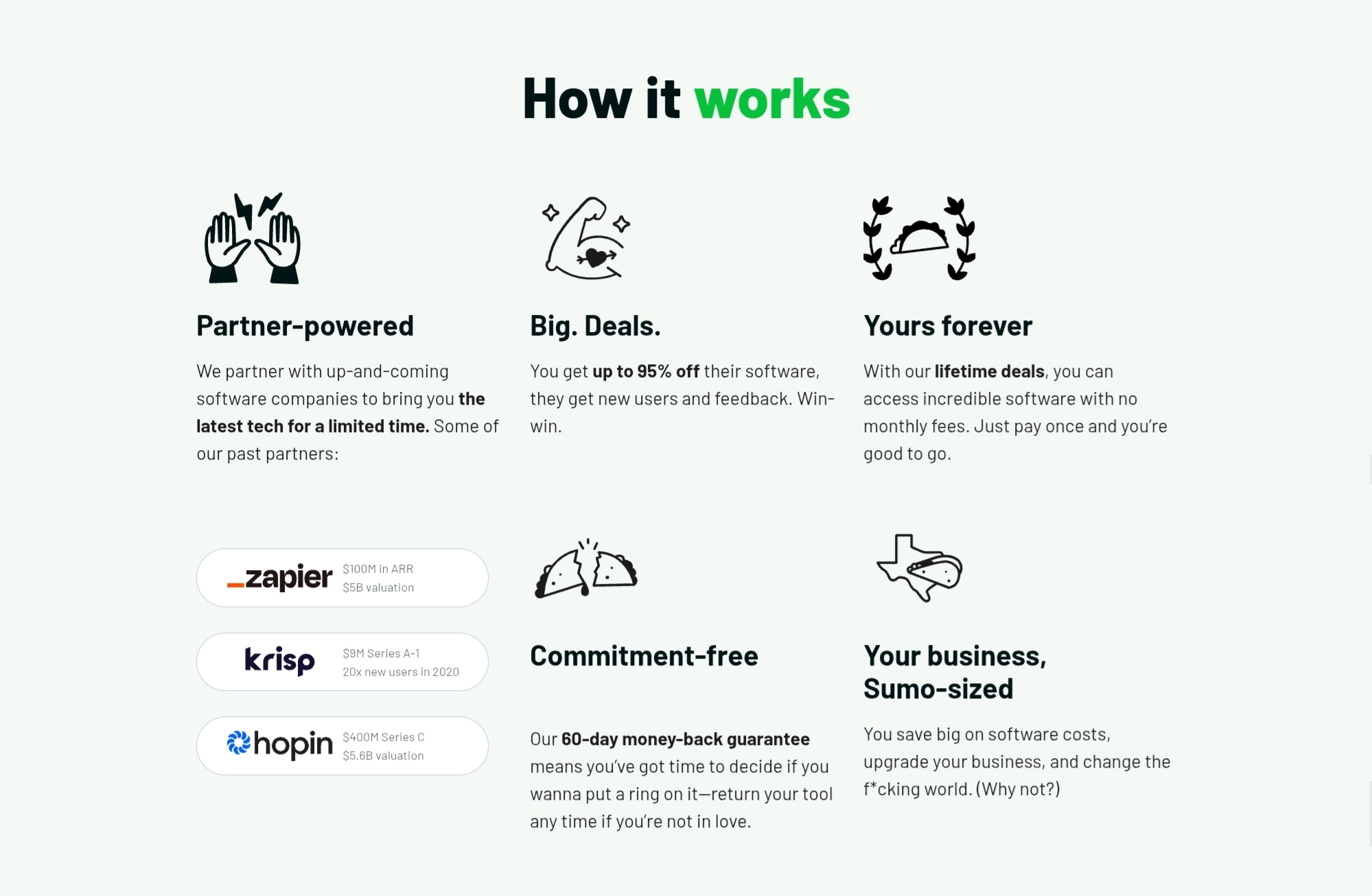
How it works: Software companies list their products directly on AppSumo to gain early users, feedback, and exposure, while buyers browse deals and pay once for permanent access.
Software available: The catalog spans marketing automation, SEO, AI tools, and general productivity software, with recent pushes into AI video generation, marketing automation, and visual design tools.
Strengths:
- Unmatched selection – 100+ deals across every category imaginable
- 60-day refund window for risk-free testing
- Long track record and strong brand trust
- AppSumo Plus membership sweetens already-discounted deals
Drawbacks:
- Not every deal delivers long-term value, and quality varies significantly between listings
- Easy to over-buy tools you’ll never actually use
- “Lifetime” means the product’s lifetime, not forever
- High volume makes vetting each purchase your own responsibility
Worth Checking: 75+ Best AppSumo Lifetime Deals for Marketers [Top Software Picks by Category]
What Is Dealify?
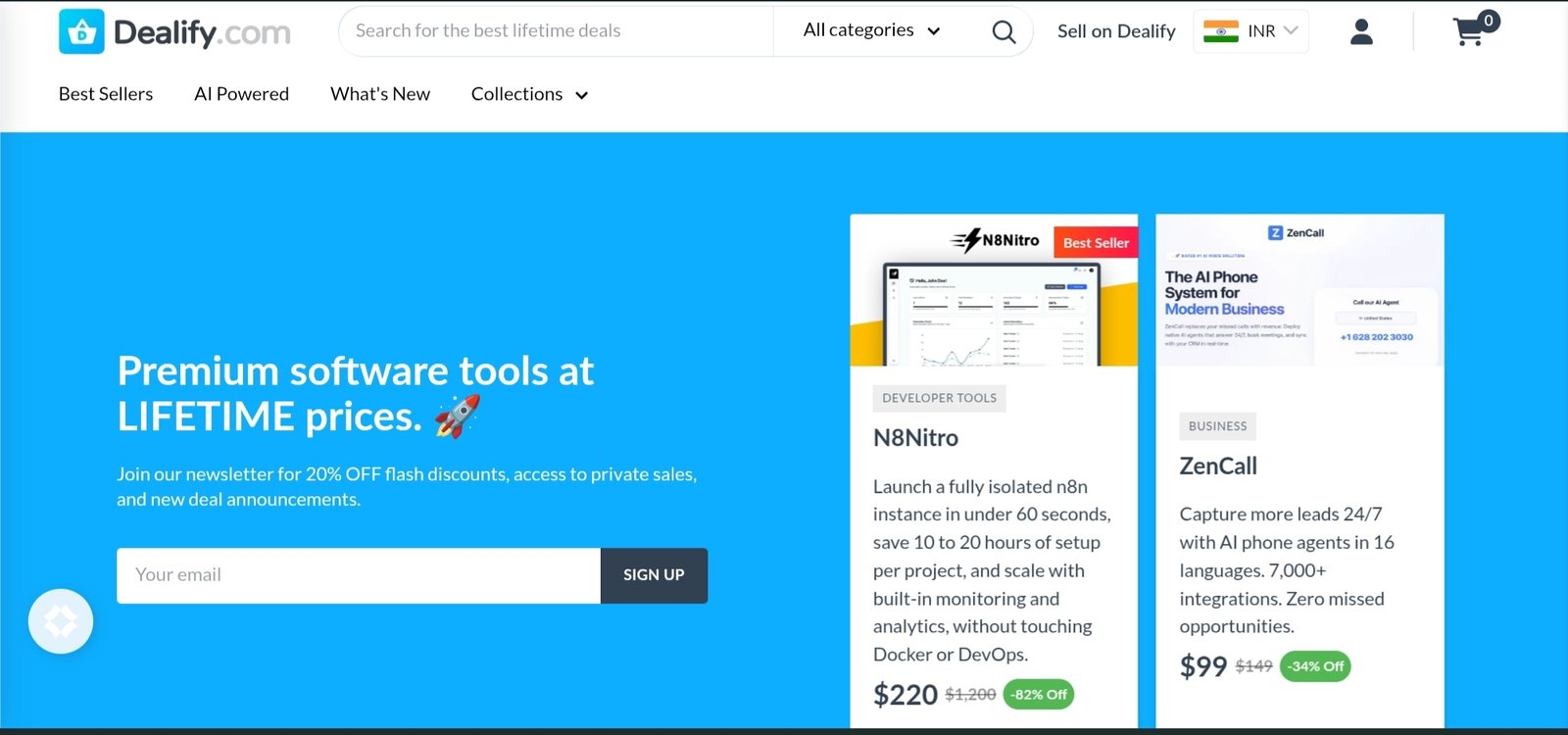
Founded in 2018 by Tom van den Heuvel, Dealify is based in Eindhoven, Netherlands, and built its reputation as a leaner, more curated alternative to the big marketplaces.
How it works: Software founders apply to list their tools, products go through a vetting process before appearing, and buyers browse by category, read feature breakdowns, and redeem most deals within minutes via a license key or direct account creation.
Software available: The catalog leans toward AI-powered content and marketing tools, email marketing and CRM platforms, and SEO monitoring software, with a further tilt toward developer tools and automation platforms for technical buyers.
Strengths:
- Independent analysts have called Dealify’s editorial filter the tightest among lifetime-deal marketplaces
- “Excellent” Trustpilot rating, 4.3–4.6/5 across 500+ reviews
- Praised for responsive, human support that steps in if a vendor disappears
- Small catalog means you can review every current deal in minutes
Drawbacks:
- Only 3–5 new deals (approx) per week. You may not find what you need on a given visit
- Shorter 30-day standard refund window versus AppSumo’s 60 days
- Smaller name recognition than the category’s biggest player
- Refund terms can vary by individual vendor, so it pays to check each listing
How Lifetime Deal Marketplaces Actually Work
Neither AppSumo nor Dealify makes software; they’re distribution partners. A SaaS company applies to the platform, gets vetted, and agrees to sell a bundle of lifetime licenses at a steep discount in exchange for a large batch of new users, real feedback, and fast cash flow.
This is exactly how ClickUp launched in 2017 with no outside funding. It used a lifetime deal to get exposure and revenue, then went on to a multi-billion-dollar valuation.
The marketplace takes a cut of every sale, which is why both AppSumo and Dealify vet applicants before listing them. A flood of bad products would tank buyer trust and, ultimately, the platform’s own revenue.
Why tools sometimes disappear: “Lifetime” means the lifetime of the product, not a guarantee that it lasts forever. If the vendor shuts down or gets acquired, your license typically ends with it.
This isn’t unique to either platform; it’s an inherent risk of buying from early-stage companies, and roughly 10% of LTD vendors industry-wide shut down within five years, regardless of which marketplace sold the deal.
Before you buy: Check the vendor’s track record, look for an active development roadmap, read recent reviews (not just launch-week hype), and confirm the specific refund terms. They can vary deal by deal even on the same platform.
AppSumo vs Dealify: Head-to-Head Comparison
1. Software Quality
Average product quality: AppSumo’s massive catalog means quality swings widely. Buyers are advised to look for a 4-star-or-higher review score before committing, since not every “cheap” tool avoids becoming a costly mistake.
Dealify’s smaller catalog trades volume for consistency: reviewers repeatedly say it competes on the quality of what it lists, not the quantity.
Vetting standards: Dealify’s team evaluates each product and the company behind it before accepting a submission, and independent analysts have named it the tightest editorial filter in the LTD space.
AppSumo vets too, but its higher listing volume means more inconsistency slips through, shifting more due-diligence work onto the buyer.
Product maturity: The best deals on either platform share traits like an active roadmap and a product that’s been alive long enough to prove staying power.
Update frequency: Dealify’s fast approval process tends to surface newer tools with active development early, while AppSumo mixes actively maintained tools with older listings that see less momentum.
Winner: Dealify for consistency and vetting rigor, though AppSumo still houses excellent tools if you’re willing to filter.
2. Variety of Software
AI: Both lean heavily into AI right now. AppSumo ran a dedicated AI Week featuring video generation, marketing automation, and visual design tools, while AI content creation, prompt optimization, and image generation are among Dealify’s fastest-growing categories.
Marketing & SEO: AppSumo covers marketing automation and SEO broadly across its catalog, and Dealify hand-picks SEO deals given how much low-quality noise exists in that category, alongside a high-volume marketing category for growth marketers.
Productivity & Design: AppSumo’s guides span productivity apps and visual/design tools as core categories, an area Dealify covers but with far fewer listings.
CRM & Lead Generation: Dealify lists CRM platforms and lead-generation software as one of its highest-volume categories for marketer buyers.
Video & Automation: AppSumo has dedicated video-tool roundups, while Dealify’s catalog skews toward developer tools and automation platforms for technical buyers.
Course creation: Neither platform treats this as a core category, though it appears occasionally on AppSumo given its broader sweep.
Winner: AppSumo for sheer category breadth. If you need one specific niche (SEO, CRM, automation), Dealify’s focus can still outmatch it there.
3. Exclusive Deals
Exclusivity: Dealify works directly with software vendors to offer deals exclusive to its own catalog, and buyers who’ve already checked AppSumo and StackSocial typically find different options waiting on Dealify.
AppSumo, meanwhile, leans on volume and speed – fast approval processes across the LTD industry mean many newer tools appear on multiple marketplaces around the same launch window rather than committing to one platform alone.
Overlap: In practice, a popular new SaaS tool often runs its lifetime deal on one primary platform first, then expands to others (or runs simultaneous listings) to maximize exposure during its launch window.
Because AppSumo has the largest reach, vendors frequently choose it as the lead platform, while Dealify picks up tools, sometimes the same ones, sometimes different ones, that fit its narrower AI, SEO, marketing, and automation focus.
Bottom line: You won’t find zero overlap between the two, but Dealify’s curated approach means its listings skew toward tools you’re less likely to have already seen on AppSumo.
Winner: Dealify for a better shot at genuinely fresh, non-duplicate finds, even though AppSumo still launches more deals overall.
Also Read: Best AppSumo Deals Under $100 for Bloggers, Marketers & Creators
4. Pricing & Discounts
Entry prices: AppSumo’s typical deals run $49-$79, while Dealify’s typical range is $39-$99, a slightly lower floor.
Multi-license tiers: Both platforms commonly sell deals in tiered license stacks (e.g., Tier 1, Tier 2, Tier 3), letting buyers pay more upfront for higher usage limits, seats, or features.
This is a standard structure across the LTD industry rather than something unique to either site.
Stackability: AppSumo has long been known for allowing “code stacking” on many deals, where buyers purchase multiple codes to unlock higher tiers.
Dealify’s smaller catalog means fewer stacking opportunities overall, simply because fewer deals are live at any given time.
Hidden costs: Watch AI tools closely on either platform. Many now meter usage through credit bundles or bring-your-own-API-key models instead of truly unlimited access, which can mean real ongoing costs even after your one-time payment.
Upgrade options: AppSumo Plus ($99/year) adds an extra 10% off every deal, and Dealify+ ($99/year) mirrors that with 10% off, flash sales, and a longer refund window.
Winner: Tie – AppSumo wins on stacking flexibility, Dealify on slightly lower entry prices.
5. Refund Policy
Refund window: AppSumo offers a 60-day money-back guarantee on most deals, giving buyers a full two months to test before committing. Dealify’s standard window is 30 days, extending to 60 days only for Dealify Plus members.
Refund process: On Dealify, you contact support directly with your order details to request a refund, and reviewers report the process is usually quick.
AppSumo runs refunds through a similar support-ticket system, with its long-standing infrastructure generally handling high volume smoothly.
Exceptions: Individual deals on Dealify can set their own terms, so the blanket 30/60-day window isn’t guaranteed for every listing.
Some trackers go further, flagging that certain Dealify listings carry no clearly stated refund policy at all, calling this the platform’s biggest buyer-protection risk.
AppSumo’s refund terms are more consistently applied across its catalog.
Ease of claiming: Dealify is heavily praised on Trustpilot for having an actual human support team that mediates when a vendor disappears or underdelivers, which is a meaningful reassurance given the exceptions above.
Winner: AppSumo – for a longer, more consistently applied refund window, even though Dealify’s support team gets strong marks for handling disputes personally.
6. User Experience
Website navigation: Dealify’s site is clean and well-organized, letting you filter by category and check what’s trending without wading through clutter.
AppSumo’s larger catalog means more menus and filters to sort through, which can feel busier by comparison.
Checkout process: Dealify’s checkout is a one-time purchase that grants a license key or direct account creation, with most deals redeemable within minutes. AppSumo’s checkout is similarly fast, built to handle much higher transaction volume during flash launches.
Deal pages: Dealify’s product pages include detailed feature breakdowns and user reviews before you commit, giving you the full picture in one place. AppSumo’s deal pages are similarly detailed but vary more in depth depending on the vendor.
Search & filters: AppSumo’s guides recommend bookmarking the deals page and filtering by “Ending Soon” to catch urgency-driven listings – useful given its volume, but it takes more digging.
Product discovery: With only a handful of new listings weekly, Dealify makes discovery effortless. The entire current catalog can be evaluated in under five minutes.
Winner: Dealify – its smaller size translates directly into a faster, less overwhelming browsing experience.
7. Product Reviews & Community Trust
Review systems: Dealify buyers can read detailed product pages and user reviews before committing to any purchase, built directly into the browsing flow.
AppSumo has a similarly established review system on each deal page, reinforced by years of accumulated buyer feedback.
Transparency: Dealify’s curation team provides detailed reviews, user feedback, and insights into each tool’s real-world application, helping buyers avoid costly pitfalls.
AppSumo’s transparency comes more from volume and longevity. Its own guides openly flag that not every “cheap” tool delivers long-term value, pushing buyers to self-vet using star ratings and roadmap activity.
Community discussions: Dealify’s community shares information about exclusive deals and supports each other, a smaller but tighter-knit group.
AppSumo’s larger footprint has spawned an ecosystem of third-party YouTube roundups and blogs curating top picks, reflecting its scale rather than in-house community tools alone.
Buyer confidence: Dealify sits firmly in Trustpilot’s “Excellent” category, with snapshots ranging from 4.3 to 4.6 out of 5 across 500+ reviews, which is a strong signal for a marketplace its size. AppSumo’s confidence comes from over a decade of track record and brand recognition.
Winner: Dealify – for tighter, more transparent curation, even though AppSumo’s scale generates more third-party validation.
Also Read: 8 Best AppSumo Lifetime Deals I Actually Recommend
8. Customer Support
Marketplace support: AppSumo backs its scale with a dedicated support team and a large self-serve help center, built to handle high-ticket volume from its bigger buyer base.
Dealify runs leaner but personal: buyers contact support directly with order details for issues like refunds, and reviewers report the process is usually quick.
Vendor responsiveness: The best deals on either platform share a responsive founding team as one of the key quality signals, but this varies vendor-by-vendor rather than by platform.
Where the platforms differ is in backup: Dealify’s internal team steps in to mediate if a software creator vanishes or a tool fails to work as promised, protecting the buyer’s investment rather than leaving them stuck negotiating with an unresponsive vendor alone.
Resolution quality: Redemption hiccups, codes not working, links expiring, are among the most commonly reported issues on lifetime deal platforms generally, and on Dealify these usually get resolved fast.
Dealify is specifically praised on Trustpilot for having an actual human support team, a distinction that stands out in a space where automated ticket queues are common.
Winner: Dealify – its smaller scale translates into more hands-on, human resolution when something goes wrong.
9. Lifetime Value After Purchase
This is where a “good deal” either proves itself or falls apart, and it’s the factor most comparisons skip entirely.
Software updates: Dealify’s fast approval process tends to surface tools with active development early, which correlates with vendors still shipping updates well after launch.
AppSumo’s larger catalog includes plenty of actively maintained tools too, but also older listings where momentum has visibly slowed.
Vendor survival: Industry-wide, roughly 10% of LTD vendors shut down within five years, regardless of which marketplace sold the deal. This risk sits at the vendor level, not the platform level, on both sites.
Feature improvements: The best deals share an active development roadmap as a defining trait, a filter worth applying before buying on either platform, since roadmap activity is the clearest early signal of long-term investment.
Abandoned products: “Lifetime” means the lifetime of the product. If a company shuts down or gets acquired, your license ends with it, though this is rare.
Long-term usability: Lifetime deals are best reserved for tools you already know you need and will use daily or weekly. Infrequent-use cases favor subscriptions you can simply cancel.
Winner: Dealify – tighter vetting modestly improves your odds of long-term survival, though neither platform eliminates vendor risk.
10. Mobile Experience
Neither platform is built around a dedicated app. Both are primarily browser-based marketplaces, so your experience on mobile largely comes down to how well each site’s responsive design holds up on a smaller screen.
AppSumo’s larger, more complex catalog with heavier filtering can feel more cramped on mobile browsers, while Dealify’s minimal, five-deals-a-week layout translates more naturally to a phone screen simply because there’s less to scroll through.
If you mostly browse deals on your commute and buy later on desktop, this difference matters less than the other factors above.
Winner: Dealify – its smaller catalog is inherently easier to browse on a small screen.
11. International Buying Experience
Payment methods: Both platforms process payments through standard checkout systems supporting major credit and debit cards; neither is known for offering an unusually wide range of regional payment methods (like local bank transfers or region-specific wallets) compared to dedicated e-commerce platforms.
Taxes: As digital marketplaces selling software licenses, both AppSumo and Dealify are generally expected to handle applicable VAT/sales tax at checkout depending on the buyer’s location, consistent with standard practice for SaaS and digital goods sellers operating internationally.
Currency: Pricing on both platforms is listed in US dollars by default. Dealify is based in Eindhoven, Netherlands, which may make it feel slightly more familiar to European buyers, though checkout still runs in USD rather than EUR.
Accessibility: AppSumo’s decade-plus track record and larger support infrastructure give it a slight edge for buyers outside the US who want faster resolution if something goes wrong across time zones.
Dealify’s smaller, more personal support team can still respond quickly, but with less around-the-clock coverage.
Winner: AppSumo – its scale and longer track record offer a modest edge for international buyers, though neither platform is purpose-built for global commerce.
Which Platform Has Better Deals in Each Category?
| Category | Better Platform | Why |
|---|---|---|
| AI | AppSumo | Runs dedicated AI-focused events like AI Week, covering video generation, marketing automation, SEO, and visual design in one push with broader AI selection overall. |
| Marketing | Dealify | Marketing automation is Dealify’s highest-volume category for growth-marketer buyers, with tighter curation than AppSumo’s broader sweep. |
| SEO | Dealify | SEO deals are hand-picked given how much low-quality noise exists in the category, reducing the guesswork. |
| CRM | Dealify | CRM platforms and lead-generation software are a core, high-volume focus area for Dealify’s growth-marketer audience. |
| Email Marketing | Dealify | Listed among Dealify’s core categories alongside CRM and lead generation, curated specifically for marketer buyers. |
| Video Editing | AppSumo | Dedicated video-tool roundups and a large catalog make AppSumo the stronger stop for creators needing video software. |
| Design | AppSumo | Visual/design tools are a consistently tracked category within AppSumo’s broader catalog. |
| Productivity | AppSumo | Productivity software is one of AppSumo’s core, broadly-covered categories across many use cases. |
| Automation | Dealify | Catalog skews toward developer tools and automation platforms built for technical buyers. |
| Project Management | AppSumo | Larger overall catalog gives more options in this space, though neither platform treats it as a headline category. |
Real-World Buying Scenarios
If you’re a blogger
You need writing, SEO, and design tools without a huge budget. AppSumo is the better starting point. Its catalog spans AI writing, SEO, and design tools with deals as low as $49, giving you more options to compare before committing.
If you’re a freelancer
You likely need a lean, specific toolkit rather than a sprawling stack. Dealify fits well here; its small, curated catalog lets you evaluate everything relevant in minutes instead of digging through pages of listings.
If you’re an agency
You’re buying in volume across many categories for multiple clients. AppSumo wins on raw selection, though Dealify’s CRM and lead-generation focus makes it worth checking for client-facing marketing tools specifically.
If you’re a startup
Cash flow matters, and so does reliability. Check both and favor deals with a 4-star-or-higher rating and an active roadmap regardless of platform, since vendor survival matters more than which site sold the deal.
Also Check: Best Appsumo Deals For Startups Every Founder Should Consider
If you’re a course creator
Neither platform specializes here, but AppSumo’s broader catalog gives slightly better odds of finding relevant hosting, video, or funnel tools.
If you’re a marketer
Dealify is purpose-built for you. Its top categories are AI marketing, email/CRM, and SEO, curated specifically for growth marketers.
If you’re building an AI toolkit
Check both. AppSumo runs dedicated AI-focused events with a broad selection, while Dealify’s fast approval surfaces newer AI tools early, often bringing their own key models worth comparing on cost.
Can You Use Both Platforms Together?
Yes, and for many buyers, this is the smartest approach rather than a compromise.
Since Dealify works directly with vendors on deals exclusive to its own catalog, buyers who’ve already checked AppSumo often find different options waiting there; the two platforms complement more than they compete.
When it makes sense: Use AppSumo as your broad-discovery engine for creative, productivity, and general SaaS categories, and check Dealify specifically when you’re hunting for AI, SEO, CRM, or automation tools, where its tighter curation tends to surface higher-quality picks faster.
How experienced buyers monitor both: Bookmark each platform’s deals page and check in on a regular cadence: AppSumo drops new deals weekly, while Dealify’s slower pace means a quick weekly glance covers its entire catalog.
Many buyers also subscribe to each platform’s newsletter so new launches land in their inbox instead of requiring manual checking.
Avoiding duplicate purchases: Before buying on either platform, do a quick search for the tool name plus “lifetime deal.” If it’s running simultaneously elsewhere, you can compare tier pricing and refund terms across both before committing, rather than after.
Who Should Choose AppSumo?
Ideal users
- Buyers who want maximum selection and enjoy browsing to compare options
- Agencies and startups building a broad, multi-category software stack at once
- Anyone who values a long track record and wants the reassurance of a full 60-day refund window
- Creators needing video, design, or productivity tools, where AppSumo’s catalog runs deepest
Not ideal users
- Buyers who get overwhelmed by choice and want a short, pre-filtered list
- Anyone short on time who can’t dedicate effort to vetting each deal individually
- Buyers who’ve been burned before by inconsistent quality across a large catalog and want tighter curation instead
Who Should Choose Dealify?
Ideal users
- Growth marketers needing AI marketing, SEO, CRM, or email tools specifically
- Freelancers and solo buyers who want to evaluate an entire catalog in minutes rather than scroll for hours
- Buyers who prioritize vetting quality and want the platform with the tightest editorial filter
- Anyone who values hands-on, human support if something goes wrong post-purchase
Not ideal users
- Buyers who need a wide range of categories covered in one place
- Anyone relying on browsing frequency with only 3–5 new deals weekly may come away empty-handed on a given visit
- Buyers who want a guaranteed refund window on every deal without checking each listing’s fine print
Frequently Asked Questions
Is Dealify cheaper than AppSumo?
Slightly. Dealify’s typical range is $39-$99 versus AppSumo’s $49-$79, though both scale larger for complex tools, so compare deal-by-deal.
Does AppSumo have better lifetime deals?
It has more deals, not necessarily better ones. Quality varies widely, so check reviews and roadmap activity before buying, regardless of platform.
Which platform has a better refund policy?
AppSumo, generally, 60 days versus Dealify’s standard 30, though Dealify Plus members also get 60 days.
Can the same software appear on both platforms?
Yes, sometimes. Dealify does offer deals exclusive to its catalog, but overlap with AppSumo isn’t unheard of.
Can I trust software sold through these marketplaces?
Mostly, since both platforms vet vendors before listing them, but individual product quality still varies.
How do I choose between AppSumo and Dealify?
Match the platform to your need: AppSumo for breadth, Dealify for curated marketing and SEO tools.
Final Verdict
If you had to pick just one platform to bookmark, AppSumo wins: its scale, 60-day refund window, and decade-plus track record make it the safer default for most buyers.
But don’t stop there: Dealify’s tighter curation makes it the sharper tool specifically for AI, SEO, CRM, and marketing deals.
The smartest move isn’t choosing sides; it’s using AppSumo as your primary marketplace and checking Dealify weekly for its focused categories.
Related Articles
Are AppSumo Deals Really Worth It? Hidden Truth Most Buyers Ignore
How to Pick the Best AppSumo Deals (Avoid Wasting Money)
AppSumo for Beginners: How to Pick Deals That Are Actually Worth It
Best AppSumo Hidden Gems: Surprisingly Good Deals Worth Buying

TechnicalStudies was started by Neeladrinath with one simple idea — give Indian students a reliable place to figure out what’s actually worth their time and money. Every recommendation here is backed by careful research, real student feedback, and honest analysis. We cover online courses, laptops, smartwatches, software deals, and learning resources — all looked at from a student’s perspective, so you can spend less time guessing and more time learning.