
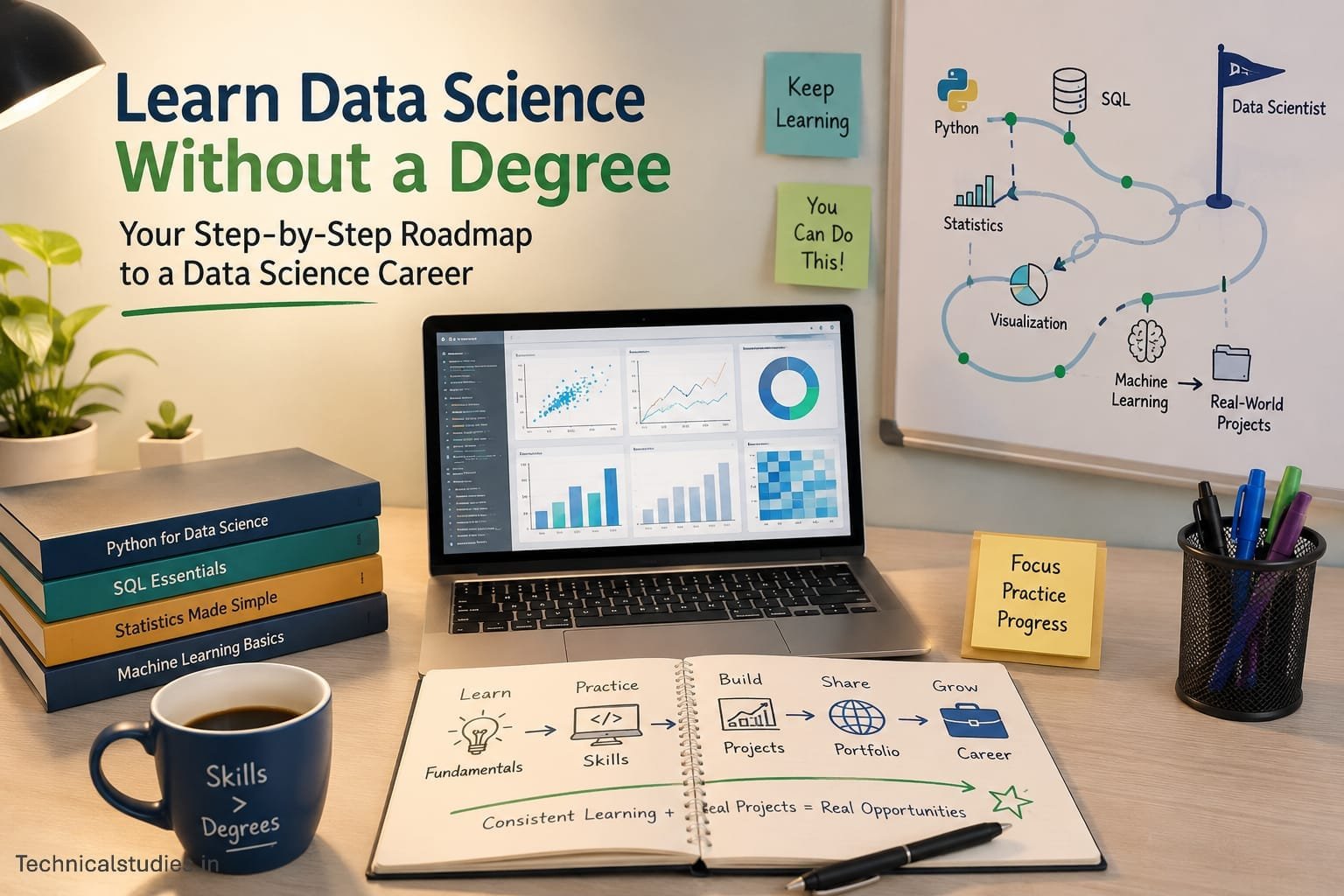
Yes, you can learn data science without a degree, and companies are hiring people who did exactly that. But let’s be honest about what that really takes, because most guides gloss over it.
A degree still helps. It signals baseline competence, gets you past automated resume filters, and comes with a built-in network.
What it isn’t anymore is a requirement. Self-taught candidates and bootcamp grads get hired regularly, especially at startups and mid-size companies, because what actually convinces a hiring manager is proof of skill, not the credential that’s supposed to imply it.
That’s the real question this roadmap answers: not “which courses should I take,” but how do you build the specific combination of skills, projects, and credibility that lets you compete without a degree in the room to vouch for you?
This guide walks through that path step by step – choosing the right skill order, building a portfolio that actually gets noticed, and closing the gaps a degree would normally cover, so you come out the other side genuinely job-ready, not just course-complete.
Can You Learn Data Science Without a Degree?
The short answer is yes. And the longer answer is yes, but “learning data science” and “getting hired as a data scientist” are two different milestones, and conflating them is where most beginners get discouraged.
What employers actually screen for at entry level isn’t a diploma. It’s evidence you can do the work.
That means SQL you can use under pressure, statistical reasoning you can explain in plain language, and code clean enough for someone else to read.
A resume that shows this, degree or not, gets an interview. A resume with a degree and nothing to show for it increasingly doesn’t.
That said, a degree still matters in specific situations. Large enterprises and research-heavy roles are more likely to filter on it automatically.
It’s also the more direct route if you’re targeting positions that lean on formal statistical theory, or if you’re a career changer from a completely non-technical background and need the structured pace a program provides.
Learning data science is a skills problem; you can solve it with focused study and real projects. Getting a data scientist job is a credibility problem.
You have to prove those skills to someone who’s never met you. Without a degree doing that proving for you, your portfolio has to do it instead.
Set your expectations accordingly. This isn’t a three-week sprint, and your first offer probably won’t be a “Data Scientist” title. It may be analyst work that gets you in the door. That’s not a failure. It’s the realistic path in.
Also Read: 12 Best Artificial Intelligence Courses Online
What Do You Need to Learn to Become a Data Scientist?
Before you touch the step-by-step roadmap, it helps to see the whole skill stack laid out because most self-taught learners jump straight into Python and machine learning while treating statistics, SQL, and communication as afterthoughts.
In practice, those “afterthoughts” are what interviews actually test hardest. Here’s everything you need, in the categories that matter.
Mathematics and Statistics
This is the reasoning layer underneath every model you’ll ever build. You need descriptive statistics (mean, median, variance, standard deviation) not as memorized formulas but as tools for describing what’s actually happening in a dataset.
Add probability fundamentals, correlation (and the discipline to not confuse it with causation), and basic hypothesis testing. Knowing when to reach for a t-test versus a chi-square test, and being able to explain that choice to someone non-technical.
Python Programming
You don’t need to be a software engineer, but you do need real fundamentals: variables, control flow, functions, and core data structures (lists, dictionaries, sets).
Add basic file handling and enough object-oriented understanding to read other people’s code without getting lost.
The skill that separates hireable candidates here isn’t cleverness. It’s writing readable code with sensible naming and structure, because that’s what a teammate will actually have to work with.
You can explore our selection of top Python programming courses online.
SQL
This is the most under-prepared-for skill on this list, and one of the most tested. Start with SELECT, WHERE, and ORDER BY, then move into GROUP BY and aggregations.
From there, get comfortable with JOINs across multiple tables, subqueries, and, critically, window functions, which show up constantly in real interviews and in real analytical work, yet get skipped by most beginner courses entirely.
These SQL courses are the top options available online.
Data Analysis
This is where theory becomes practice. NumPy gets you comfortable with array-based computation; pandas is where you’ll actually live day to day, doing the unglamorous work of data cleaning, including handling missing values, fixing types, and reshaping messy tables.
Exploratory data analysis (EDA) ties it together: forming and testing hypotheses about a dataset before you ever build a model.
Data Visualization
Matplotlib and Seaborn are the standard toolkit for turning cleaned data into charts that actually communicate something.
The skill isn’t making a chart; it’s making the right chart, and building the habit of asking what decision this visualization should help someone make.
This is also where dashboard thinking starts to matter, even before you touch a dedicated BI tool.
Machine Learning
Understand the split between supervised learning (regression, classification) and unsupervised learning (clustering) before you touch any code.
Then learn model evaluation, knowing when accuracy is a misleading metric, and feature engineering, which usually matters more to real-world performance than model choice does. Scikit-learn is the library you’ll use to put all of this into practice.
Explore these machine learning courses to learn ML the right way.
Portfolio and Professional Skills
This category gets skipped constantly, and it’s the one hiring managers notice fastest. Git and GitHub aren’t optional extras; they’re how you prove your work is real and track how it evolved.
Beyond that: communication (can you explain a finding to someone who doesn’t know what a p-value is?), problem-solving, enough business understanding to connect a model to an actual decision, and data storytelling.
The ability to turn a result into a narrative someone will act on. Technical skill gets you the model. These skills get you the job.
How to Learn Data Science Without a Degree: Step-by-Step Roadmap
This is the core of the roadmap. The actual sequence to follow, in the order that builds on itself instead of jumping around.
Step 1: Understand What Data Science Actually Is
Before you learn anything, get clear on what the job is. Data scientists build models and run statistical analysis to answer open-ended questions.
Data analysts work closer to the business, answering defined questions with SQL, dashboards, and reporting. ML engineers take models into production and keep them running reliably.
These roles blur at smaller companies but diverge sharply at larger ones. Knowing the difference now saves you from learning the wrong things later, and helps you honestly decide if this path fits how you like to work.
Step 2: Learn the Mathematics and Statistics You Actually Need
Start with descriptive statistics, probability basics, and hypothesis testing; enough to reason about data, not derive formulas from scratch.
You don’t need linear algebra proofs or calculus mastery to start; that depth matters more for research roles than applied ones.
Prioritize practical understanding: can you look at a dataset and correctly judge whether a difference is meaningful? That skill matters more early on than mathematical elegance.
Step 3: Learn Python for Data Science
Get comfortable with Python fundamentals first before touching a single library. Then move into NumPy for array operations and pandas for real data work.
Practice on small, messy datasets, not toy examples. Good beginner projects: cleaning a public dataset and summarizing it, or analyzing a CSV of retail transactions to find basic trends. The goal isn’t cleverness; it’s fluency.
Step 4: Learn SQL
SQL matters because it’s how data actually lives inside companies, and it’s tested constantly in interviews. Learn to query databases, then build up through joins and aggregations.
This is where most beginners plateau, so push past it. Practice on platforms like Mode Analytics, StrataScratch, or LeetCode’s database section, using real-feeling datasets rather than single-table exercises.
Step 5: Master Data Cleaning and Exploratory Data Analysis
This is the unglamorous 80% of real data work. Learn to handle missing values, spot and remove duplicates, catch outliers, and fix mismatched data types.
Then practice EDA: exploring a dataset to find patterns before you assume anything, and learning to ask questions the data can actually answer, not just questions that sound interesting.
Step 6: Learn Data Visualization and Storytelling
Learn to choose the right chart for the question, not the flashiest one. Build basic dashboards, then practice explaining what you found to someone with zero technical background.
The real skill is turning an analysis into a recommendation: “here’s what I found” is analysis; “here’s what we should do about it” is storytelling, and it’s what actually gets valued.
Step 7: Learn the Fundamentals of Machine Learning
Start with regression and classification, then clustering. Learn train/test splits and cross-validation before you learn fancy models; understanding why you evaluate this way matters more than memorizing algorithms.
Get comfortable with evaluation metrics beyond accuracy, and learn to recognize overfitting and underfitting by sight, not just by definition.
Step 8: Build Real-World Data Science Projects
Without a degree, projects are your credibility. Progress deliberately: beginner (sales analysis), intermediate (customer churn prediction, house price prediction), advanced (customer segmentation, a recommendation system). Each stage should stretch a real skill from the steps above, not just add another notebook.
Step 9: Build a Data Science Portfolio
Host everything on GitHub, documented properly, not just code dumps. Each project needs a clear README explaining the problem, your process, and your results, written so a non-technical hiring manager could follow it.
A simple portfolio website tying projects together, with a short write-up on each, goes a long way toward looking like a professional rather than a student.
Step 10: Start Applying for Jobs and Internships
Apply broadly across data analyst roles, junior data roles, internships, and junior data scientist positions, plus freelance or contract work, which is often easier to land first and builds real experience fast.
Network deliberately; referrals convert far better than cold applications for candidates without a degree.
How Long Does It Take to Learn Data Science Without a Degree?
There’s no fixed answer here, and anyone promising one is guessing. What follows are realistic ranges, not guarantees.
If You Study 1 Hour a Day
Expect 18-24 months to reach job-ready. Progress is real but slow enough that consistency, not intensity, becomes the deciding factor.
If You Study 2-3 Hours a Day
A more typical pace for working adults: roughly 10-14 months to build the core stack and a solid portfolio.
If You Study Full-Time
With genuine focus, 6-9 months is realistic; though the core technical skills (Python, SQL, statistics) usually solidify in 3-4 months, with the rest going toward projects and portfolio work.
Also Check: How to Use ChatGPT to Write Product Descriptions for Ecommerce – A Practical Guide
A Practical Data Science Learning Roadmap for Beginners
If everything above feels like a lot to hold in your head at once, here’s the same roadmap condensed into a single reference table.
Use it as a checklist to track where you are, but treat the “Main Goal” column as the real target for each stage, not the topic name. Ticking off a library isn’t the point; being able to actually do what that column says is.
| Stage | What to Learn | Main Goal |
|---|---|---|
| Foundation | Math + Statistics | Understand data |
| Programming | Python | Work with data |
| Databases | SQL | Query data |
| Analysis | Pandas + NumPy | Analyze datasets |
| Visualization | Matplotlib + Seaborn | Communicate insights |
| Machine Learning | Scikit-learn | Build models |
| Projects | Real datasets | Gain practical experience |
| Portfolio | GitHub + Projects | Demonstrate skills |
| Career | Resume + Applications | Find opportunities |
A few of these stages will overlap in practice; you’ll likely be doing small projects while you’re still learning pandas, and that’s fine, even encouraged.
The stages aren’t strict gates; they’re a rough order of priority for a beginner figuring out a data science roadmap from scratch, without wasting months on the wrong things first.
Best Ways to Learn Data Science Without a Degree
There’s no single right resource, and the mistake is relying on only one.
Online Courses
Courses are useful for structure, especially early on when you don’t yet know what you don’t know.
Choose one based on whether it includes graded projects, not just video lectures; that’s the real quality signal.
The trap to avoid is course-hopping: starting a new course every time you feel stuck, mistaking motion for progress. Pick one, finish it, then build something with what you learned.
YouTube and Free Resources
Genuinely good for building fundamentals and understanding concepts explained in multiple ways. The limitation is passivity; watching someone else write code teaches recognition, not recall.
If videos are your only input, you’ll understand data science without being able to actually do it.
Practice Platforms
Kaggle is useful for datasets and community notebooks, though treat its competitions as a supplement, not your whole portfolio.
Query practice platforms sharpen SQL specifically, which general courses tend to under-teach. Dataset-based learning, picking a raw dataset and working it from scratch, builds skills tutorials can’t.
Books and Documentation
Official documentation is underrated. It’s how you’ll actually solve problems on the job, so getting comfortable reading pandas or scikit-learn docs directly, instead of only searching for tutorials, builds real independence early.
Learning Through Projects
This is the most important method on the list, not an optional add-on. Build while you learn, not after you feel “ready,” and that feeling rarely arrives on its own.
Projects reveal gaps courses can’t show you, and they’re what eventually becomes your portfolio.
How to Build a Data Science Portfolio Without a Degree
Without a degree, your portfolio isn’t a nice extra; it’s the entire case you’re making for yourself. This deserves its own close look.
What Projects Should You Build?
Pick problems in a domain you actually find interesting, not whatever dataset is trending. Interest shows in the depth of your analysis, and interviewers can tell the difference between a project you cared about and one you rushed to check a box.
How Many Data Science Projects Do You Need?
Four to six finished ones, not fifteen half-finished ones. A single project with proper cleaning, honest analysis, and a clear write-up outperforms a stack of shallow notebooks every time; depth is the signal, not volume.
What Should Every Project Include?
Treat this as a non-negotiable structure for each one:
- The problem – a real question, stated clearly
- The dataset – where it’s from, and its limitations
- Cleaning – what was wrong with the raw data and how you fixed it
- Analysis – what you explored and what you found
- Visualization – charts that support your findings, not decorate them
- Model (if applicable) – what you built and how you evaluated it
- Results – stated plainly, including what didn’t work
- Business recommendations – what someone should actually do with this
That last piece is the one beginners skip most, and it’s often what separates a portfolio that gets interviews from one that doesn’t.
Where Should You Publish Your Projects?
GitHub is non-negotiable. It’s where hiring managers expect to look. A simple portfolio website ties your projects into one coherent narrative. Kaggle adds visibility and community credibility.
LinkedIn is where you talk about the work, and short posts on what you built and learned, so people encounter your portfolio before they ever see your resume.
How to Get a Data Science Job Without a Degree
Skills and a portfolio get you ready. This is how you turn that into an actual offer.
Start With the Right Job Titles
Widen your search beyond “Data Scientist.” Data Analyst, Junior Data Analyst, Business Intelligence Analyst, Data Science Intern, and Junior Data Scientist roles all use the same core skills and are meaningfully more accessible without a degree in the room to vouch for you. Many people who now hold data scientist titles started in one of these first.
Create a Skills-Based Resume
Lead with what you can prove, not where you studied. Put projects near the top, not buried at the bottom.
List technical skills specifically (SQL, pandas, scikit-learn) rather than vaguely (“data analysis”). Always include GitHub and portfolio links directly in the header, not hidden at the end.
Use LinkedIn Strategically
Treat LinkedIn as a second portfolio, not just a job board. Post short breakdowns of your projects, such as what you found and what surprised you.
Share analysis on topics you’re genuinely curious about. Connect with people actually working in data roles and engage with their posts before you ever ask them for anything; cold connection requests convert far better when there’s already a thread of context behind them.
Gain Experience Without a Traditional Job
Freelance platforms and short contract gigs build real, citable experience fast. Internships remain one of the most reliable entry points, degree or not. Contributing to open-source data projects shows collaboration skills a solo portfolio can’t.
Volunteer work for nonprofits needing basic data help is often underused. It’s a real-world impact you can point to, and it’s usually easier to get than a first paid role.
Do You Need Certificates to Learn Data Science Without a Degree?
Not really. Certificates prove course completion, not competence, and hiring managers know the difference.
They can help in narrow cases: passing an automated resume filter, or building structure early on when you don’t know where to start. But a certificate with no visible work behind it is now a weak signal, precisely because they’re so easy to collect.
Prioritize projects and a working portfolio over adding another certificate. If you have time for just one more thing, build something instead.
Can You Get a Data Science Job Without a Degree?
Yes, it’s possible, but not effortless. It’s harder at large enterprises and research-heavy roles, which lean on degrees as an automatic filter. Startups and mid-size companies tend to be far more flexible, judging candidates on demonstrable skills instead.
Realistically, entry-level or analyst-track roles are a more achievable first step than aiming straight for a senior data scientist title. Get in, build real experience, then move up from there.
Frequently Asked Questions
Can I learn data science without a degree?
Yes. Employers increasingly screen for SQL fluency, clean code, and a real portfolio over credentials, especially at startups and mid-size companies where demonstrable skill outweighs where you studied.
Can I become a data scientist without a computer science degree?
Yes. Most self-taught data scientists come from unrelated backgrounds. What matters is fluency in statistics, SQL, Python, and a portfolio proving you can actually apply them.
Is a degree necessary for a data science career?
Not necessary, but helpful at large enterprises and research-heavy roles that filter on it automatically. Startups and mid-size companies judge portfolios and interview performance far more heavily.
Can I learn data science by myself?
Yes, but relying on one resource type fails. Combine structured courses, official documentation, and, critically, self-directed projects, which reveal gaps that passive video-watching never will.
Is Python enough to get into data science?
No. SQL is tested just as heavily in interviews, and statistical reasoning underlies every model decision. Python without those two leaves obvious, easily-spotted gaps.
Do I need advanced mathematics for data science?
Not initially. Descriptive statistics, probability, and hypothesis testing cover most applied work. Linear algebra and calculus matter more for research roles than typical entry-level positions.
Can I get a data science job without experience?
Yes, through internships, freelance contracts, and entry-level analyst roles. A strong portfolio of deployed, well-documented projects often substitutes for traditional work history at this stage.
What should I learn first in data science?
Statistics fundamentals and SQL, not machine learning. Both get tested constantly in interviews, and beginners who skip straight to modeling usually have visible, correctable gaps here.
Final Takeaway
You don’t need to wait for a degree to start learning data science. You can start today, with a laptop and a real dataset.
Build the foundation in statistics, learn Python and SQL until they’re genuinely comfortable, practice real data analysis, and work through the fundamentals of machine learning.
Then build projects that mean something, document them properly, and publish your work somewhere a stranger can actually find it.
None of this guarantees a job. No roadmap honestly can. The market is real, and it’s competitive. What this path does give you is something better than a guarantee: proof. A portfolio that shows, not tells.
That’s what gets you in front of the right people. From there, it’s on you to apply, ask, and keep building steadily, not perfectly. That’s genuinely how people without a degree get in.
Related Articles
Top 10 Udemy Courses for Aspiring Data Scientists
11 Data Science Mistakes Beginners Make (And How to Avoid Them)
Best Free Python Courses on Udemy
Best Deep Learning Courses with Hands-On Projects: Learn AI Through Real-World Projects

TechnicalStudies was started by Neeladrinath with one simple idea — give Indian students a reliable place to figure out what’s actually worth their time and money. Every recommendation here is backed by careful research, real student feedback, and honest analysis. We cover online courses, laptops, smartwatches, software deals, and learning resources — all looked at from a student’s perspective, so you can spend less time guessing and more time learning.