
Explore 11 data science mistakes beginners make and effective ways to avoid those.
Every month, thousands of people open a new tab, type “how to learn data science,” and start their journey with genuine excitement. They enroll in a course, install Python, and start grinding through tutorials.
Six months later, a lot of them quietly disappear.
Most beginners don’t quit because data science is too hard. They quit because they spend months learning the wrong things in the wrong order and burn out before they ever see progress that feels real.
You memorize pandas syntax without knowing when to use it. You watch fifty YouTube videos on machine learning but can’t explain your own project in an interview.
You lean on ChatGPT to write code you don’t fully understand, then freeze the moment something breaks.
Sound familiar? You’re not lacking intelligence or discipline. You’re likely repeating patterns that trip up almost every self-taught beginner.
Patterns that rarely get talked about because most “beginner mistake” articles were written years ago, before AI tools, saturated portfolios, and endless roadmap options changed the game.
This article breaks down 11 mistakes shaping data science learning right now. So you can skip the confusion and build skills that actually stick.
Read on.
Why Most Beginners Struggle With Data Science
Learning data science today isn’t hard because of a lack of resources. It’s hard because there are too many.
Search “data science roadmap,” and you’ll get thousands of conflicting opinions. Some say start with statistics, others say jump straight into Kaggle projects, others insist you need a math degree first.
Each one sounds convincing. Together, they create paralysis. Beginners end up switching roadmaps every few weeks, never building enough momentum to actually learn anything deeply.
Then there’s AI. Tools like ChatGPT can write a regression model in seconds, which feels like progress until you realize you can’t explain what the code does or why it works.
AI hasn’t just made learning faster; it’s made it easier to skip understanding entirely, and that gap shows up fast in interviews and real projects.
Add in social media, where every other post is a 22-year-old landing a six-figure data science job in “3 months,” and expectations get skewed before you’ve even opened your first notebook.
None of this means you’re doing something wrong. It means the landscape has changed, and avoiding these mistakes can save you months of frustration.
Data Science Mistakes Beginners Make and How to Avoid Them
Mistake #1: Depending on ChatGPT Instead of Understanding the Concepts
When you’re stuck on an error at 11 PM, ChatGPT feels like a lifeline. You paste your code, get a fix in seconds, and move on. It’s fast, it’s painless, and it feels like learning.
It isn’t.
Copying AI-generated code without understanding it creates a dangerous illusion of progress. You finish tutorials faster, but the knowledge doesn’t stick because you never struggled with the logic yourself.
Struggle is where real learning happens. Skip it enough times, and you’ll hit a wall the moment you’re asked to write code from scratch in an interview or debug something AI didn’t generate.
That said, AI isn’t the enemy. Used correctly, it’s one of the best learning tools available for explaining concepts, reviewing your logic, or unblocking you after a genuine attempt.
Also Check: Best ChatGPT Courses for Beginners With No AI Experience
How to avoid it?
- Attempt every problem yourself first, even if you fail
- Use AI to explain why something works, not just to generate answers
- Rewrite AI-generated code in your own words afterward
- Ask AI to quiz you instead of solving for you
- Set a rule: 20-30 minutes of independent effort before asking for help
Mistake #2: Following Too Many Learning Roadmaps
You start with one YouTuber’s “Complete Data Science Roadmap.” A week later, someone on Reddit says that the roadmap is outdated and shares a better one.
Then a LinkedIn post convinces you to try a different course entirely. Three months in, you’ve watched dozens of roadmap videos and completed almost none of them.
This is roadmap hopping, and it’s one of the quietest ways beginners sabotage their own progress. Every new roadmap resets your momentum.
You spend more time researching how to learn than actually learning, mistaking motion for progress. Worse, constant switching means you never go deep enough in any one path to build real competence. You just keep collecting introductions.
Part of the problem is that most roadmaps aren’t wrong. Statistics, Python, SQL, and machine learning all show up eventually, regardless of the order. The real issue isn’t the roadmap; it’s the hopping.
Related: Best Python Courses for Beginners (Start Coding from Zero)
How to avoid it?
- Pick one credible roadmap or course structure
- Commit to it for 3 – 6 months minimum before evaluating alternatives
- Remind yourself: an imperfect roadmap you finish beats a “perfect” one you keep restarting
- Turn off roadmap-shopping content once you’ve chosen your path and stop comparing
- Track weekly progress instead of researching new plans
Mistake #3: Jumping Into Machine Learning Before Learning SQL and Data Analysis
Machine learning gets all the hype. It’s the flashy part of data science that makes headlines and impressive LinkedIn posts. So it’s no surprise beginners want to skip straight to building neural networks and predicting stock prices.
But here’s what most job postings actually ask for first: SQL, Excel, Python, and data visualization. Not TensorFlow. Not deep learning.
Because in real jobs, 80% of “data science” work is querying databases, cleaning messy data, and communicating findings clearly, not training models.
When beginners jump straight into ML, they end up with impressive-sounding project titles but shaky fundamentals. They can copy a classification model tutorial, but can’t write a SQL query to pull the data in the first place.
That gap gets exposed fast in technical interviews, where SQL and data manipulation questions are often the first filter, long before ML concepts come up.
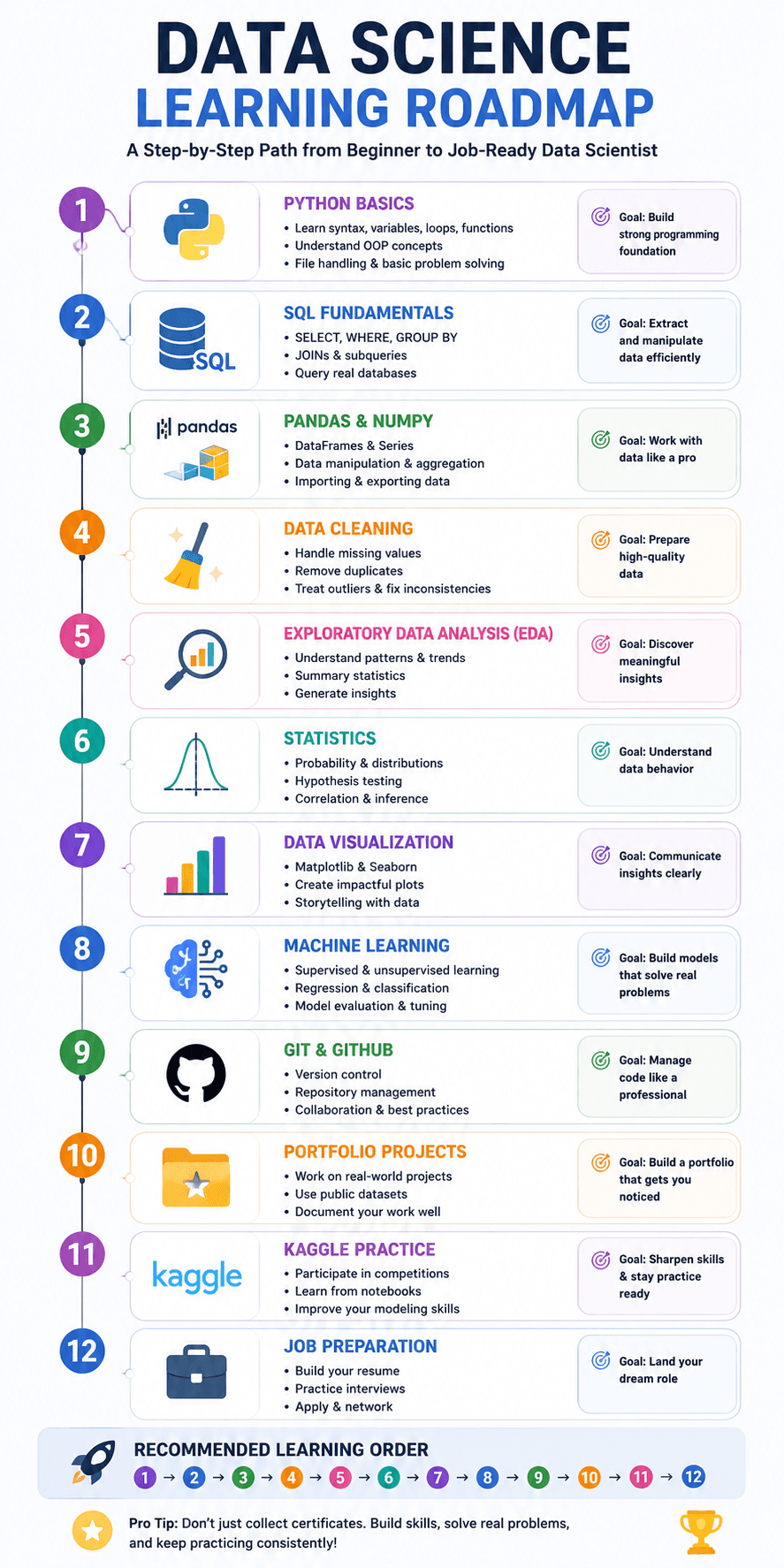
Recommended learning order
Python → SQL → Pandas → Visualization → Statistics → Machine Learning
This sequence mirrors how data science actually works on the job: extract data (SQL), manipulate it (Pandas), understand it (visualization and statistics), then model it (machine learning).
Also Check: Best Machine Learning Courses for Beginners: Start Learning ML the Right Way
How to avoid it?
- Get comfortable writing SQL joins, filters, and aggregations before touching ML
- Practice cleaning and exploring real datasets with Pandas
- Build 2 – 3 visualization-heavy projects before your first ML model
- Treat ML as the final step, not the starting point
Master the foundation first. It’s what employers actually screen for.
Mistake #4: Collecting Certificates Instead of Building Skills
There’s a comforting feeling to finishing a course and adding a shiny new certificate to your LinkedIn profile. It feels like proof you’re progressing.
So beginners chase more – another Coursera specialization, another Udemy badge, another “certified” title – hoping the collection itself will impress recruiters.
It usually doesn’t.
Recruiters and hiring managers see thousands of profiles listing the same generic certificates from the same popular platforms. On their own, certificates prove you finished something, not that you can do something.
Without projects to back them up, a certificate-heavy resume actually raises a red flag: it can look like someone who’s comfortable consuming content but hasn’t tested their skills on real, messy problems.
What actually gets attention is evidence of applied thinking, projects that show you can clean data, ask good questions, and communicate results.
The better approach
One certificate + three quality projects beats ten certificates with nothing to show for them.
How to avoid it?
- Stop after one or two relevant certificates in your core stack
- Redirect that time into building real projects with public datasets
- Choose projects that solve a specific problem, not tutorial clones
- Document your process (not just results) in a portfolio or GitHub README
- Ask yourself: “Could I explain this project for 10 minutes in an interview?”
Mistake #5: Copying Portfolio Projects From GitHub
The Titanic survival predictor. The Iris flower classifier. The generic “COVID-19 data analysis” dashboard. If you’ve browsed data science portfolios, you’ve seen these projects dozens of times because thousands of beginners build the exact same ones, often copying the code structure nearly line for line.
Recruiters notice. When someone reviews 50 resumes and sees the same five tutorial projects repeated over and over, it doesn’t signal skill.
It signals that you followed instructions without adding original thinking. Worse, in interviews, copied projects fall apart fast.
The moment you’re asked “why did you choose this approach?” or “what would you do differently?”, generic answers make it obvious you didn’t build genuine understanding.
A strong portfolio doesn’t need to be complex; it needs to be yours.
What makes a portfolio stand out
- Local or personal datasets: analyze something specific to your city, industry, college, or even personal habits (spending, fitness, commute data)
- Real business problems: pick a small business, nonprofit, or public dataset and solve an actual decision-making question, not just “explore the data”
- Improved Kaggle projects: take a popular Kaggle notebook and genuinely extend it: better feature engineering, a different modeling approach, deeper error analysis, or a business-focused write-up
How to avoid it?
- Choose problems with personal or local relevance
- Add your own questions, not just the dataset’s default target variable
- Explain your reasoning, trade-offs, and mistakes, not just your final accuracy score
Mistake #6: Ignoring Data Cleaning Because AI Can Generate Code
Ask ChatGPT to “handle missing values” or “remove duplicates,” and it’ll spit out working code in seconds. It’s tempting to treat data cleaning as a solved problem. Just prompt your way through it and move on to the “interesting” parts like modeling.
But roughly 80% of real data science work is cleaning and preparing messy data, not building models. Skipping the thinking behind data cleaning and only copying the code means you never develop the judgment to spot problems AI won’t catch on its own.
Real-world data is rarely clean, and every issue requires a decision, not just a function call.
- Missing values: Should you drop them, fill them with a mean/median, or is their absence itself meaningful? AI can’t know your business context.
- Duplicates: Are they true duplicates, or legitimate repeat entries (like a customer ordering twice)?
- Inconsistent formatting: “NY,” “New York,” and “new york” all mean the same thing to a human, but not to code, unless you standardize it.
- Outliers: Is that number a data entry error, or a genuinely important edge case you shouldn’t remove?
How to avoid it?
- Manually inspect datasets before running any cleaning code
- Ask why a value is missing or unusual before deciding how to handle it
- Use AI to speed up execution, not to make judgment calls for you
- Practice on genuinely messy, real-world datasets, not pre-cleaned tutorial ones
Mistake #7: Learning Too Many Python Libraries Too Early
Open any “data science tools” article, and you’ll get an overwhelming list: NumPy, Pandas, Polars, Dask, PySpark, TensorFlow, PyTorch, Scikit-learn, and more. Beginners see this and panic, assuming they need to learn all of it just to be considered “job-ready.”
This leads to shallow, scattered learning. You skim NumPy for a week, jump to PySpark because a video mentioned “big data,” dabble in TensorFlow because it sounds impressive, and end up with surface-level exposure to ten libraries instead of real fluency in the ones that actually matter early on.
Most beginner and entry-level roles don’t require Dask, PySpark, or deep learning frameworks at all. Those tools solve specific problems like massive datasets, distributed computing, and neural networks that most beginners aren’t working with yet.
What to actually master first
- Python: core syntax, functions, loops, and logic
- Pandas: data manipulation, filtering, grouping, merging
- NumPy: numerical operations and array handling
- Matplotlib: basic visualization to explore and explain data
These four form the backbone of almost every real data science task, from cleaning data to exploratory analysis.
How to avoid it?
- Resist adding a new library until you’re genuinely limited without it
- Build 3 – 5 solid projects using only Python, Pandas, NumPy, and Matplotlib
- Learn advanced tools (PySpark, TensorFlow) only when a specific project or job requirement demands it
Mistake #8: Never Reading Documentation
When beginners hit an error or don’t know how a function works, the instinct is to search Stack Overflow or ask ChatGPT for a quick copy-paste fix. Documentation, meanwhile, gets ignored. It looks intimidating, dense, and slower than just getting an answer.
But skipping documentation quietly caps how far your skills can grow. Tutorials and forum answers show you one way to use a function. Documentation shows you every way, and that difference matters more than beginners realize.
Reading documentation teaches you the following.
- Parameters: the full range of options a function offers, many of which never show up in basic tutorials but solve real problems efficiently
- Best practices: the intended, recommended way to use a tool, rather than a workaround someone posted five years ago
- Edge cases: what happens with missing data, unusual inputs, or specific data types, so you’re not caught off guard mid-project
How to avoid it?
- When learning a new function, check its official documentation before searching tutorials
- Read the parameters list, not just the example code
- Bookmark documentation for your core libraries (Pandas, NumPy, Scikit-learn) and refer back often
- Treat documentation as a skill-building habit, not a last resort
Mistake #9: Ignoring Git and GitHub
Here’s a scene most beginners will recognize: a project folder filled with files named analysis.py, analysis_v2.py, analysis_final.py, and eventually analysis_final_FINAL_v3.py.
No clear record of what changed, no way to go back to a working version, and complete confusion about which file is actually the latest one.
This is what happens without version control, and it’s a habit that doesn’t just create messy folders; it actively hurts you professionally.
Git and GitHub aren’t optional extras for data scientists; they’re standard tools used daily in real jobs to track changes, collaborate with teams, and showcase work publicly.
Skipping them means showing up to your first job (or interview) without a skill everyone assumes you already have.
The good news is you don’t need to master Git deeply to benefit from it. A handful of core commands cover most beginner needs.
Basic Git skills every beginner should know
- git init – start tracking a project
- git add and git commit – save meaningful checkpoints of your work
- git push and git pull – sync your code with GitHub
- git clone – copy someone else’s repository to work with locally
- Writing clear commit messages instead of vague ones like “updates”
- Creating a clean GitHub profile to host your portfolio projects
How to avoid it?
- Use Git from your very first project, not just when you feel “ready”
- Push every project to GitHub, even small or unfinished ones
- Replace version-numbered filenames with proper commits
Mistake #10: Practicing Only on Tutorial Datasets
The Titanic dataset. The Iris dataset. The Boston housing dataset. They’re everywhere in beginner tutorials for a reason. They’re clean, well-documented, and easy to follow along with.
But that’s also exactly why they hurt your portfolio: virtually every beginner has used them, often producing nearly identical analysis with identical conclusions.
Tutorial datasets are great for learning a concept. They’re terrible for proving your skills, because they don’t require you to make real decisions. The data’s already clean, the questions are already framed, and the “right answer” is often just a Google search away.
Instead, try datasets people actually care about
- Spotify data: analyze listening trends, playlist patterns, or audio features behind popular songs
- IPL data: explore player performance, match outcomes, or team strategy over seasons
- Sales dashboards: build a project around inventory trends, regional performance, or seasonal demand
- Netflix data: study content trends, genre popularity, or viewer preferences over time
- Government open datasets: analyze public health, transportation, or economic data relevant to your city or country
Why do original projects stand out?
Unfamiliar datasets force you to ask your own questions, handle unexpected messiness, and justify your own decisions, exactly what real jobs require.
Recruiters notice immediately when a project reflects genuine curiosity rather than a copied tutorial, and interviews become easier because you’re explaining your thinking, not repeating someone else’s.
How to avoid it?
- Pick at least one dataset tied to a personal interest (music, sports, gaming, finance)
- Choose sources with some built-in messiness, not pre-cleaned CSVs
- Frame your own business or research question before touching the data
Mistake #11: Expecting a Job Before Building Real Problem-Solving Skills
Finishing a course feels like the finish line. In reality, it’s the starting line. Employers don’t hire people because they completed a curriculum. They hire people who can walk into messy, ambiguous problems and figure out a path forward.
That skill isn’t built by watching lectures; it’s built by struggling through real projects, wrong turns included.
This mismatch is why many beginners feel blindsided when applications go unanswered despite finishing “everything.”
Realistic expectations
- Internships – usually the most accessible entry point; expect to apply broadly and prioritize learning over salary early on
- Junior roles – typically require 3–5 solid, original projects and demonstrable SQL/Python fluency, not just certificates.
- Freelancing – small, real-world gigs (even unpaid case studies) can build problem-solving speed and a track record faster than job applications alone
How to avoid it?
- Treat every project as practice for explaining your thinking, not just producing output
- Seek small, real problems before chasing big job titles
- Expect a runway of months, not weeks, and use that time to build proof, not just knowledge
Quick Checklist: Are You Making These Mistakes?
Before moving forward, take a minute to run through this list. Most beginners recognize themselves in at least three or four of these, and that’s completely normal. The goal isn’t perfection; it’s awareness.
| Mistake | Fix |
|---|---|
| Using ChatGPT as a shortcut | Solve first, ask AI later |
| Roadmap hopping | Commit to one roadmap |
| Skipping SQL | Learn SQL before ML |
| Chasing certificates | Build projects |
| Copying GitHub projects | Create original work |
| Ignoring data cleaning | Practice with messy datasets |
| Learning too many libraries | Master the fundamentals |
| Avoiding documentation | Read official docs regularly |
| Ignoring Git | Learn version control early |
| Using only tutorial datasets | Work on real-world datasets |
| Expecting quick jobs | Focus on problem-solving |
Bookmark this table. Revisit it every few weeks as a quick gut-check on your learning habits. It’s a faster way to course-correct than waiting until an interview reveals the gap.
FAQs
Is it okay to use ChatGPT while learning data science?
Yes, but attempt problems yourself first. Use ChatGPT to explain concepts or review logic after genuine effort, not as a shortcut that skips understanding and weakens your problem-solving skills long-term.
Should I learn SQL before machine learning?
Yes. Most real jobs involve querying and cleaning data daily. SQL is often an interview’s first filter, and employers expect fluency here before evaluating any machine learning knowledge.
How many projects should a beginner have?
Three to five original, well-explained projects beat ten generic ones. Focus on depth like unique datasets, clear reasoning, and documented decisions rather than quantity or tutorial-based portfolio padding.
Do recruiters care about certificates?
Certificates help minimally without proof of applied skill. Recruiters prioritize projects demonstrating real problem-solving. One relevant certificate plus strong projects outperforms multiple certificates with no practical application shown.
Is Kaggle enough to get a data science job?
Not alone. Kaggle builds technical skills, but employers value business context, communication, and original problem-solving. Pair Kaggle practice with real-world, business-oriented projects.
Which Python libraries should beginners learn first?
Master Python, Pandas, NumPy, and Matplotlib first. These cover data manipulation, numerical operations, and visualization.
How long does it take to become job-ready in data science?
Realistically, six to twelve months of consistent, focused learning. Timeline varies based on prior background, but skipping foundations to rush the process usually backfires and extends the journey.
Conclusion
Success in data science is never about learning everything; it’s about learning the right things, in the right order, with genuine understanding at each step.
The beginners who move forward fastest aren’t the ones with the most certificates or the flashiest projects. They’re the ones who mastered fundamentals, built original work, and treated AI as a learning partner rather than a crutch.
If you’ve recognized a few of these mistakes in your own journey, that’s not a setback; it’s clarity.
Adjust the course now, focus on depth over speed, and let your next project reflect real problem-solving, not just completed tutorials. That’s what actually gets noticed.
Related Articles
Top Udemy Courses for Aspiring Data Scientists in
How to choose the right career after 12th in India? (Step-by-Step)
Best Artificial Intelligence Courses Online
Best Free Python Courses on Udemy

TechnicalStudies was started by Neeladrinath with one simple idea — give Indian students a reliable place to figure out what’s actually worth their time and money. Every recommendation here is backed by careful research, real student feedback, and honest analysis. We cover online courses, laptops, smartwatches, software deals, and learning resources — all looked at from a student’s perspective, so you can spend less time guessing and more time learning.