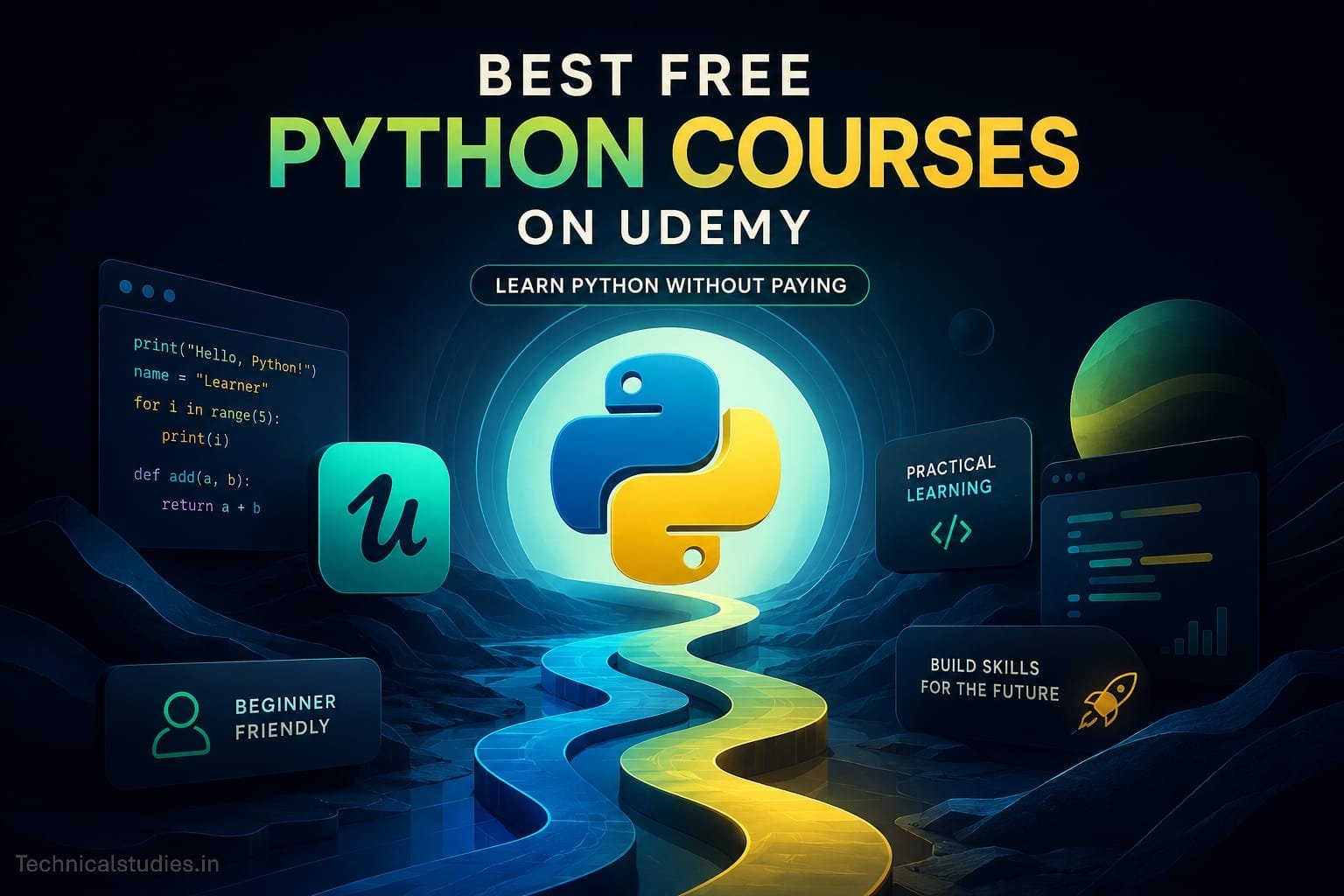
Python is often the first language people recommend to beginners, and for good reason. The syntax reads almost like plain English, you can build something functional in your first sitting, and it’s the backbone of everything from data science to automation to web development.
That accessibility is exactly why so many people want to learn it before investing a rupee or dollar.
If you’ve been searching for the best free Python courses on Udemy, you’ve probably noticed the platform isn’t short on options.
Udemy hosts hundreds of Python courses, and a good chunk of them are free, but “free” doesn’t mean “worth your time.” Some are outdated, some rush through basics without real practice, and some are free previews disguised as full courses.
To save you the guesswork, we actually went through the top free Python courses on Udemy, evaluating each one on content depth, teaching style, course length, hands-on exercises, how recently it was updated, and most importantly, who it’s actually built for.
Let’s get started.
The Best Free Python Courses on Udemy at a Glance
| Course | Best For | Length | Level | Projects/Practice | My Take |
|---|---|---|---|---|---|
| Introduction To Python Programming | Complete beginners wanting a fast first pass | 1h 10m | Beginner | Coding exercises | Best overall |
| Python for Beginners [2025]: Zero to Hero | Hands-on, structured learners | 1h 59m | Beginner | Practice after every section | Best for practice |
| Python for Beginners: Learn Python from Scratch | Absolute beginners short on time | 30m | Beginner | 2 mini projects | Best short course |
| Python OOP: Object Oriented Programming in Python | Learners past the basics | 2h 10m | Beginner–Intermediate | Quizzes + exercises w/ solutions | Best for OOP fundamentals |
| Learn Python for Total Beginners | Learners wanting real depth | 5h 35m | Beginner | 5 exercises + full solutions | Best in-depth free course |
| Python for Intermediate Learners | Interview/competitive prep | 1h 33m | Intermediate | Practice questions + quizzes | Best for algorithms |
| 6 Hour FREE Python Course (Part 3 of 3) by KITE | Learners already in the KITE series | 1h 50m | Beginner | Text-based exercises | Best university-inspired curriculum |
| Python for Absolute Beginners – A Free 2-Hour Crash Course | Setup help + string mastery | 1h 48m | Beginner | Hands-on script writing | Best for installation & strings |
| Python For Beginners Course | Zero To Hero | Real-world mini-projects | 1h 2m | Beginner | Applied scripts (Flask, GUI, files) | Best for practical variety |
Our Picks for the Best Free Python Courses on Udemy
1. Introduction To Python Programming – Best Overall Free Python Course
What you’ll learn
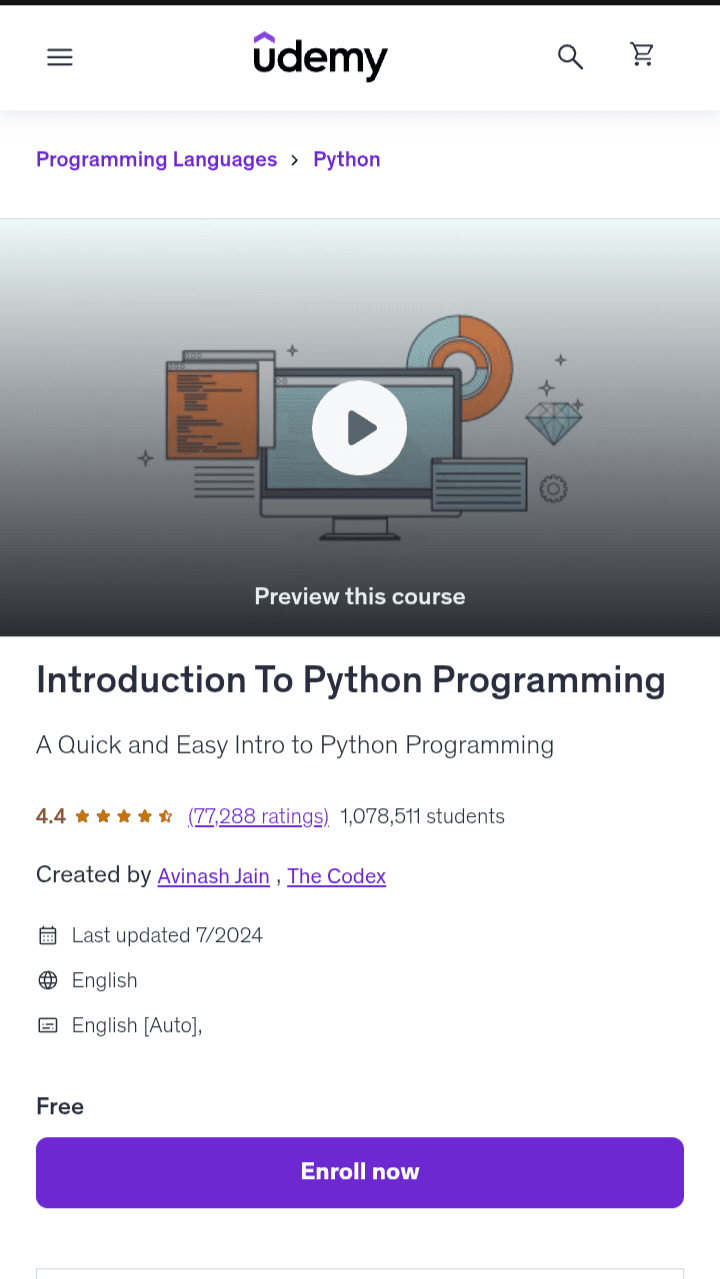
This course covers Python fundamentals from the ground up, including variables, data types, operators, and syntax, before moving into control flow (if-else, loops), core data structures (lists, dictionaries, tuples), functions, error handling with try/except, and a genuinely useful bonus: an introduction to object-oriented programming, including classes, inheritance, and the super function.
Course details
Roughly 1 hour 10 minutes across 22 lectures, with English captions and coding exercises built into the lessons. It has over 77,000 ratings at a 4.5 average and over a million enrolled students, which is a strong signal of consistency.
What I like
It doesn’t waste time on filler intros. The pacing is brisk without skipping explanations, and covering OOP basics in a free intro course is rare. Most free courses stop at loops and functions.
What could be better
At just over an hour, this is a primer, not a deep dive. Concepts like OOP and exception handling are introduced but not practiced extensively, so learners will need a second, project-heavy resource to actually retain and apply what’s covered here.
Best for
Complete beginners who want a fast, structured first pass at Python before committing to a longer course.
2. Python for Beginners: Zero to Hero – Best for Structured, Step-by-Step Learning
What you’ll learn
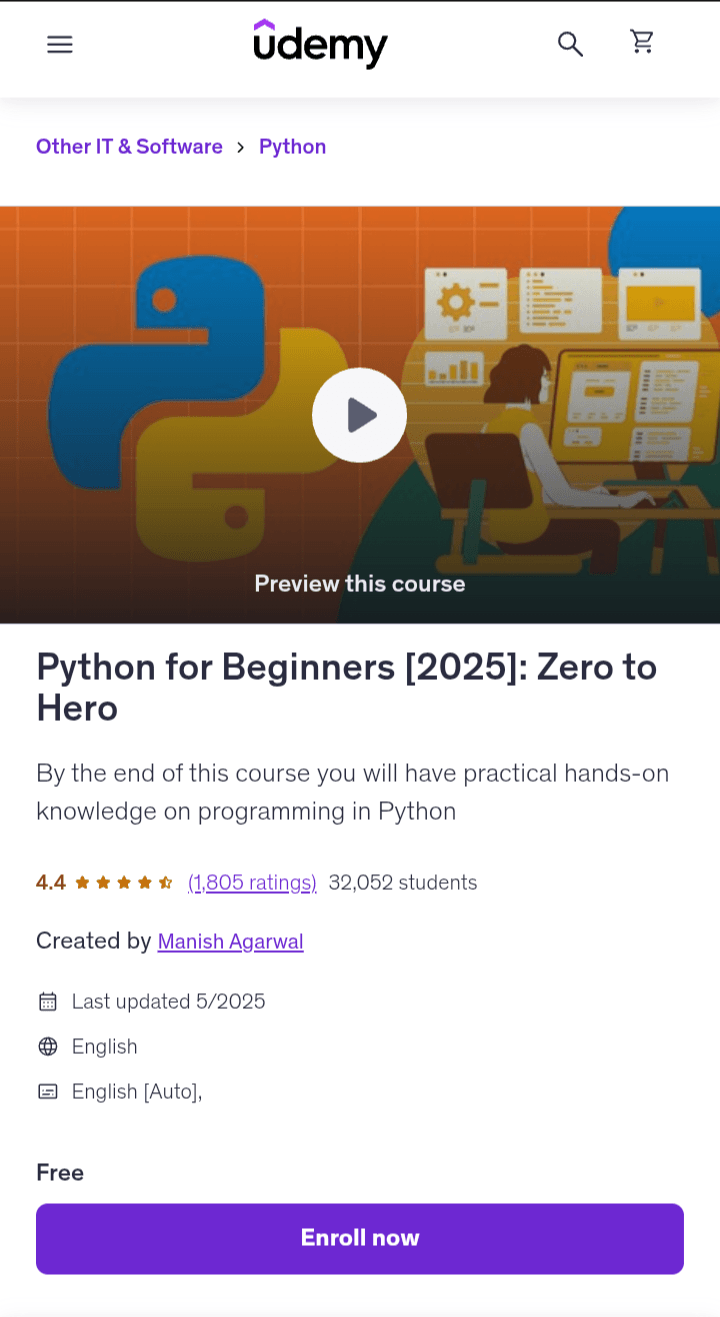
This course walks through Python basics, syntax, data structures (tuples, lists, dictionaries, sets), operators, control flow, functions, exception handling, and a genuinely thorough OOP module covering inheritance, polymorphism, and encapsulation, not just the definitions, but working examples for each.
Course details
Around 1 hour 59 minutes across 23 lectures in 10 sections. It also includes a dedicated installation module for Python and PyCharm, plus practice exercises after almost every section.
What I like
The structure is genuinely methodical; each concept gets its own section with a follow-up practice exercise, so you’re not just watching, you’re immediately applying.
The OOP section alone is more detailed than what most free courses offer, covering all four pillars with concrete car/vehicle examples rather than abstract theory.
Read Also: How To Build A Daily Learning Habit With Udemy? – Guide
What could be better
Two hours is still a light introduction for a topic this broad – polymorphism and encapsulation, in particular, get covered in under 8 minutes combined, which is enough to recognize the concepts but not enough to feel confident using them. Expect to revisit these topics elsewhere.
Best for
Beginners and students who want a course with built-in installation help and a practice-first structure, especially those aiming to understand OOP fundamentals early.
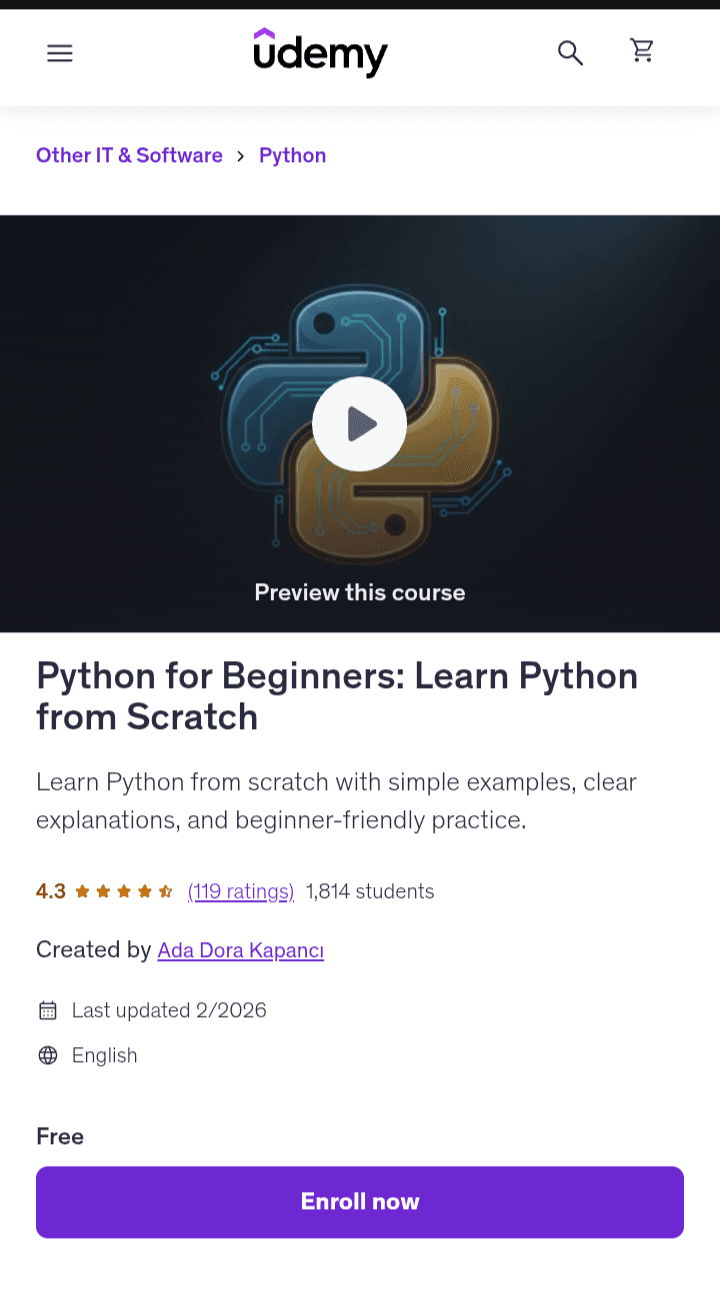
3. Python for Beginners: Learn Python from Scratch – Best for Absolute Beginners Short on Time
What you’ll learn
This course covers the essential building blocks of Python, including variables, data types, operators, string handling, if/else logic, and loops.
Then puts them to work through two mini projects: a budget tracker and a number-guessing game, before closing with a roadmap for what to practice next.
Course details
Just 30 minutes across 13 lectures in 5 sections, last updated February 2026, making it one of the most recently refreshed courses on this list. It includes coding exercises plus a written setup guide for installing Python and VS Code.
Read Also: Why Is Online Education Perfect for Lifelong Learning? 13 Points to Understand
What I like
The mini projects are the standout feature. Most 30-minute courses stop at theory, but this one has you actually build something functional, twice, before you finish. The “how to practice after this course” lesson is also a thoughtful touch that most free courses skip entirely.
Best for
Absolute beginners who want a quick, confidence-building first taste of Python before committing to a longer, more comprehensive course.
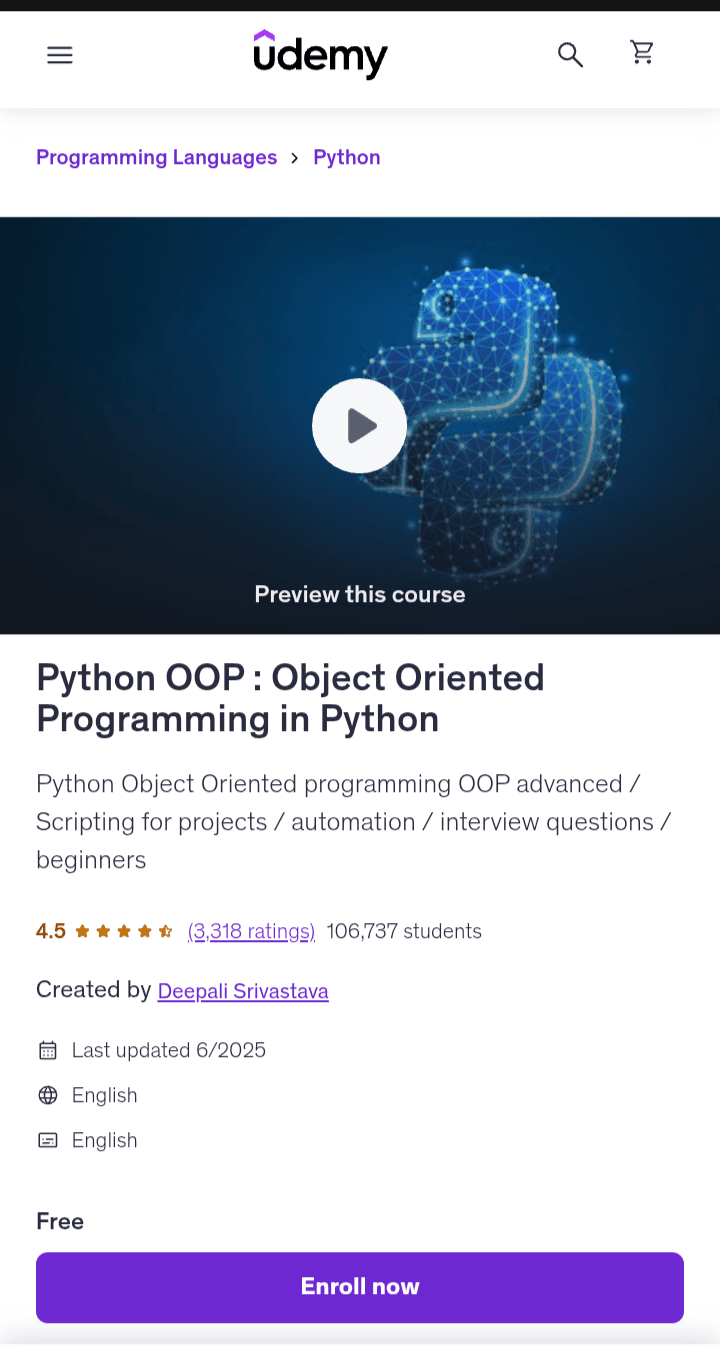
4. Python OOP: Object Oriented Programming in Python – Best for Learners Ready to Go Beyond the Basics
What you’ll learn
This course is entirely dedicated to object-oriented Python with topics like classes and objects, the __init__ method, data hiding, properties, class variables, class and static methods, magic methods, inheritance, multiple inheritance, MRO, super(), and polymorphism, all explained with dedicated demos and practice exercises.
Course details
2 hours 10 minutes across 28 lectures in 5 sections, rated 4.5 from over 3,318 students and taken by more than 106,000 learners.
It’s taught by Deepali Srivastava, author of “Ultimate Python Programming,” and includes quizzes plus practice exercises with solutions after nearly every major topic.
What I like
This is the rare free course that treats OOP as a subject worth its own two hours instead of a rushed afterthought.
Concepts like MRO, magic methods, and static vs. class methods get proper explanations with real code demonstrations, and the practice exercises actually test whether you understood the concept, not just whether you watched the video.
Best for
Learners who’ve already covered Python fundamentals and want a focused, interview-ready understanding of OOP concepts.
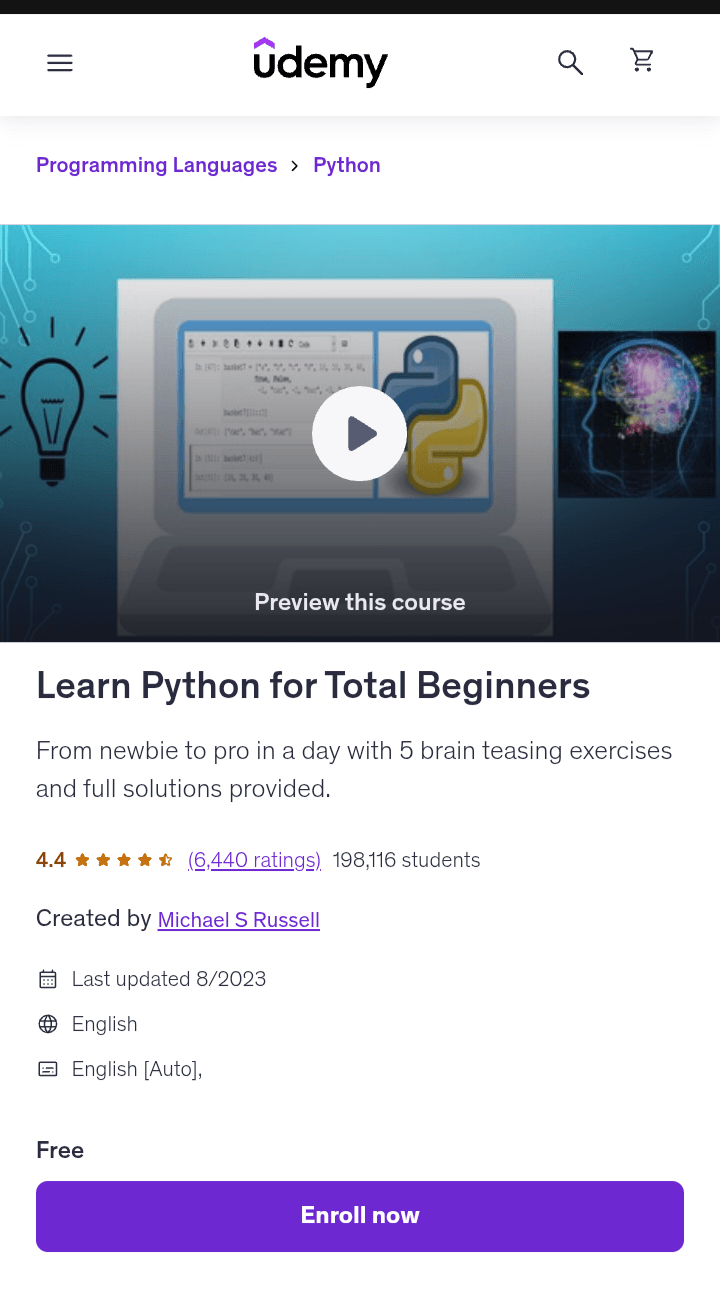
5. Learn Python for Total Beginners – Best for the Most In-Depth Free Course
What you’ll learn
This is a genuinely comprehensive walkthrough including variables, operators, strings (including slicing, splitting, and joining), lists, tuples, dictionaries, control flow, both for and while loops (with zip and enumerate), functions, the random module, built-in functions, and a bonus section on working with text files.
Course details
5 hours 35 minutes across 32 lectures in 7 sections, rated 4.4 from over 6,437 students with nearly 200,000 enrolled. It uses Jupyter Notebook and Anaconda rather than a plain text editor, and includes 5 exercise sets with full video and PDF solutions.
Read Also: 10 Best C++ Courses for Beginners That Are Actually Worth it
What I like
The depth here is rare for a free course – string slicing, zip/enumerate, and working with text files are topics many paid beginner courses skip entirely. The five structured exercises with complete solutions also mean you’re not left guessing whether your code is “right.”
Best for
Beginners who want real depth and thorough practice in a single free course, and don’t mind learning through Jupyter Notebook.
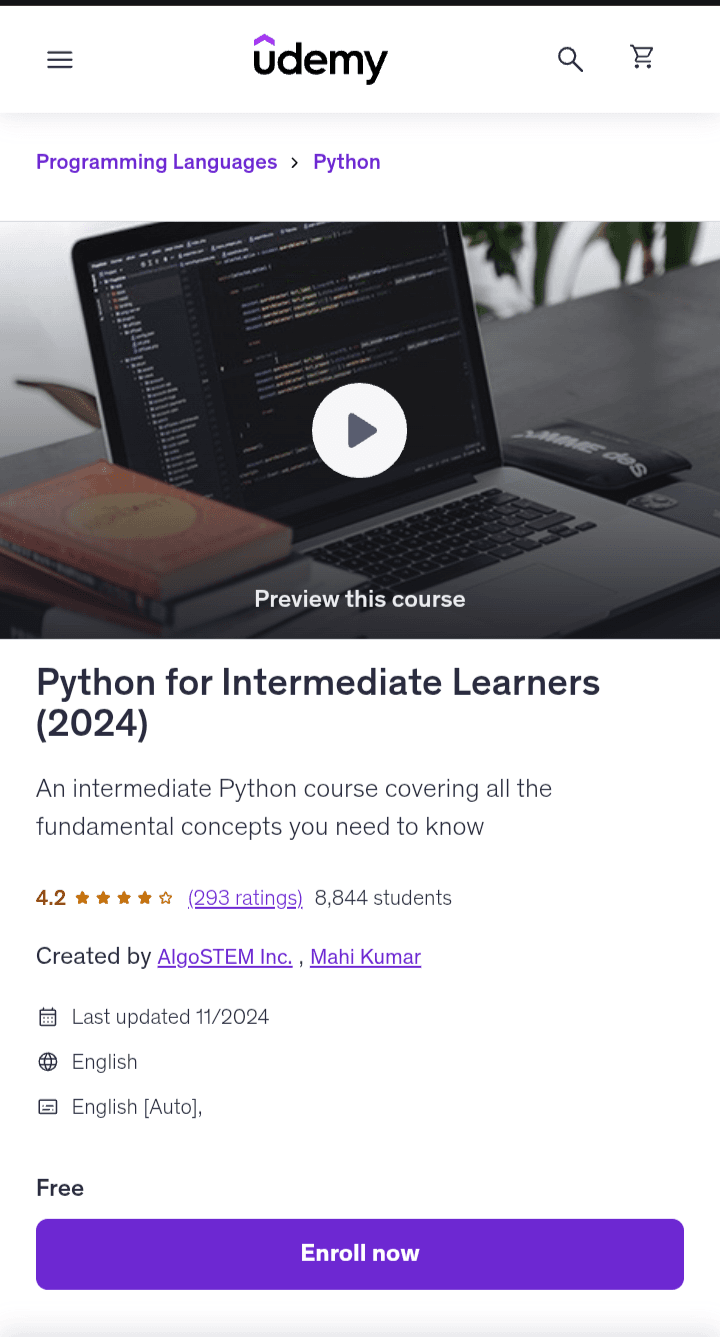
6. Python for Intermediate Learners – Best for Bridging Beginner to Competitive Programming
What you’ll learn
This course picks up where beginner courses stop – loop control statements (break, continue, pass), sets and dictionaries, exception and file handling, recursion, OOP (classes, inheritance, polymorphism), and a genuinely substantial algorithms section covering Big O notation, binary search, and five sorting algorithms including merge sort and quicksort with full implementations.
Course details
1 hour 33 minutes across 22 lectures in 7 sections. It’s built by AlgoSTEM, a nonprofit ed-tech organization, and includes practice questions and quizzes after nearly every section, taught using PyCharm.
What I like
The searching and sorting section is genuinely rare to find for free. Most intermediate Udemy courses stop at OOP, but this one walks through Big O notation and implements five different sorting algorithms with time-complexity analysis, which is exactly what technical interviews test.
Best for
Learners who’ve finished a beginner Python course and want to build toward coding interviews or competitive programming.
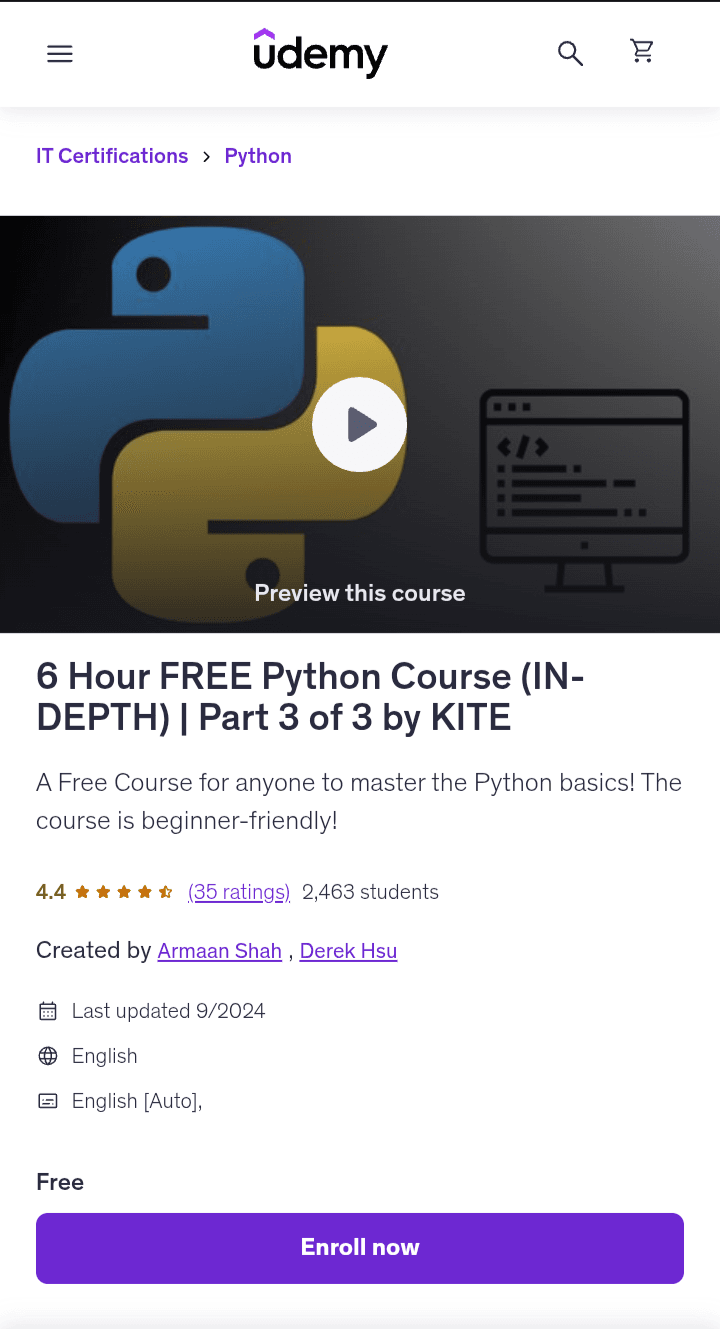
7. 6 Hour FREE Python Course (IN-DEPTH) | Part 3 of 3 by KITE – Best for Learners Who Want a University-Backed Curriculum
What you’ll learn
This course covers dictionaries (including real text-parsing exercises using word-frequency counting), tuples, regular expressions with the re module, and an introduction to object-oriented programming, all built around exercises drawn from a university-affiliated textbook.
Course details
1 hour 50 minutes across 12 lectures in 6 sections. The curriculum is inspired by University of Michigan Professor Charles Severance’s well-known “Python for Everybody” course, and includes Discord community access for direct instructor questions.
What I like
The dictionary and regex exercises use real-world text parsing (like counting word frequencies from a Romeo and Juliet text file) instead of toy examples, which makes the practice genuinely more useful than most beginner exercises. Community access for asking instructors questions directly is also a standout feature rarely offered in free courses.
Read Also: 10 Best SQL Courses for Beginners That Are Actually Worth It
Best for
Learners already partway through KITE’s Python series, or anyone wanting a university-curriculum-inspired course with real text-based practice exercises.
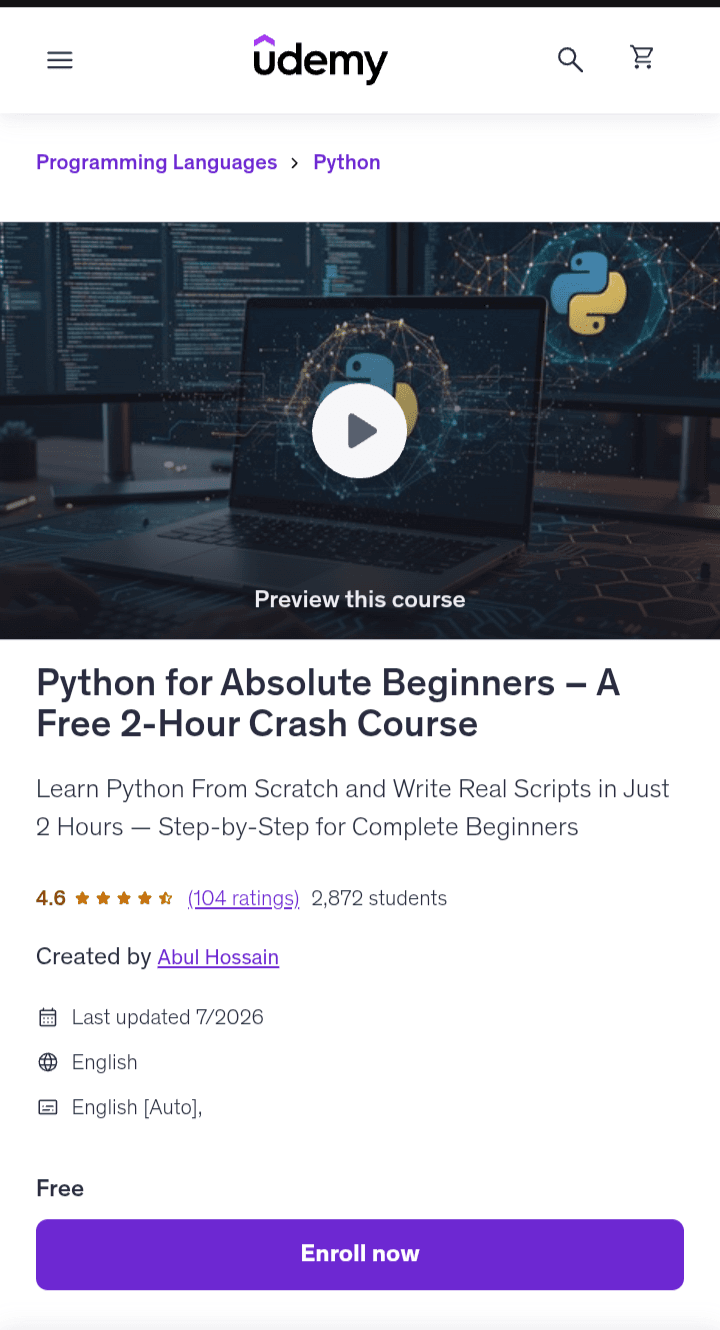
8. Python for Absolute Beginners – A Free 2-Hour Crash Course – Best for Setup Help and String Handling
What you’ll learn
This course starts before “Hello World,” installing Python and setting up PyCharm, VS Code, and Atom.
Then covers variables, comments, and data types, before spending the bulk of its time on Python strings: over 20 lectures dedicated to individual string methods like capitalize, find, replace, split, and validation methods like isalnum and isdigit.
Course details
1 hour 48 minutes across 37 lectures in 6 sections. The course description discloses that it was built with AI assistance.
What I like
The installation section is unusually thorough, walking through three different editors instead of just one, which genuinely helps beginners who get stuck before writing a single line of code.
The string-method coverage is also more exhaustive than most beginner courses, breaking down over 15 individual methods with isolated examples.
Best for
Beginners who keep getting stuck on installation, or who want a deep, methodical understanding of Python’s string methods specifically.
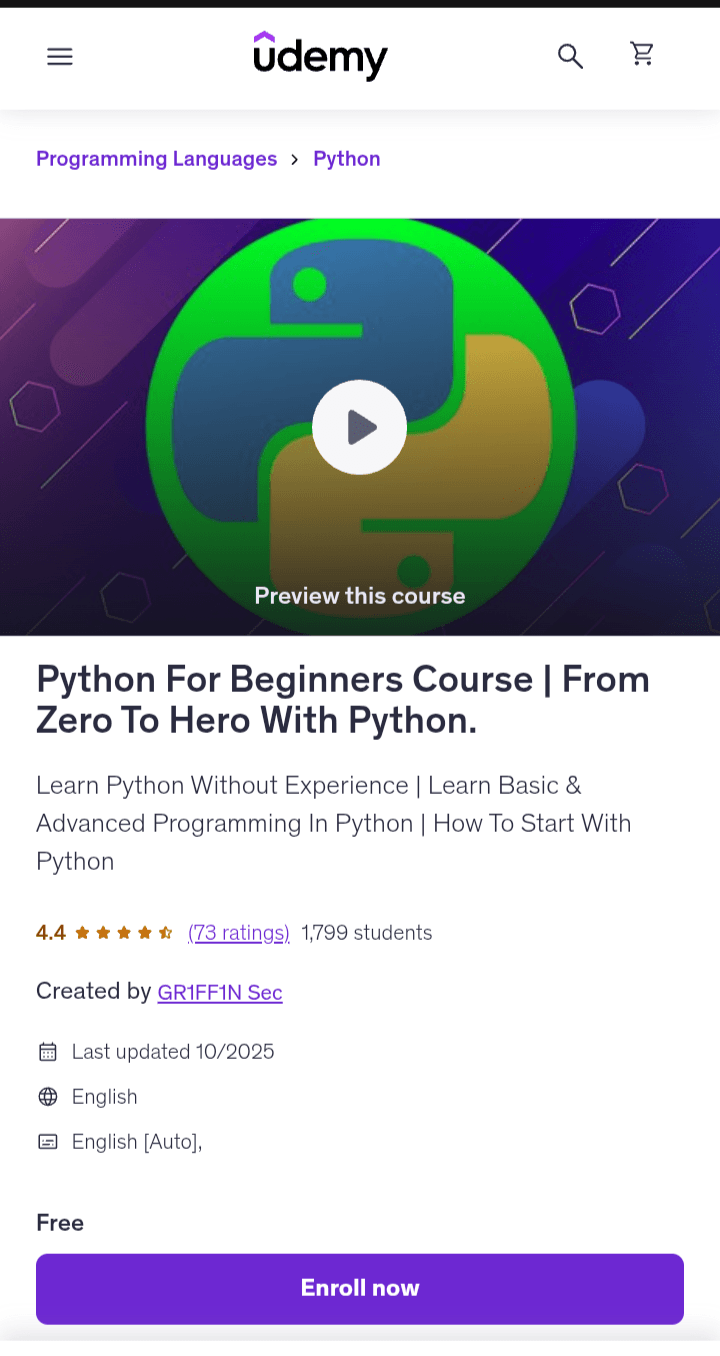
9. Python For Beginners Course | From Zero To Hero With Python – Best for Real-World, Practical Mini-Projects
What you’ll learn
This course moves quickly from fundamentals (variables, data types, if statements, lists, loops) into applied territory: making HTTP requests with the requests library, reading and writing files, building a basic GUI with tkinter, generating random outputs, compiling Python scripts into .exe files, and even a simple Flask web application.
Course details
1 hour 2 minutes across 21 lectures in 8 sections. It also touches on running Python via the command line on Windows and executing system commands through the os module.
What I like
The breadth of practical application is unusual for a free course this short. Most beginner courses stop at syntax, but this one shows you web requests, file handling, GUIs, and even packaging a script into a standalone executable, giving you a real taste of what Python can actually do.
Best for
Beginners who’ve grasped the basics elsewhere and want a fast tour of what real Python projects, web requests, file handling, GUIs, Flask, actually look like.
What You Can Actually Learn From a Free Python Course
“Python is useful” doesn’t tell you what you’ll actually walk away knowing. Here’s a realistic breakdown of what a solid free course gets you, and where its limits are.
Read Also: How To Choose The Right Course For You – 12 Aspects to Consider
Python fundamentals
Nearly every free course on this list covers the same core building blocks: variables, data types (integers, strings, booleans, floats), operators, string manipulation, lists, and dictionaries. This is genuinely enough to start writing simple, working scripts.
Programming logic
Beyond syntax, the courses above teach you to think like a programmer, using if/else statements to make decisions, loops (for and while) to repeat actions, and functions to organize reusable code. A few, like the Zero to Hero and Intermediate Learners courses, go further into basic problem-solving through practice exercises, which matters more than the syntax itself.
Working with files and packages
Some free courses, including a few reviewed here, go beyond the basics into file handling (reading and writing text files), using pip to install packages, and importing external libraries like requests. If your course covers this, you’re closer to writing genuinely useful scripts than most free-course graduates.
Frequently Asked Questions
What is the best free Python course on Udemy for beginners?
“Introduction To Python Programming” is the strongest overall pick because it is concise, well-rated, and covers fundamentals through basic OOP in just over an hour, ideal for a first pass.
Can I learn Python completely for free?
Yes. Combining free Udemy courses with official documentation, YouTube tutorials, and practice platforms like HackerRank or LeetCode can take you from beginner to job-ready without spending money.
Is Udemy good for learning Python?
Udemy is solid for structured, video-based learning with real instructors and exercises. Quality varies widely by course, so check ratings, recency, and content depth before committing your time.
Can I get a certificate from a free Udemy course?
Yes, Udemy issues completion certificates for free courses too. However, these certificates hold limited weight with employers compared to skills demonstrated through projects, GitHub, or technical interviews.
Should I learn Python before data science?
Yes, absolutely. Python fundamentals – variables, loops, functions, data structures – are prerequisites for data science. Learn Python basics first, then move into libraries like pandas and NumPy.
Can I learn Python without any programming experience?
Yes. Python is widely considered the most beginner-friendly language due to its readable syntax. Most courses reviewed here assume zero prior experience and start from complete basics.
Final Verdict – Which Free Python Course Should You Take?
Skip the overwhelm and match the course to your starting point.
Complete beginner with an hour to spare? Start with Introduction To Python Programming.
Want structure and practice built in? Go with Zero to Hero.
Already know the basics and need OOP for interviews? Take the Python OOP course.
Want maximum depth in one sitting? Learn Python for Total Beginners delivers it.
Don’t chase the highest rating, chase the course that matches where you actually are. And whichever you pick, finish it by writing your own small project, not just watching lectures.
Related Articles
Best Machine Learning Courses for Beginners: Start Learning ML the Right Way
Best Deep Learning Courses with Hands-On Projects: Learn AI Through Real-World Projects
Best Python Courses for Beginners (Start Coding from Zero)
Best React Courses and Certifications for Developers
Best Angular Courses for Web Developers Online

TechnicalStudies was started by Neeladrinath with one simple idea — give Indian students a reliable place to figure out what’s actually worth their time and money. Every recommendation here is backed by careful research, real student feedback, and honest analysis. We cover online courses, laptops, smartwatches, software deals, and learning resources — all looked at from a student’s perspective, so you can spend less time guessing and more time learning.