
With so many flashy new languages popping up every year, you’d think C++ would’ve faded into the background by now. It hasn’t. Not even close.
C++ still powers the software running your favorite AAA games, high-frequency trading systems, operating systems, and even the code controlling spacecraft.
It’s fast, it’s powerful, and once you understand it, other languages start to feel a lot easier to pick up.
So who should actually learn C++ in 2026? If you’re a student building a CS foundation, an aspiring software engineer aiming for performance-critical roles, a game developer eyeing engines like Unreal, a competitive programmer chasing faster execution times, or someone tinkering with embedded systems and IoT devices, C++ deserves a spot on your list.
But every course out there is not worth your time. Some are outdated, some skip the fundamentals, and some just aren’t built for actual beginners.
That’s exactly why I put together this guide. We’re breaking down the best C++ courses for beginners, based on teaching quality, hands-on projects, and real value for your money, so you can skip the guesswork and start learning C++ from scratch with confidence.
Let’s Start.
How We Chose These C++ Courses
Not all courses are created equal, so we didn’t just pick the most popular ones and call it a day. Every course on this list was evaluated against a set of practical criteria that actually matter when you’re starting from zero.
A beginner-friendly curriculum was non-negotiable. If a course assumes prior coding knowledge, it’s not making the cut for a beginner’s list. We also checked whether courses were updated to Modern C++ (C++11/14/17/20), since a lot of outdated tutorials still teach old-school practices that professional codebases have long moved past.
Beyond that, we looked for hands-on coding exercises woven throughout the lessons, not just theory dumps. A genuinely useful C++ course with projects helps you apply concepts immediately, which is how the language actually sticks.
Instructor quality mattered too. Clear explanations, good pacing, and a teaching style that doesn’t assume you already “get it.” We cross-checked student ratings and reviews to see how real learners experienced each course, not just how it’s marketed.
Finally, I weighed the value for money (including solid free C++ courses where available) and whether the course offers a C++ course with a certificate, which can be a nice bonus for your resume or LinkedIn profile.
Quick List of the Best C++ Courses for Beginners
If you’re short on time, here’s a fast side-by-side comparison of every course covered in this guide.
| Course | Platform | Level | Duration | Certificate | Projects | Best For |
|---|---|---|---|---|---|---|
| Object Oriented Programming Specialization | Coursera (University of London) | Beginner to Intermediate | ~4 weeks | Yes | 1 (crypto trading platform) | Learners with some coding background wanting a single cumulative project |
| Programming in C++: A Hands-on Introduction | Coursera (Codio) | Beginner | ~4 weeks | Yes | Multiple (incl. graphics/animation) | True beginners wanting zero-setup, browser-based coding |
| Coding for Everyone: C and C++ | Coursera (UC Santa Cruz) | Beginner | ~ 52 hours | Yes | Multiple + algorithms | Learners wanting deep foundations for AI/competitive programming |
| Microsoft Introduction to C++ Programming | Coursera (Microsoft) | Beginner | 3–4 months | Yes | 4 portfolio projects | Career switchers targeting entry-level dev roles |
| C++ Programming and Graphics Development | Coursera (EDUCBA) | Beginner | 4 weeks | Yes | 6 (incl. graphics/visualization) | Visual learners, aspiring game/graphics developers |
| Beginning C++ Programming – From Beginner to Beyond | Udemy (Buchalka/Mitropoulos) | Beginner | 46 hours | Yes | Multiple + Unreal Engine intro | Comprehensive fundamentals with a game dev taste |
| Deep Dive in C++ | Udemy (Abdul Bari) | Beginner | 30.5 hours | Yes | 48 coding exercises | Competitive programmers, DSA-focused learners |
| C++: From Beginner to Expert | Udemy | Beginner | 17 hours | Yes | Practical exercises | Absolute first-timers wanting a fast, low-commitment start |
| C++: Ultimate C++ Programming from Beginner to Advanced | Udemy (Raj Kumar Thokala) | Beginner | 11 Hours | Yes | 20+ real-world apps | Hands-on learners who want a big project portfolio |
| Master C++ Programming – 2026 Edition | Udemy (Codaming/Dinesh Kumar) | Beginner | 22 Hours | Yes | 5 (incl. Qt GUI) | Learners wanting GUI development + proven scale (86K+ learners) |
Best C++ Courses for Beginners
1. Object Oriented Programming Specialization – Coursera
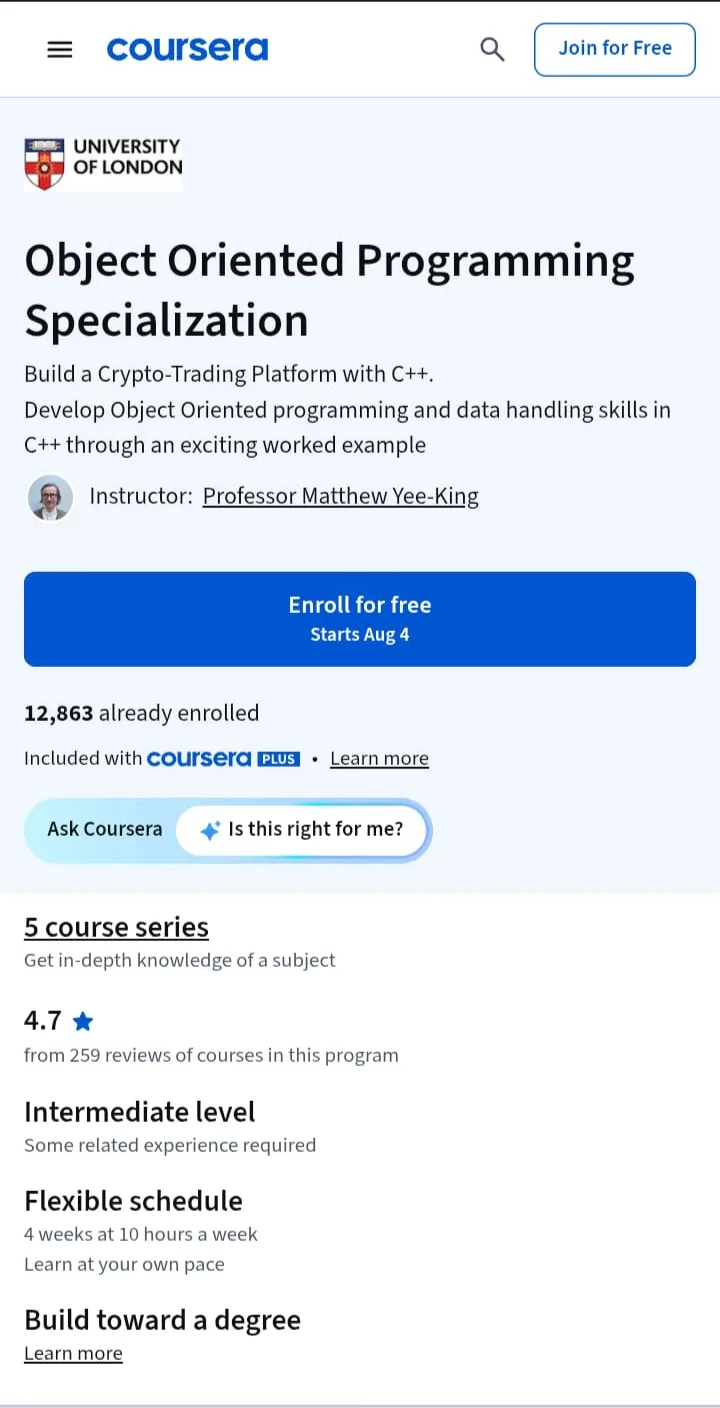
Offered by the University of London and taught by Professor Matthew Yee-King, this specialization takes a refreshingly different approach to teaching C++.
Instead of jumping between disconnected mini-exercises, you build one continuous project, a simplified cryptocurrency trading platform, across five courses.
It’s part of the same curriculum used in the University of London’s online BSc Computer Science degree, so the material carries real academic weight.
Duration: Around 4 weeks total at about 10 hours a week, though you can move at your own pace.
What You’ll Learn
You’ll start with the basics like writing, compiling, and running C++ programs, using loops and conditionals to build an interactive menu before moving into data types, classes, and object-oriented design.
By the later courses, you’re handling file I/O, exception handling, pseudocode-to-C++ conversion, and iterating over vectors of objects, all while building toward a fully functional command-line trading app that works with real exchange order book data.
Best For
This is genuinely one of the better picks if you’re searching for a C++ course with projects rather than isolated theory.
2. Programming in C++: A Hands-on Introduction – Coursera
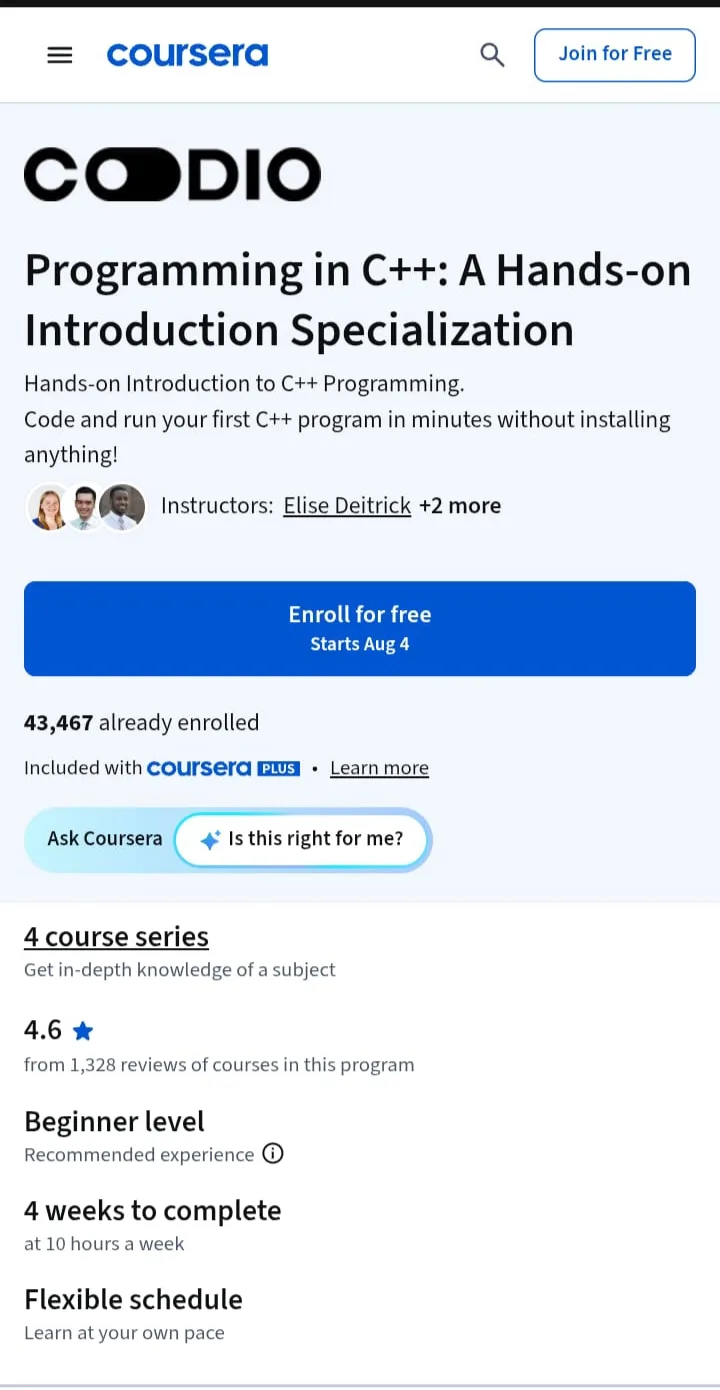
This specialization from Codio, taught by Elise Deitrick along with two co-instructors, is built specifically for people with zero coding background. What makes it stand out right away is the “code in your browser” setup.
You can write and run your first C++ program in minutes without installing a compiler or fighting with setup errors, which is often where beginners give up before they even start.
Duration: About 40 hours total across 4 courses, roughly 9 hours each, at a flexible self-paced schedule (Coursera estimates 4 weeks at 10 hours/week).
What You’ll Learn
The specialization starts with true fundamentals, including variables, operators, selection statements, and loops, before moving into vectors, pointers, strings, and file handling.
From there, it builds into functions, recursion, and custom objects, and wraps up with object-oriented concepts like inheritance and encapsulation.
A nice touch: later projects introduce graphical output using the Clmg library, including simple animations, so the learning doesn’t stay purely text-based.
Also Check: Best Java Courses for Beginners and Students
Best For
This is one of the most genuinely beginner-friendly picks on this list. Coursera explicitly states no prior programming experience is needed, just basic computer literacy and elementary math.
If you’re searching for a true C++ for beginners option to learn C++ from scratch, this fits the bill better than most.
3. Coding for Everyone: C and C++ – Coursera
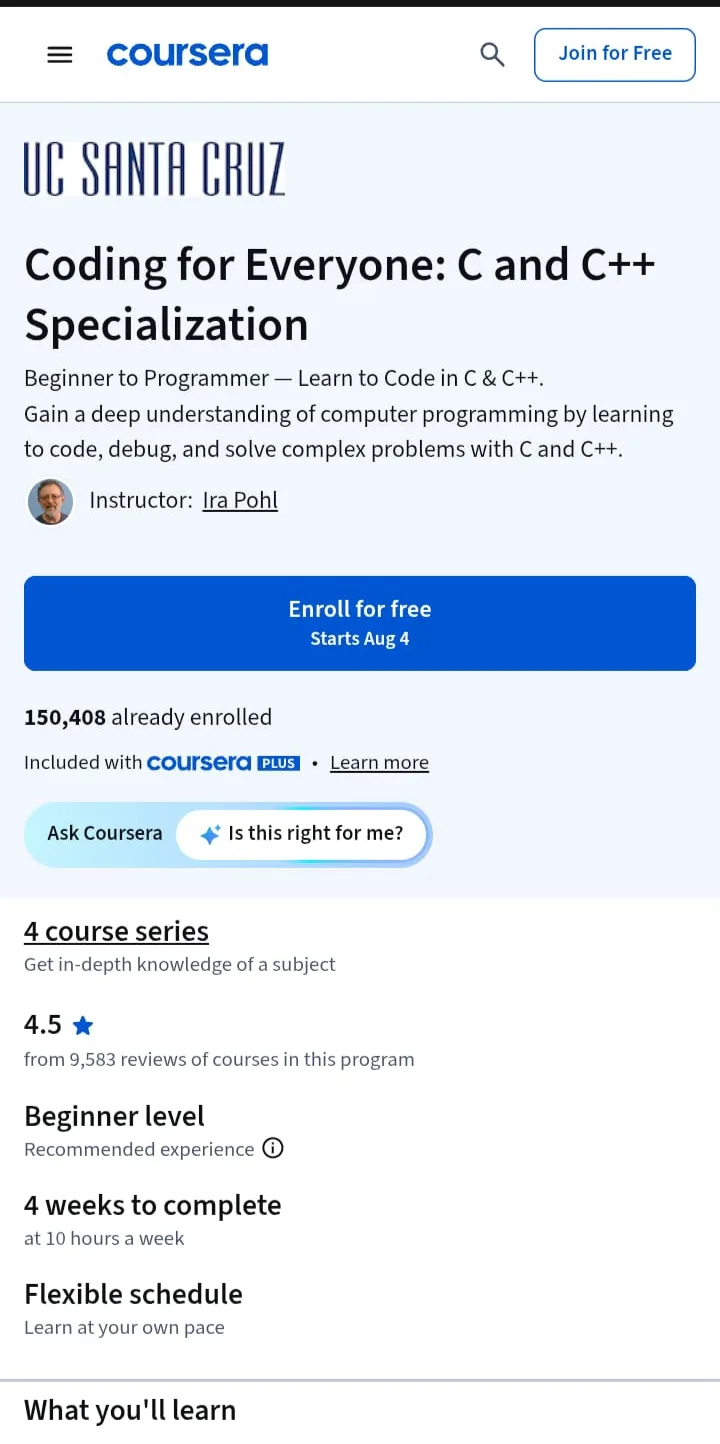
Taught by Ira Pohl at the University of California, Santa Cruz, this specialization takes a “learn the roots first” approach.
Instead of diving straight into C++, it starts you with C, the language C++ was built on, before transitioning into C++ itself. With over 150,000 learners enrolled, it’s one of the most established programs of its kind on Coursera.
Duration: Roughly 52 hours across 4 courses (two in C, two in C++), self-paced with flexible scheduling.
What You’ll Learn
The first two courses cover core programming fundamentals in C, including syntax, data types, control structures, functions, arrays, and debugging strategies.
Once that foundation is solid, courses three and four shift into C++, covering how to convert C code into C++, container classes, the Standard Template Library, inheritance, and object-oriented design.
It even ventures into applied territory like Dijkstra’s shortest path algorithm, Monte Carlo evaluation, and Min-Max/Alpha-Beta algorithms used in game-playing AI.
Best For
This is a great fit if you want a genuinely deep understanding of how C++ works under the hood, not just surface-level syntax. It’s especially useful for aspiring software engineers, competitive programmers, or anyone interested in AI and algorithmic problem-solving later on.
Coursera lists it as beginner-friendly with no prior experience required, though be aware the C-first structure means you’re technically learning two languages, not just one.
4. Microsoft Introduction to C++ Programming Professional Certificate – Coursera
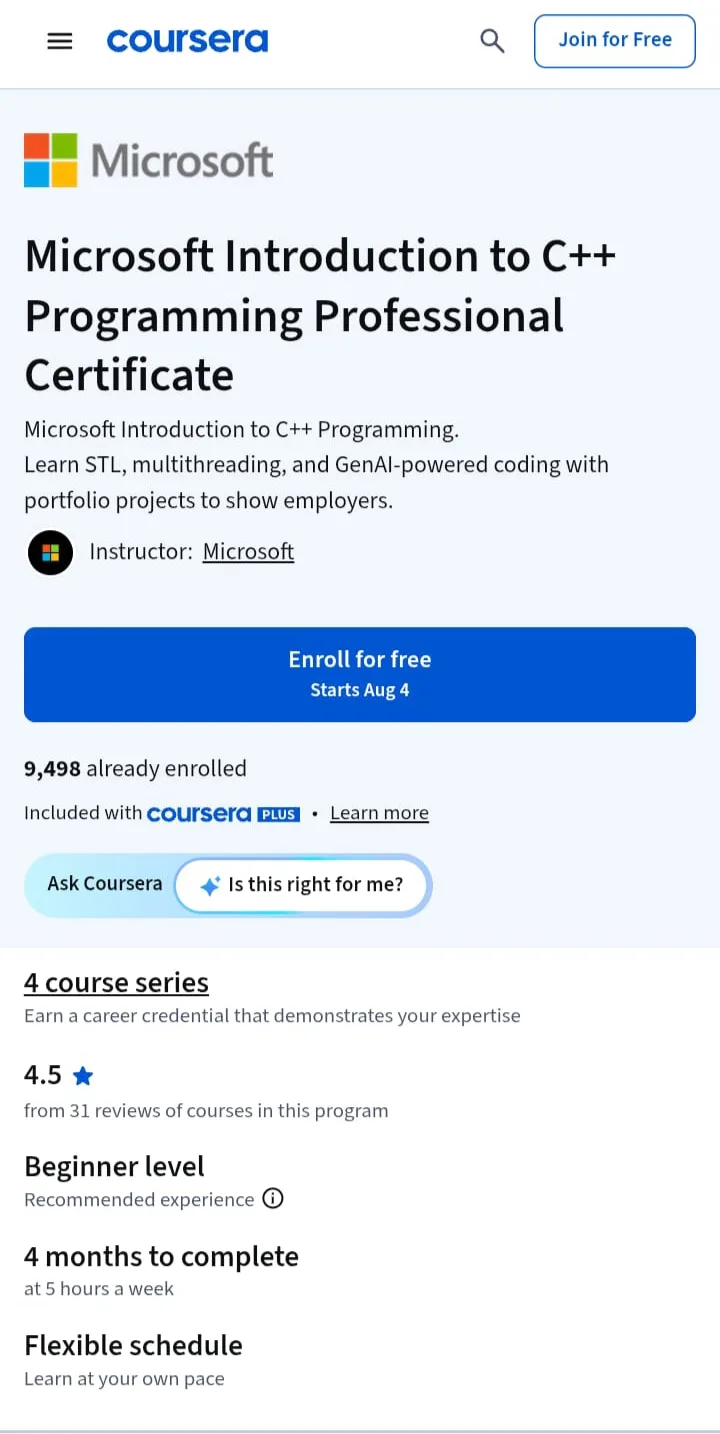
This is Microsoft’s own entry into beginner C++ education, and it shows in the polish and structure.
Built as a Professional Certificate rather than a standard specialization, it’s designed specifically to take absolute beginners to job-ready status, blending traditional programming instruction with modern GenAI-assisted coding workflows.
Duration: About 3–4 months at 10 hours a week, spread across four courses (roughly 37–39 hours each), self-paced.
What You’ll Learn
Course one covers true fundamentals such as syntax, data types, control flow, debugging, and compilation.
Course two moves into arrays, strings, file I/O, and modular programming, while introducing GenAI tools to speed up development.
Course three tackles full object-oriented programming: classes, inheritance, polymorphism, and memory management, with AI-assisted code review.
The capstone course is where this modern C++ course really earns its name, covering the Standard Template Library (STL), multithreading, concurrency, performance optimization, and C++17/C++20 features.
Check: AI in Programming: 7 Game-Changing AI Coding Tools You Should Try
Best For
Career switchers and true beginners aiming for entry-level roles in software development, systems programming, or game development.
No prior coding experience is required, and each course builds a portfolio project, so by the end you’ll have four real, showable projects, not just a certificate.
5. C++ Programming and Graphics Development – Coursera
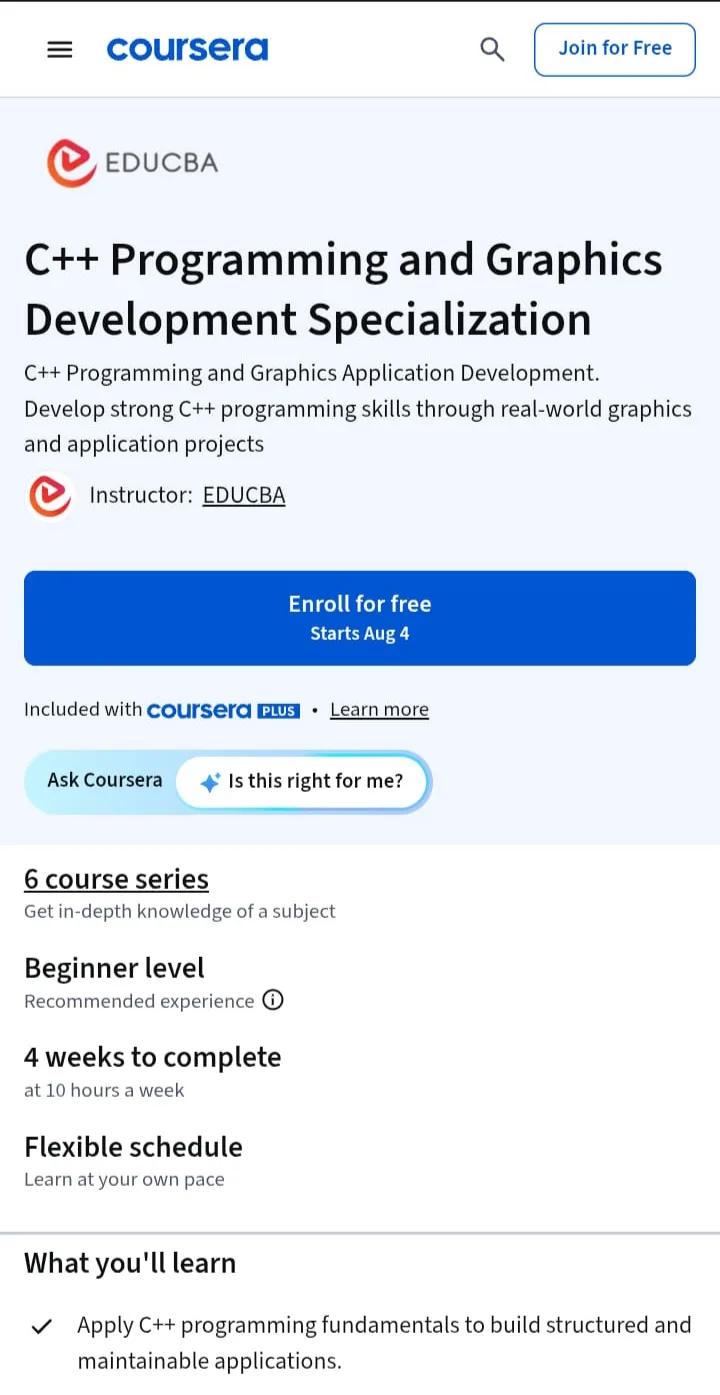
Offered by EDUCBA, this specialization takes a distinctly visual, project-first approach to learning C++.
Instead of sticking to abstract exercises, it has you building tangible, portfolio-worthy applications almost immediately: things like a payroll system, sales charts, organograms, and even a full graphical scenery project.
It’s a good option if you learn best by seeing your code produce something visual.
Duration: About 3-4 weeks at a relaxed 10 hours a week, spread across 6 courses ranging from 4 to 12 hours each.
What You’ll Learn
You’ll start with true C++ fundamentals like variables, operators, functions, and clean coding practices and immediately apply them to build a complete employee payroll system using classes and encapsulation.
From there, the course pivots into graphics programming: creating bar and pie charts from sales data, building organizational hierarchy diagrams using inheritance, drawing complete graphical landscapes, and visualizing real-world population data through scalable graph frameworks.
Best For
This is an excellent pick if you’re a visual learner or someone who wants to see immediate, tangible results from your code rather than staring at console output.
It’s also a genuinely strong C++ course with projects, since literally every course culminates in a real, standalone build. No prior programming experience is required, making it accessible for true beginners.
6. Beginning C++ Programming – From Beginner to Beyond – Udemy
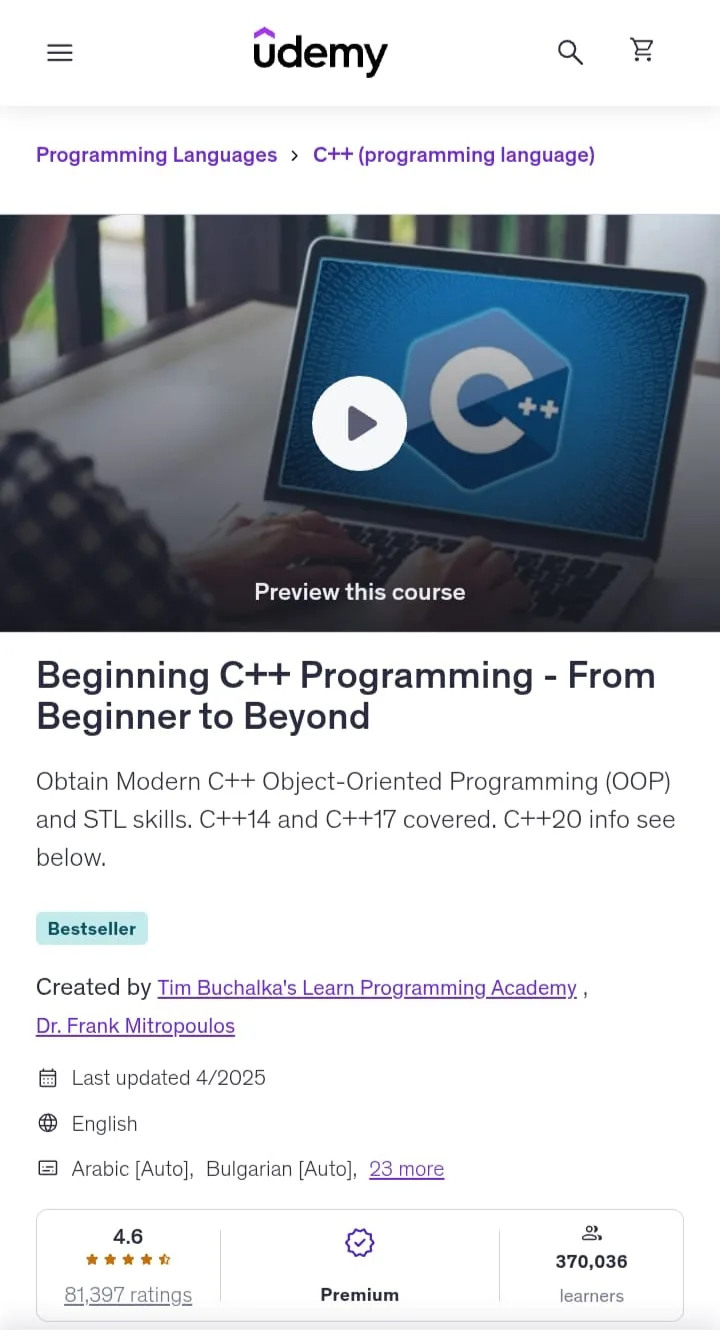
Created by Tim Buchalka’s Learn Programming Academy alongside Dr. Frank Mitropoulos, an experienced computer scientist and educator, this is one of the most popular and consistently high-rated C++ courses on Udemy.
Duration: Around 46 hours of on-demand video, plus 75 downloadable resources and dozens of coding exercises, self-paced with lifetime access.
What You’ll Learn
The course starts from true basics and builds methodically through loops, recursion, and functions before tackling pointers and memory management (an area where a lot of beginner courses get shallow, but this one doesn’t skip).
From there, it moves into full object-oriented programming, explaining classes, Standard Template Library basics like Vector, constructors, destructors, copy/move semantics, and operator overloading.
It’s also explicitly built around modern C++ practices, including C++14 and C++17 features, rather than the outdated syntax still floating around in older tutorials.
As a bonus, it wraps up with an introduction to game development in Unreal Engine, giving you a taste of applied, real-world C++ use.
Also Check: Best SQL Courses for Beginners That Are Actually Worth It
Best For
A great fit if you want a genuinely comprehensive, no-shortcuts C++ programming course with heavy emphasis on the trickier fundamentals like pointers and memory management.
It’s also a solid pick for anyone eyeing game development down the line, thanks to the Unreal Engine section.
7. Learn C++ Programming – Beginner to Advance – Deep Dive in C++ – Udemy
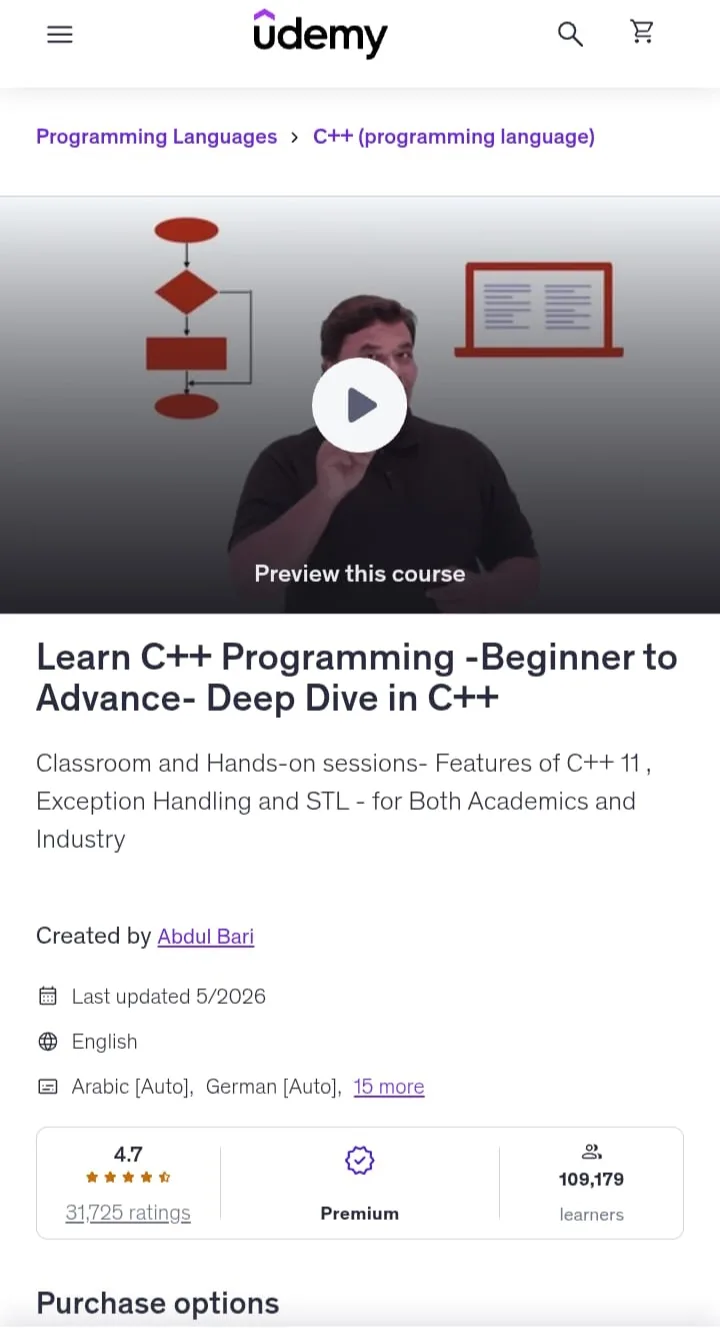
Created by Abdul Bari, a well-known name in programming education (especially for his data structures and algorithms content), this course is built around taking learners from absolute basics through to genuinely advanced C++ concepts.
It’s designed for both academic learners looking to strengthen CS fundamentals and professionals brushing up their skills for real-world application development.
Duration: About 30.5 hours of pre-recorded video content, plus 319 downloadable resources and 48 coding exercises, and self-paced with unlimited lifetime access.
What You’ll Learn
The course covers core C++ fundamentals before moving into the areas that tend to trip beginners up most: polymorphism, inheritance, and exception handling.
It also introduces Visual Studio as a development environment and dives into the Standard Template Library (STL), giving you exposure to the tools and containers used in real, professional C++ codebases rather than just toy examples.
Best For
This is a strong pick if your goal is competitive programming, strengthening your data structures and algorithms (DSA) foundation, or simply wanting a structured, in-depth path rather than piecing together scattered tutorials and documentation.
Beginners who want real depth without jumping between disconnected resources, and anyone using C++ as a stepping stone into algorithmic problem-solving will benefit from this course.
8. C++: From Beginner to Expert – Udemy
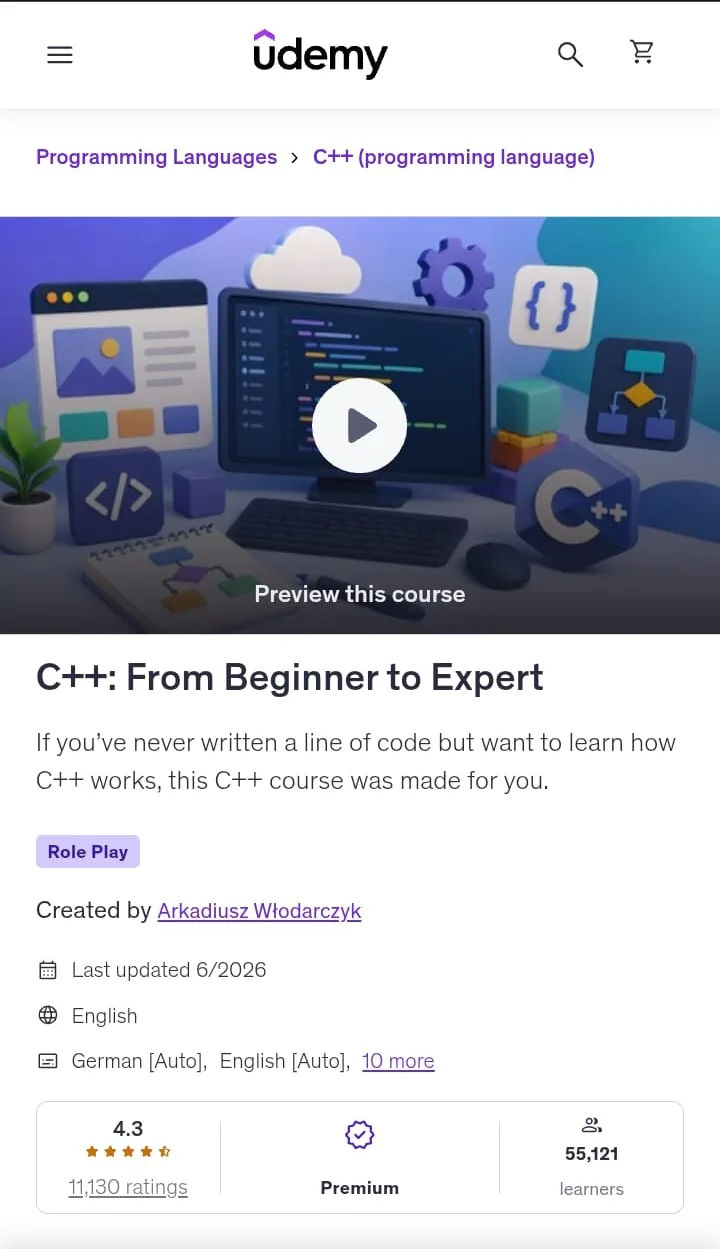
This is a compact, no-frills course built specifically for people who have never written a single line of code.
The instructor’s stated goal is simple: strip away the confusion and overwhelm that often comes with learning C++, and get you writing real programs as fast as possible, without assuming any prior technical background.
Duration: Just over 17 hours of video content, significantly shorter than most other options on this list, making it one of the more time-efficient picks if you don’t want a 40+ hour commitment.
What You’ll Learn
The course starts at true zero, explaining what a compiler and IDE actually are, along with variables and data types, before moving into practical territory like file handling using the fstream library, and arithmetic, assignment, logical, and bitwise operators.
Throughout, the emphasis is on writing actual working programs rather than passively watching lectures, so you’re applying concepts as you go.
Best For
Genuine first-timers who want a fast, low-pressure C++ for beginners entry point without committing to a 40+ hour marathon course. If you’ve never coded anything and terms like “compiler” or “IDE” feel intimidating, this course is built to demystify exactly that.
9. C++: Ultimate C++ Programming from Beginner to Advanced – Udemy
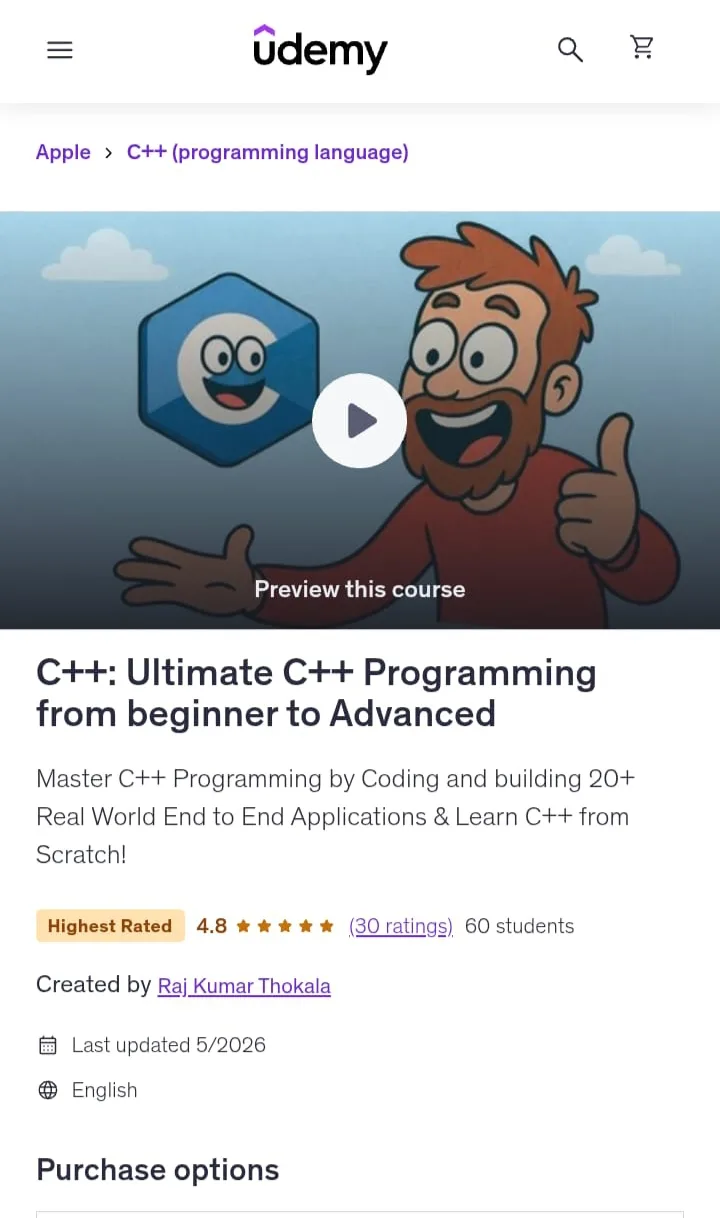
Created by Raj Kumar Thokala, this is a project-heavy course built around a simple philosophy: you learn C++ best by building things, not just watching lectures.
The course promises over 20 real-world, end-to-end applications, positioning itself less as a theory-first course and more as a practical, build-as-you-learn experience.
It’s also freshly updated, so the content reflects current teaching practices rather than years-old material.
Duration: Self-paced, with course promotional material citing a structure of building 20+ real-world projects. Total 11 hours of content.
What You’ll Learn
The course takes you from true scratch through to advanced C++ concepts, with an emphasis on applied coding rather than passive learning.
You’ll come away confident enough to build a wide range of applications using C++, having practiced with dozens of hands-on projects along the way rather than just a handful of toy examples.
Read Also: Best Courses to learn Dart Programming for Developers
Best For
This is a strong pick if you’re someone who learns by doing and gets more out of building real projects than sitting through pure theory.
The sheer volume of projects (20+) also makes it a genuinely solid C++ course with projects for anyone wanting a portfolio to show for their learning time.
10. Master C++ Programming From Beginner To Advance 2026 Edition – Udemy
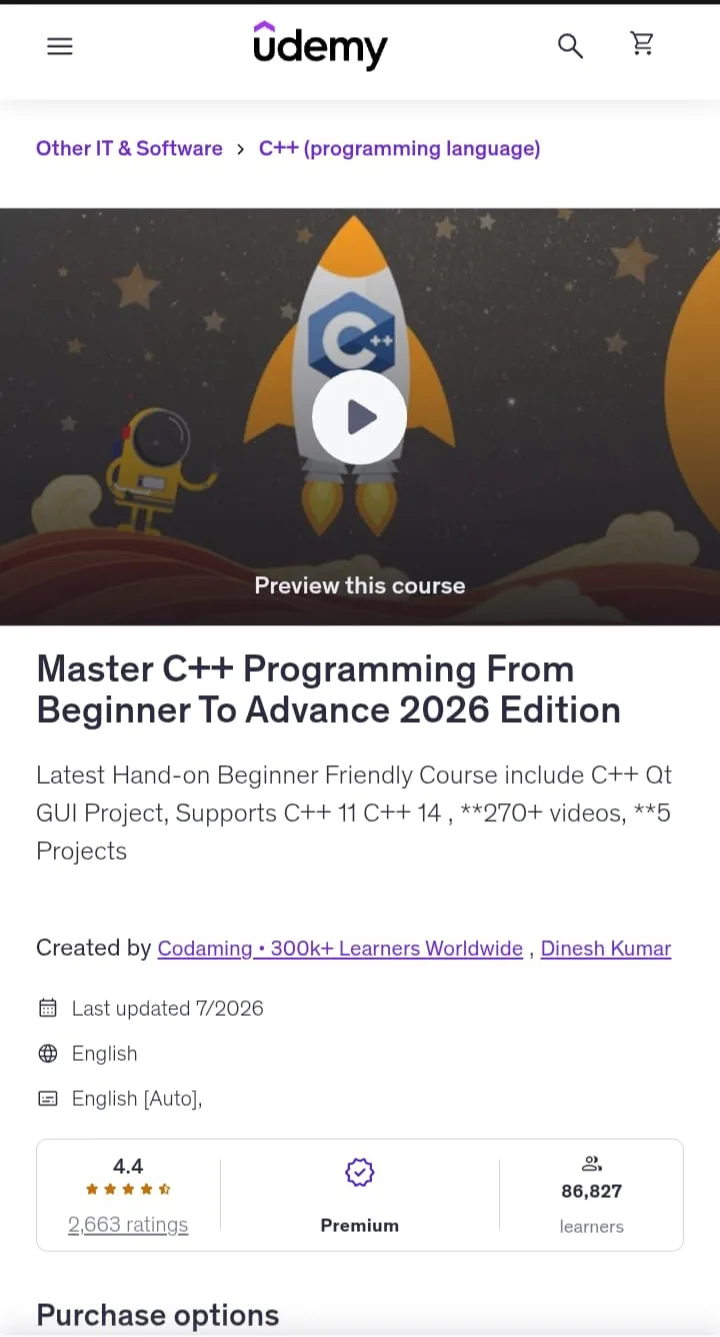
Created by Codaming, a channel with over 300k learners worldwide, alongside instructor Dinesh Kumar, this course is built as a genuinely modern, actively maintained option.
It’s a well-established, heavily vetted choice among beginner-focused C++ courses on Udemy.
Duration: Over 260 videos packed into a self-paced format, giving you a substantial, granular breakdown of topics rather than a handful of long, dense lectures. Around 22 hours of video content with 113 downloadable resources.
What You’ll Learn
This is explicitly positioned as a modern C++ course, supporting both C++11 and C++14 standards, so you’re learning current syntax and practices rather than outdated conventions.
A standout feature here is the inclusion of a C++ Qt GUI project, which takes you beyond command-line programs and into building programs with an actual graphical interface.
Overall, the course includes five hands-on projects, giving you practical, portfolio-ready experience alongside the theory.
Best For
Beginners who want a course that’s been tested at real scale (over 87,000 learners) and stays current with regular updates. It’s also a solid pick if you’re specifically interested in building GUI-based applications rather than sticking purely to the command line.
Which C++ Course Is Right for You?
Different goals call for different courses. Here’s a quick recommendation table based on what you’re actually trying to achieve.
| Goal | Recommended Course |
|---|---|
| Complete beginner | Programming in C++: A Hands-on Introduction (Coursera/Codio) – zero setup, true ground-zero start |
| College student | Object Oriented Programming Specialization (Coursera/University of London) – ties directly into a BSc Computer Science degree |
| DSA preparation | Deep Dive in C++ (Udemy/Abdul Bari) – built for algorithmic depth and competitive programming |
| Game development | Beginning C++ Programming – From Beginner to Beyond (Udemy) – includes an Unreal Engine introduction |
| Embedded systems | Coding for Everyone: C and C++ (Coursera/UC Santa Cruz) – starts with C fundamentals close to the hardware |
| Software engineering | Microsoft Introduction to C++ Programming (Coursera) – covers STL, multithreading, memory management, and modern practices |
| Job preparation | C++: Ultimate C++ Programming from Beginner to Advanced (Udemy) – 20+ real-world projects to build a job-ready portfolio |
| Budget learners | C++: From Beginner to Expert (Udemy) – short, affordable, and frequently discounted |
One quick note: several of these overlap in strengths (for example, the Microsoft certificate and the Codaming course both build real portfolios), so if your goal doesn’t fit neatly into one row, feel free to mix and match based on the detailed reviews above.
Frequently Asked Questions
Is C++ good for beginners?
Yes, though it has a steeper learning curve than Python. It teaches memory management and core computing concepts deeply, giving beginners a strong foundation that makes learning other languages significantly easier later.
Which is the best C++ course online?
It depends on your goals. For true beginners, Codio’s Hands-on Introduction works well; for job-readiness, Microsoft’s Professional Certificate; for algorithms, Abdul Bari’s Deep Dive stands out.
Can I learn C++ without knowing C?
Absolutely. Most modern C++ courses, including several on this list, are designed for complete beginners with zero prior programming experience, teaching C++ directly without requiring C knowledge first.
Are free C++ courses enough?
Free courses work well for basic syntax and concepts, but paid courses typically offer structured projects, certificates, and deeper coverage of memory management, STL, and modern C++ practices.
How long does it take to become good at C++?
Basic proficiency takes 2-3 months of consistent practice. True comfort with memory management, OOP, and STL usually takes 6-12 months of regular, hands-on coding and projects.
Which C++ version should beginners learn?
Learn Modern C++ (C++11 and later, ideally C++17/20). Older tutorials teaching pre-C++11 practices can leave gaps, since most current codebases and job requirements expect modern syntax.
Is C++ still worth learning?
Yes. It remains foundational in game development, systems programming, embedded devices, and high-performance software, with consistent demand in software engineering roles for over two decades.
Which platform is best for learning C++?
Coursera suits structured, university-backed learning with certificates; Udemy offers more affordable, project-heavy courses with lifetime access. Both host excellent beginner-friendly options depending on your learning style.
Can I get a job after learning C++?
Yes, especially in systems programming, game development, or embedded roles. Pairing course completion with portfolio projects and data structures practice significantly improves your job readiness and hireability.
Final Verdict
Choosing the best C++ course for beginners really comes down to your goal. Want a true zero-to-hero start? Go with Codio’s Hands-on Introduction.
Chasing a job? Microsoft’s Professional Certificate builds a real portfolio.
Prepping for coding interviews? Abdul Bari’s Deep Dive has you covered.
There’s no single “best” course for everyone; just the best one for where you’re starting and where you’re headed.
Pick one, stick with it for at least 30 days, and actually build the projects. That’s what separates people who “took a course” from people who can genuinely code in C++.
Related Articles
Best Golang Courses (Go Language) & Certifications Online
Best HTML Courses & Certifications Online
Best Swift Programming Courses on Coursera
Best JavaScript Courses for Beginners (Start Coding From Scratch)

TechnicalStudies was started by Neeladrinath with one simple idea — give Indian students a reliable place to figure out what’s actually worth their time and money. Every recommendation here is backed by careful research, real student feedback, and honest analysis. We cover online courses, laptops, smartwatches, software deals, and learning resources — all looked at from a student’s perspective, so you can spend less time guessing and more time learning.