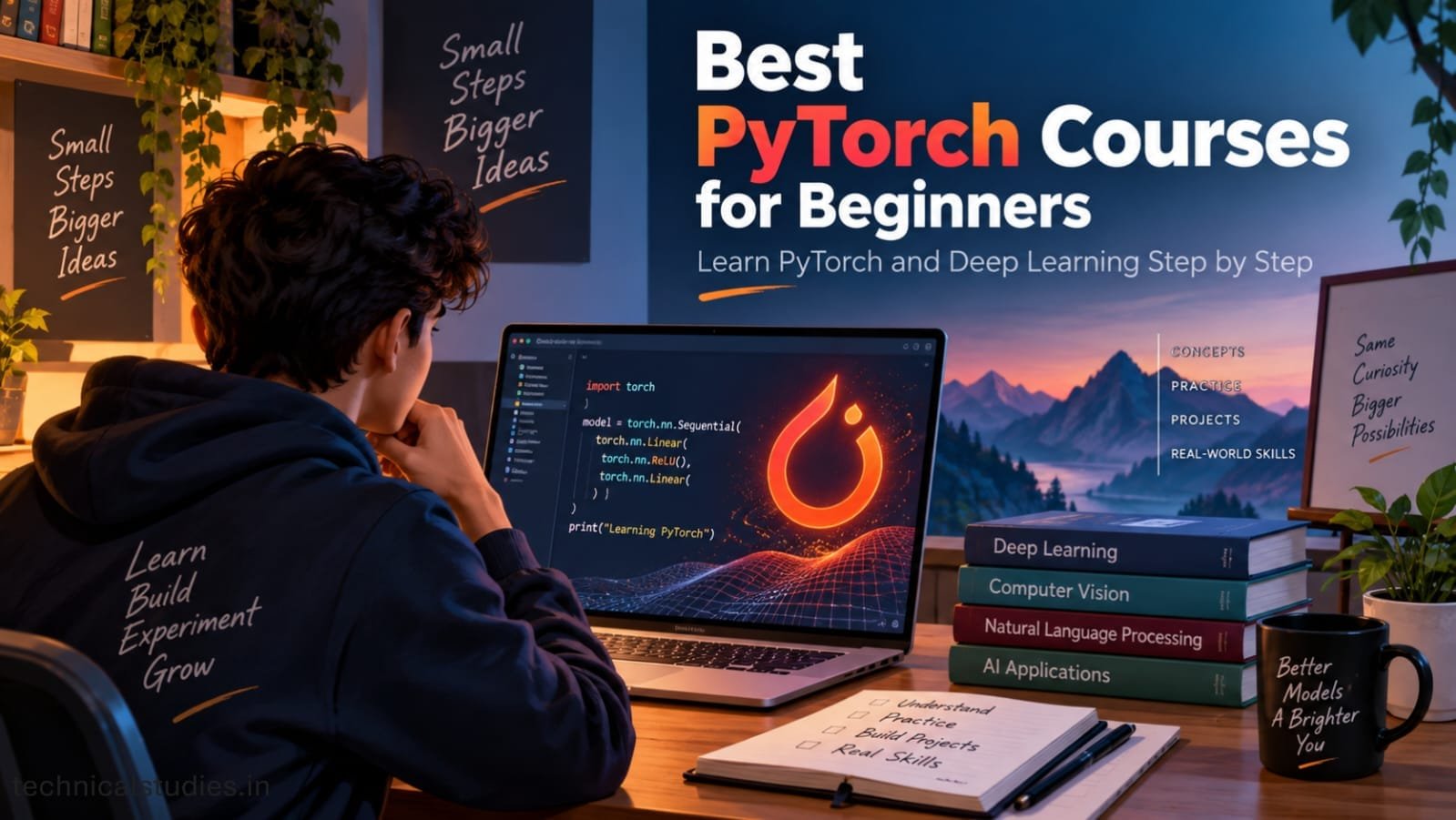
You don’t need to understand every part of deep learning before learning PyTorch, but you do need to start at the right level.
PyTorch has quietly become the default framework for anyone serious about deep learning.
Most research papers ship with PyTorch code, companies like Tesla and Meta build production systems on it, and it’s the backbone of tools you’ve probably already heard of, like Stable Diffusion and countless LLM projects.
If you want to work in AI in any hands-on capacity, PyTorch is no longer optional; it’s expected.
But here’s where beginners get stuck: type “PyTorch course” into Google and you’ll get hundreds of options, ranging from two-hour crash courses to 60-hour bootcamps, some assuming you already know calculus and Python, others hand-holding from “what is a tensor?” There’s no single “best” course; only the best course for where you’re starting from.
So instead of handing you a generic top-10 list, this article evaluates each course against things that actually matter: how beginner-friendly it really is, what prerequisites it assumes, how the curriculum is structured, whether it’s project-based or theory-heavy, how deep it goes, and whether it’s worth your time and money.
By the end, you’ll know exactly which course fits you, not just which one has the best marketing.
What Is PyTorch and Why Should Beginners Learn It
PyTorch is an open-source deep learning framework built by Meta AI that lets you design, train, and deploy neural networks using Python.
What makes it popular isn’t just performance; it’s that the code reads and behaves like regular Python, so debugging feels intuitive instead of fighting a black box.
What can you build with PyTorch?
Once you’re comfortable with the basics, PyTorch opens the door to real projects: image classification models, computer vision systems (object detection, facial recognition), natural language processing tools (chatbots, sentiment analysis), generative AI (image and text generation), recommendation systems, and fully custom neural networks built from scratch for whatever problem you’re solving.
Is PyTorch difficult for beginners?
Honestly? It depends on your Python comfort level, not your math background. If you can write basic Python, loops, functions, classes, PyTorch’s syntax won’t feel foreign.
The real learning curve is conceptual: understanding tensors, gradients, and how training loops work. That takes practice, not intelligence.
Most beginners find PyTorch easier to reason about than other frameworks, even if it takes a few weeks to get comfortable.
PyTorch vs. TensorFlow: Which should a beginner learn?
For beginners specifically, PyTorch usually wins. Its dynamic computation graph means you can print, debug, and inspect your model mid-execution, which makes learning far less frustrating.
TensorFlow has improved a lot, but PyTorch’s straightforward, “just Python” feel makes it the more forgiving starting point, and it’s what most current courses, tutorials, and research code are built around.
What Should You Know Before Taking a PyTorch Course?
Before picking a course, be honest about where you’re starting from. This determines whether a course helps you or overwhelms you.
Python knowledge
You don’t need to be an expert, but you should be comfortable with: writing and calling functions, basic classes and objects (PyTorch models are built using classes), loops and conditionals, working with lists and dictionaries, and basic NumPy operations like arrays and indexing.
If any of these feel shaky, spend a week on Python fundamentals first; it’ll save you weeks of confusion later.
Machine learning fundamentals
Must know: what regression and classification mean, and the general idea of how a neural network makes predictions (input → weights → output).
Nice to know, not required upfront: gradient descent, backpropagation math, and different neural network architectures.
Good beginner courses teach these concepts as you go; you don’t need to master them beforehand.
Mathematics
You need less math than you think. A working sense of linear algebra (vectors, matrices, and what multiplying them does) and a basic feel for derivatives helps you understand why training works, not just how to code it.
Probability comes in handy later for topics like loss functions, but it’s not a prerequisite. You don’t need to solve equations by hand. You need conceptual comfort.
What if you know Python but have never studied machine learning?
Don’t jump straight into a pure PyTorch course; you’ll spend more time confused about ML concepts than learning the framework itself.
Instead, take a short machine learning fundamentals crash course (even a free 3–5 hour one) covering regression, classification, and how training works conceptually.
Once those ideas click, PyTorch becomes dramatically easier because you’ll understand what the code is doing, not just copying syntax.
Best PyTorch Courses for Beginners
Before diving into individual reviews, here’s a quick side-by-side comparison to help you narrow down your options at a glance.
| Course | Best For | Projects | Prerequisites | Learning Style |
|---|---|---|---|---|
| PyTorch for Deep Learning Professional Certificate (DeepLearning.AI) | Best Overall for Beginners | CV & NLP projects, deployment | Basic Python | Structured, certificate-based |
| Deep Learning with PyTorch (IBM) | Strong Theoretical Foundation | Image classification (Fashion MNIST) | Basic Python + ML basics | Concept-first, lab-heavy |
| ML with Scikit-learn, PyTorch & Hugging Face | Broader ML Career Path | Full capstone + labs per course | Python, linear algebra basics | Comprehensive, multi-framework |
| IBM Deep Learning with PyTorch, Keras & TensorFlow | Comparing Frameworks | Capstone (geospatial classification) | Python + ML fundamentals | Multi-framework, structured |
| PyTorch Ultimate 2024 (Packt) | Fast-Paced, Project-Heavy Learning | Image, audio, object detection, deployment | Python + basic ML | Rapid, hands-on |
| PyTorch for Deep Learning Bootcamp (Udemy) | Hands-On, Code-Along Learning | 3 milestone projects | 3–6 months Python experience | Code-along, research-oriented |
| PyTorch: Deep Learning and AI (Lazy Programmer) | Breadth Across AI Applications | Stock trading bot + domain projects | Basic Python | Broad, application-focused |
| Practical Deep Learning: Master PyTorch in 15 Days | Fast, Structured Crash Course | Spam filter, digit classifier, more | None | Fast, day-by-day roadmap |
| PyTorch for Deep Learning and Computer Vision | Computer Vision Specialization | CNN image classifier, style transfer | None | Beginner-paced, vision-focused |
| PyTorch Ultimate (Udemy, Gollnick) | Cutting-Edge Architectures | Solve-it-yourself challenges | Basic Python | Challenge-based, broad coverage |
Our top picks for the best PyTorch Courses for Beginners
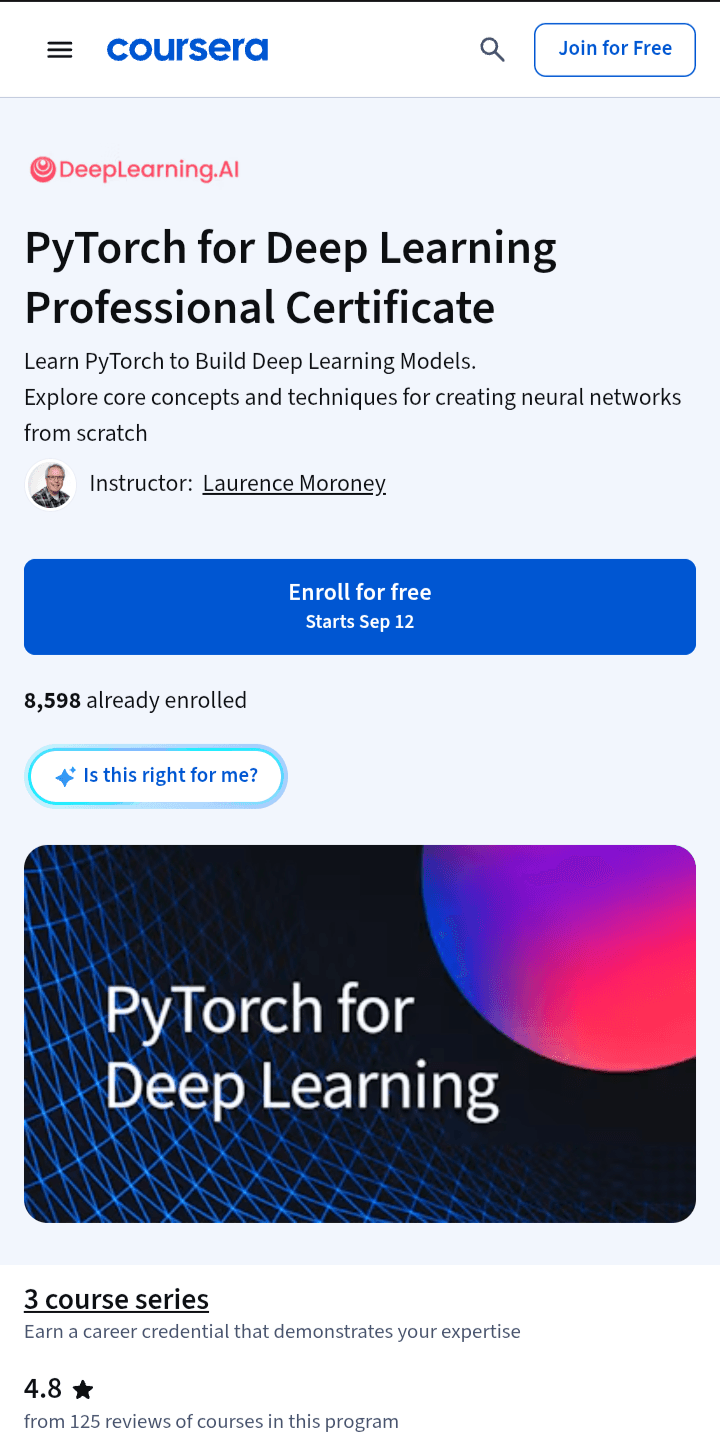
1. PyTorch for Deep Learning Professional Certificate (DeepLearning.AI, Coursera) – Best Overall for Beginners
Who it’s for
This is the most structured option on this list, ideal for beginners who want a guided, certificate-backed path rather than piecing together random tutorials.
It suits learners who already have basic Python and want a program that builds systematically instead of jumping straight into advanced topics.
What you’ll learn
The certificate is split into three progressively harder courses. You start with tensors, core PyTorch building blocks, and how to construct and train neural networks from the ground up.
From there, you move into using TorchVision and Hugging Face for computer vision and NLP tasks, along with hyperparameter tuning and transfer learning.
The final course covers advanced architectures – Siamese networks, ResNet, DenseNet, Transformers – plus model deployment using ONNX, MLflow, pruning, and quantization.
Projects included
Yes, you build and refine computer vision and NLP models from scratch, fine-tune pretrained models, and work on applied projects like text classification and image segmentation before preparing models for deployment.
Course length
Roughly 88 hours total across three courses (2 months at 10 hours/week).
Strengths
Real curriculum depth, strong instructor pedigree (DeepLearning.AI), a shareable certificate, and a natural progression from fundamentals to deployment-ready skills.
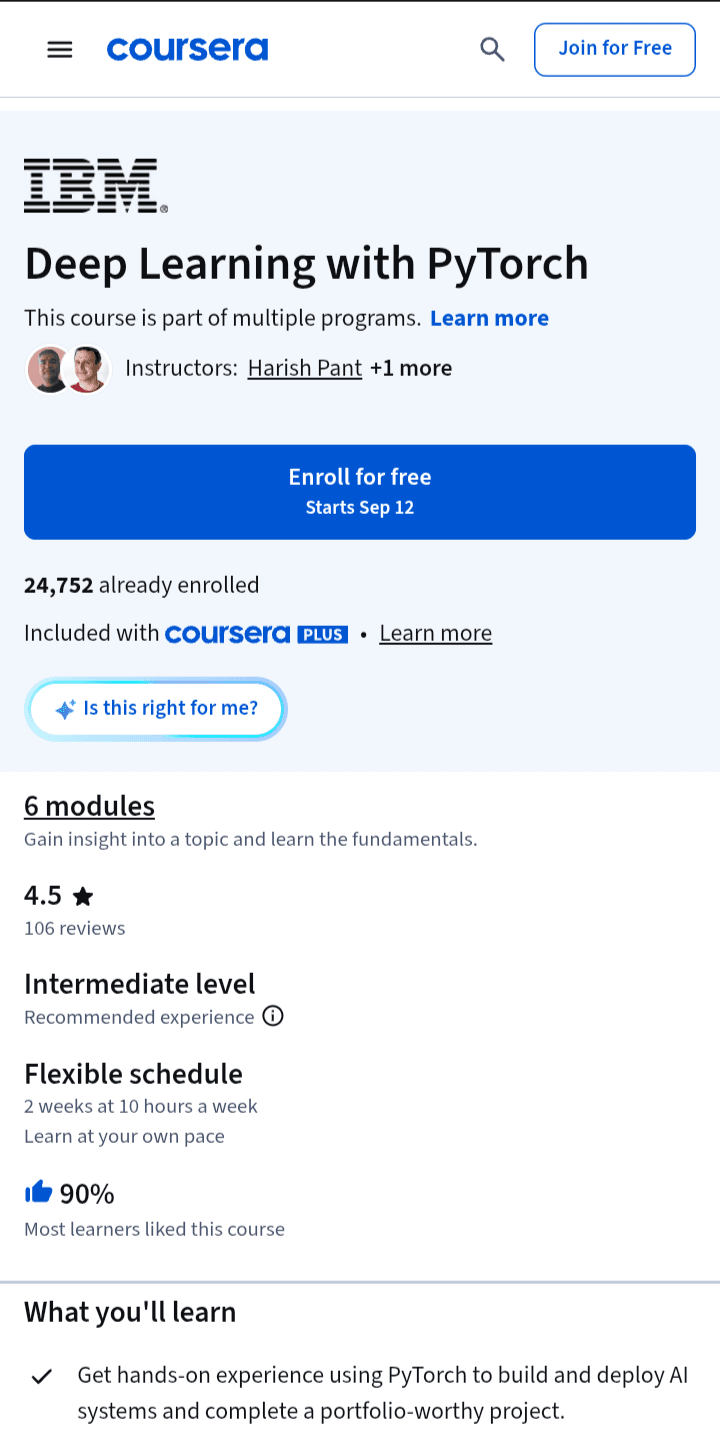
2. Deep Learning with PyTorch (IBM, Coursera) – Best for Building a Strong Theoretical Foundation
Who it’s for
This course suits beginners who want to understand the why behind deep learning, not just copy-paste model code. It’s a good fit if you like structured, concept-first learning before jumping into big projects.
What you’ll learn
The course moves methodically through logistic regression and cross-entropy loss, Softmax regression for multi-class classification, and shallow neural networks using PyTorch patterns like nn.Module and nn.Sequential.
From there, it goes deeper into optimizing deep networks, dropout, weight initialization, momentum, and batch normalization, before finishing with convolutional neural networks, GPU/CUDA training, and transfer learning using ResNet18.
Topics covered
Gradient descent, backpropagation, activation functions, overfitting/underfitting, CNN layers and pooling, and pretrained model usage via TorchVision.
Projects included
You’ll build a practice project classifying anime images and a final project classifying Fashion MNIST images, both structured as guided, real training pipelines rather than toy examples.
Course length
About 2 weeks at 10 hours/week (roughly 21 hours of content across 6 modules).
Strengths
Excellent conceptual depth for a short course, heavy hands-on lab component, and a genuinely useful final project for a portfolio.
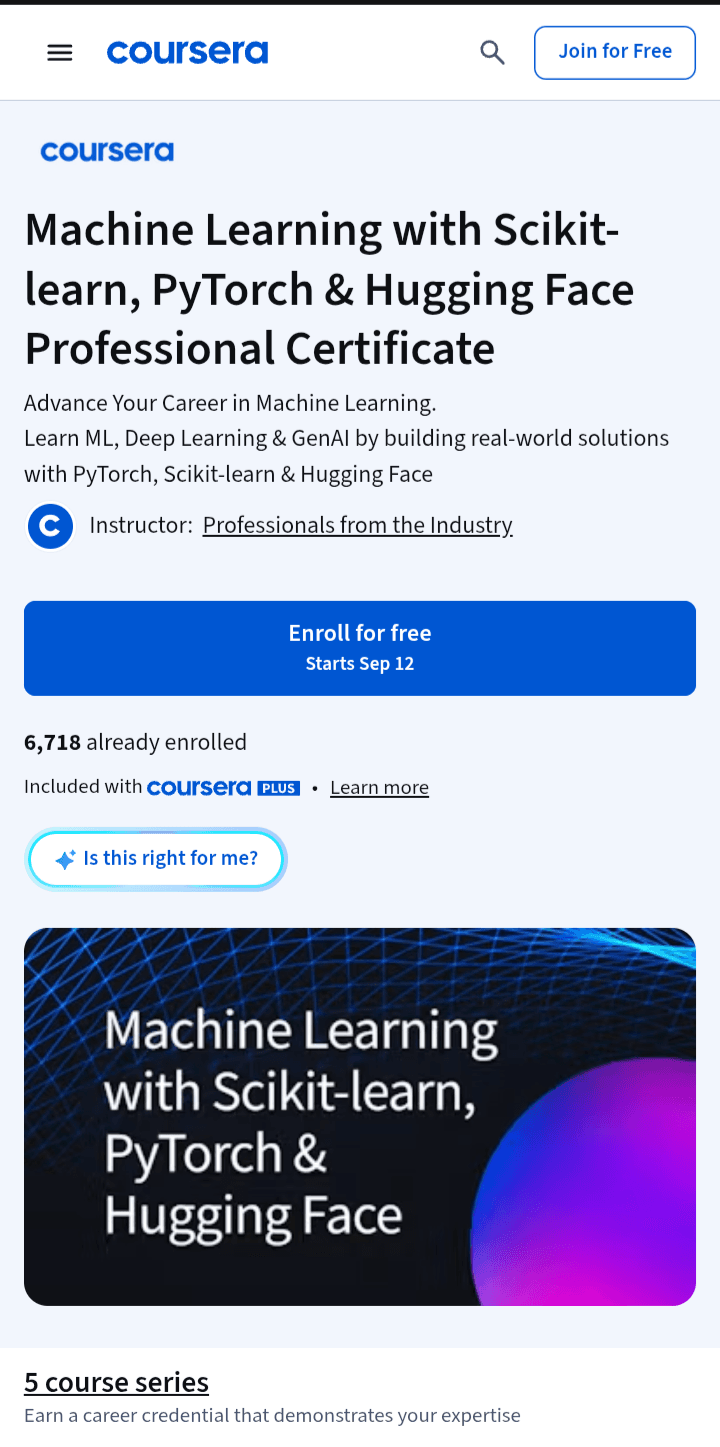
3. Machine Learning with Scikit-learn, PyTorch & Hugging Face Professional Certificate (Coursera) – Best for Learning PyTorch Within a Broader ML Career Path
Who it’s for
This one isn’t a pure PyTorch course; it’s a full machine learning program where PyTorch is one major piece of a bigger puzzle.
It’s best suited for beginners who want to understand classical ML (regression, ensembles, time series) before deep learning, and who are thinking about a long-term ML career rather than just “learning PyTorch fast.“
What you’ll learn
The program runs through five courses. It starts with foundational ML (supervised/unsupervised learning, feature engineering, time series) using Scikit-learn, then moves into advanced techniques like ensemble methods and NLP.
The dedicated PyTorch course (Course 3) covers neural network foundations, forward/backward propagation, CNNs, RNNs, LSTMs, and Transformers, plus transfer learning, regularization, and mixed precision training.
The program then shifts into generative AI, GANs, VAEs, diffusion models, and LLMs, before closing with a full capstone.
Projects included
Yes, extensively. Each course has hands-on labs, and the program ends with a capstone where you build and deploy a complete ML solution end-to-end.
Course length
About 5 months at 7 hours/week (roughly 137 hours total across 5 courses); the PyTorch course alone is 26 hours.
Strengths
Unmatched breadth; you leave understanding classical ML, deep learning, and GenAI, not just PyTorch in isolation. Strong for building a genuine portfolio.
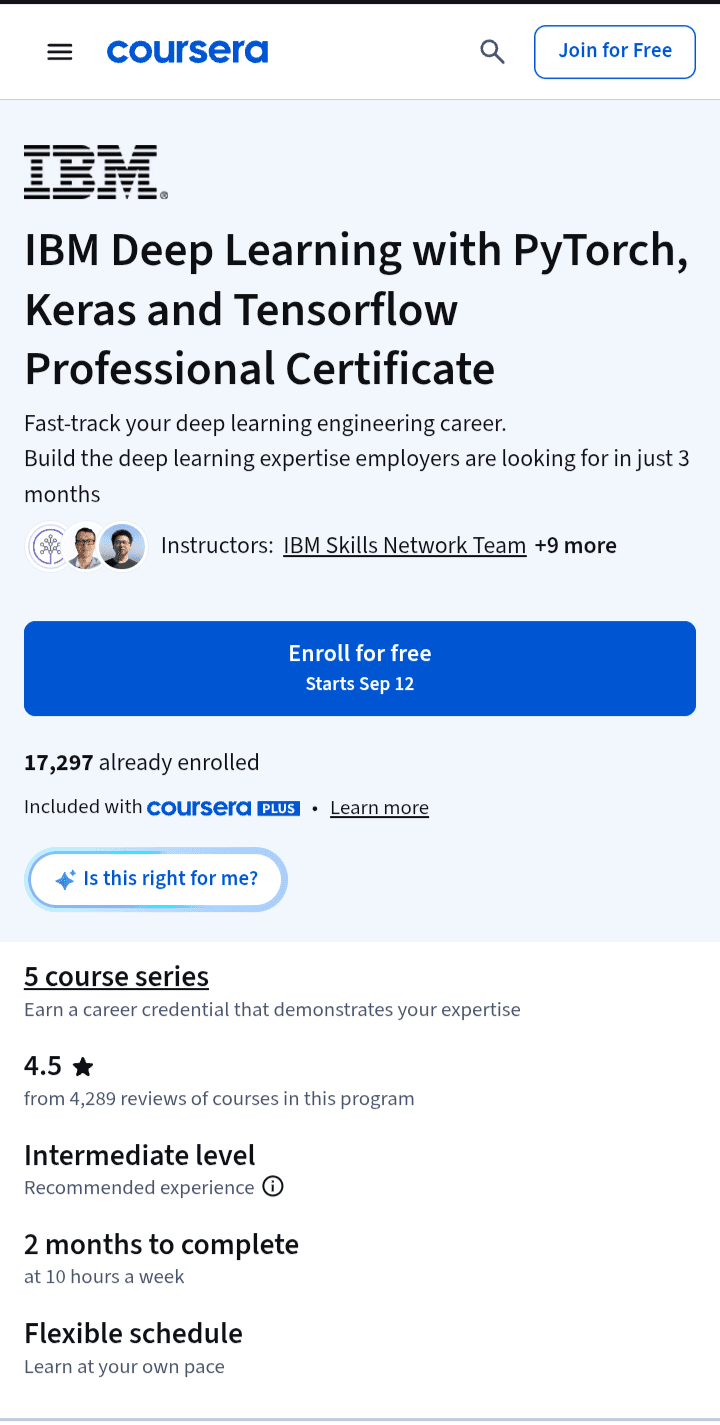
4. IBM Deep Learning with PyTorch, Keras and TensorFlow Professional Certificate (Coursera) – Best for Comparing Frameworks Side by Side
Who it’s for
This program is a strong pick for beginners who aren’t fully committed to PyTorch alone and want exposure to Keras and TensorFlow too, so they can make an informed choice, or simply because job listings often ask for familiarity with multiple frameworks.
It also suits learners aiming specifically at a “deep learning engineer” job title.
What you’ll learn
The certificate runs five courses. It opens with neural network fundamentals using Keras, then moves into building custom layers, CNNs, transformers, and even reinforcement learning with Keras/TensorFlow.
Courses 3 and 4 are dedicated PyTorch courses, covering tensors, autograd, DataLoader, linear and logistic regression, gradient descent, shallow and deep neural networks, dropout, batch normalization, and CNNs.
The program closes with a capstone applying CNNs and vision transformers to a real-world image classification problem.
Projects included
Yes, hands-on labs throughout, plus a substantial capstone project involving data loading, augmentation, model validation, and evaluation on a geospatial land classification task.
Course length
About 2 months at 10 hours/week (roughly 88 hours across 5 courses); the two PyTorch-focused courses total about 40 hours.
Strengths
Rare side-by-side exposure to PyTorch, Keras, and TensorFlow in one program, strong IBM instructional pedigree, and a portfolio-ready capstone.
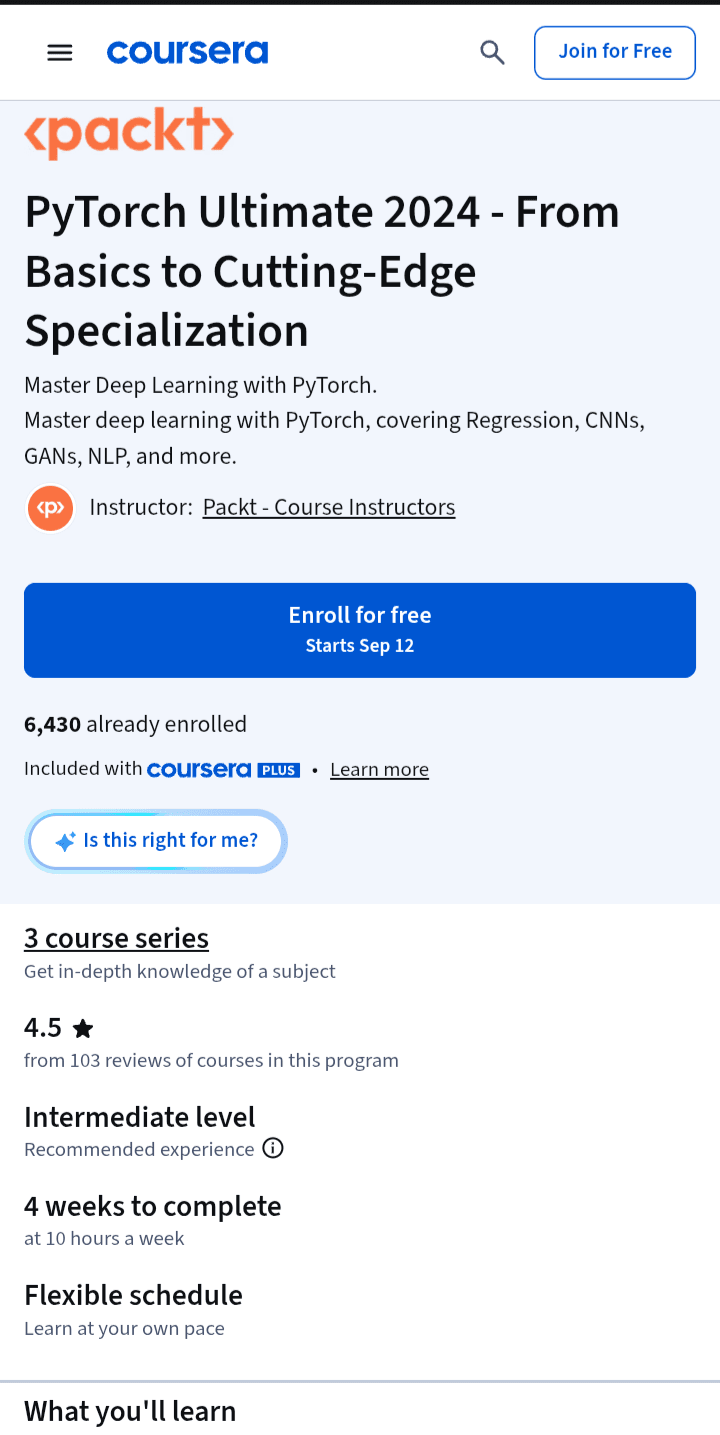
5. PyTorch Ultimate 2024 – From Basics to Cutting-Edge (Packt, Coursera) – Best for Fast-Paced, Project-Heavy Learning
Who it’s for
This specialization is built for people who learn best by doing, not by watching long theory lectures.
It’s compact, moves quickly, and is a great fit for beginners who already have some Python and basic ML exposure but want to reach advanced PyTorch topics without a multi-month time commitment.
What you’ll learn
Course 1 sets up your PyTorch environment and covers core ML/DL concepts, building and training neural networks from scratch with different optimization techniques.
Course 2 gets hands-on fast with multi-class and multi-label classification, CNNs for image and audio classification, YOLO-based object detection, neural style transfer, transfer learning, and RNNs/LSTMs.
Course 3 pushes into advanced territory: autoencoders, GANs, Graph Neural Networks, Vision Transformers, semi-supervised learning, and deploying models with Flask on Google Cloud.
Projects included
Yes, and unusually varied; learners build models across image, audio, and object detection tasks, plus deploy a working model, which is rare at this level.
Course length
About 4 weeks at 10 hours/week (roughly 26 hours total across all three courses).
Strengths
Excellent topic-to-time ratio, genuinely advanced content (GANs, GNNs, ViTs, deployment) packed into a short specialization, and strong, consistent reviews praising its pacing and instructor.
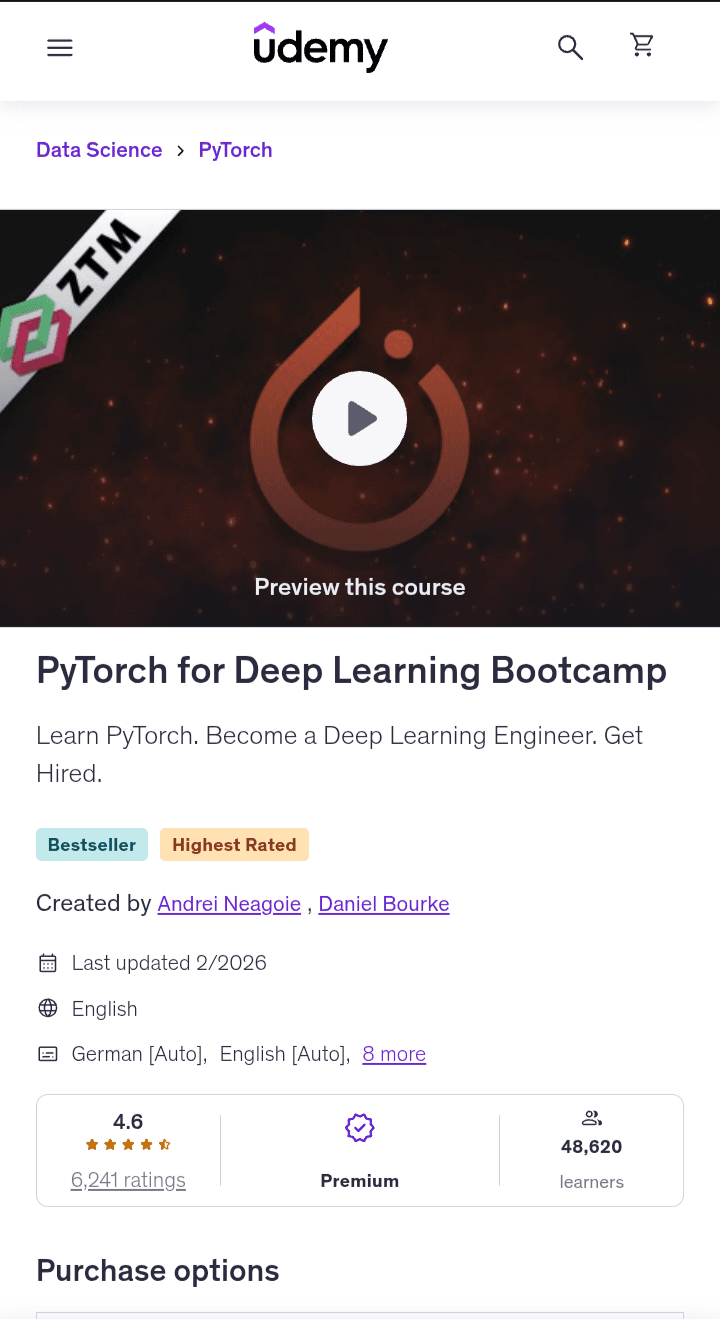
6. PyTorch for Deep Learning Bootcamp (Andrei Neagoie & Daniel Bourke, Udemy) – Best for Hands-On, Code-Along Learning
Who it’s for
This is one of the most popular PyTorch courses online, and for good reason; it’s designed for people who learn by typing code alongside the instructor, not by watching passively.
It suits beginners who already have some Python under their belt (the creators recommend 3-6 months of Python experience) and want a research-oriented, “build everything from scratch” style course.
What you’ll learn
The course is genuinely massive – 300+ videos and 50+ hours of content across 10 sections with 3 milestone projects.
It starts with PyTorch fundamentals (tensors), moves into the PyTorch workflow (data → model → training), then covers neural network classification, computer vision, and custom datasets.
Later sections cover PyTorch Going Modular, Transfer Learning, Experiment Tracking, Paper Replicating, Model Deployment, and an introduction to PyTorch 2.0 and torch.compile.
Topics covered
Tensors, training loops, CNNs, transfer learning, reading and replicating research papers in code, experiment tracking, and deploying a trained model publicly.
Projects included
Three milestone projects plus continuous hands-on coding throughout, including building and deploying a custom-trained PyTorch neural network accessible to the public.
Course length
~52 hours of video content, self-paced.
Strengths
Extremely thorough, project-based, and taught line-by-line so you understand why each line of code exists.
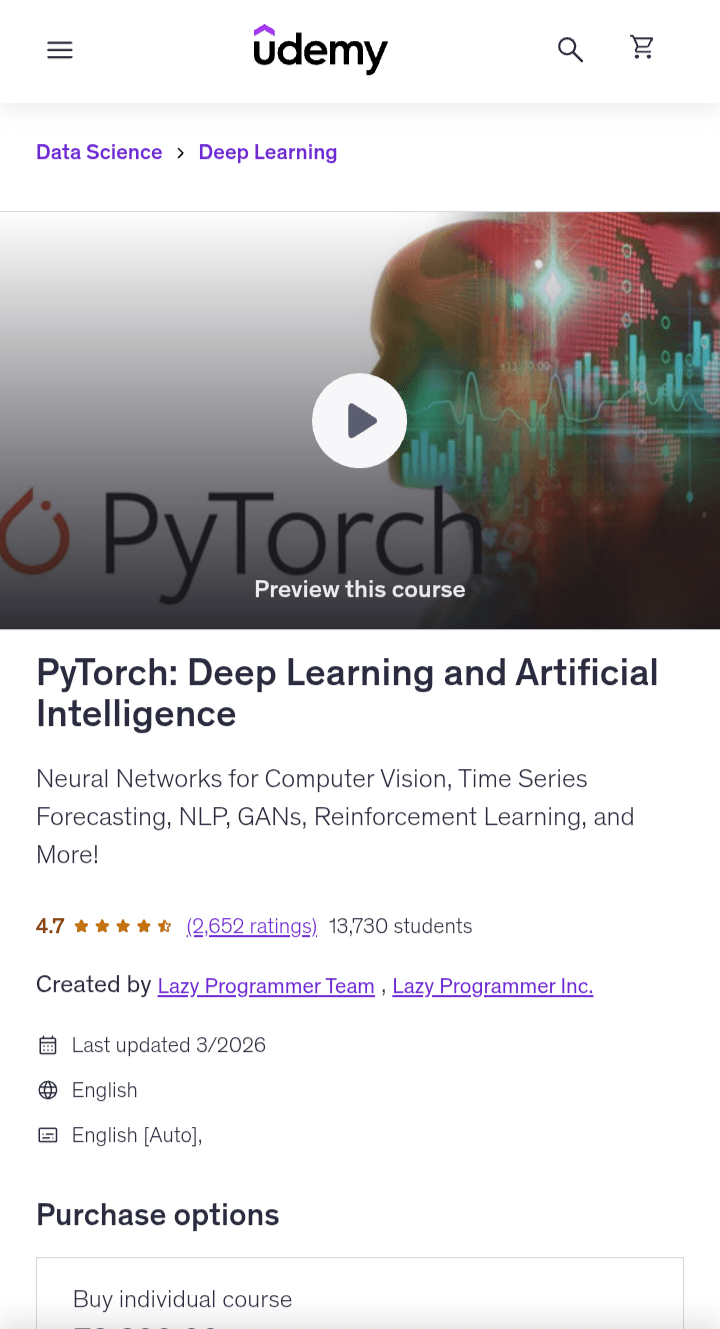
7. PyTorch: Deep Learning and Artificial Intelligence (Lazy Programmer, Udemy) – Best for Breadth Across AI Applications
Who it’s for
This course suits learners who want to see PyTorch applied across a wide range of AI domains rather than mastering one narrow track.
It caters to a broad range, from beginners to more advanced students, and is a strong pick if your goal is understanding the AI landscape broadly, including computer vision, NLP, GANs, reinforcement learning, rather than specializing early.
What you’ll learn
The course covers feed-forward neural networks from the neuron up, then moves through convolutional and recurrent architectures, time series forecasting, GANs, reinforcement learning, and NLP.
It ties these concepts directly to real applications like stock prediction, speech recognition, and recommender systems, and explicitly frames the material as foundational to understanding tools like ChatGPT, DALL-E, and Stable Diffusion.
Topics covered
Feed-forward and convolutional neural networks, RNNs, GANs, deep reinforcement learning, NLP, transfer learning, and time series forecasting, all built and run using Google Colab.
Projects included
Yes, including a deep reinforcement learning stock trading bot and various applied projects across the covered domains, with theory-focused “in-depth” sections you can dig into if you want the math behind concepts like loss functions and gradient descent variants.
Course length
Self-paced with lifetime access; the course emphasizes breadth, so total hours vary depending on how many optional in-depth sections you complete.
Strengths
Exceptional breadth; few other courses touch GANs, reinforcement learning, and NLP all within one program, plus the option to skip or dive into theory depending on your comfort level.
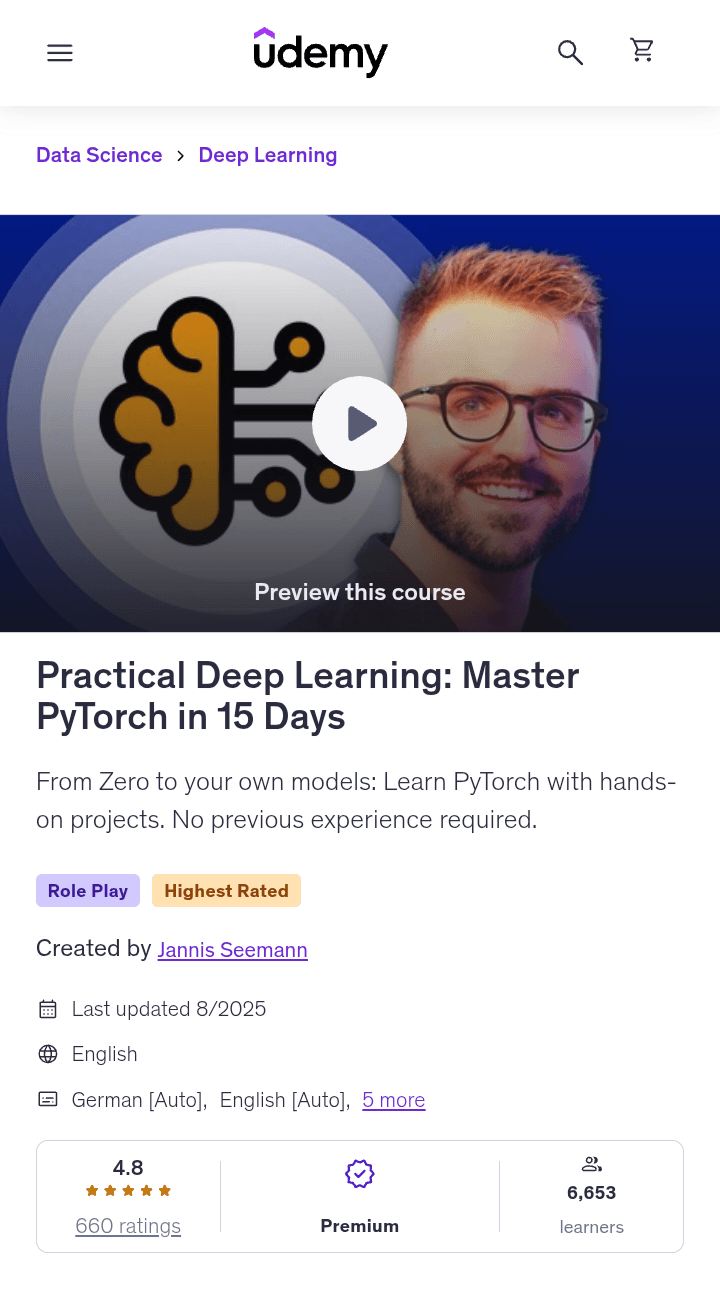
8. Practical Deep Learning: Master PyTorch in 15 Days (Udemy) – Best for a Fast, Structured Crash Course
Who it’s for
This course is built for absolute beginners who want a tight, day-by-day roadmap instead of an open-ended sprawling curriculum.
It works well for coding novices or data analysts stepping into AI who want quick wins and a visible finish line rather than a multi-month commitment.
What you’ll learn
True to its name, the course follows a 15-day structure moving from PyTorch fundamentals, tensors, their size, shape, and dimensions, through building, training, and evaluating models.
It progresses into practical territory fast: preparing different data types (text and images), improving and optimizing models, and using CNNs and transfer learning with ResNet.
Topics covered
Tensor operations, neural network basics, CNNs, transfer learning, and model deployment using Gradio to turn trained models into interactive, shareable apps.
Projects included
Projects are deliberately varied and real-world: a spam filter for SMS text, a handwritten digit classifier, a fashion item recognizer, and a used car price predictor.
Course length
Structured as a 15-day roadmap, making it one of the shorter, more time-bound options on this list.
Strengths
The “no fluff, no endless theory” approach keeps momentum high, the Gradio deployment step is a nice bonus most beginner courses skip, and the fixed 15-day framing gives you a concrete goal to work toward.
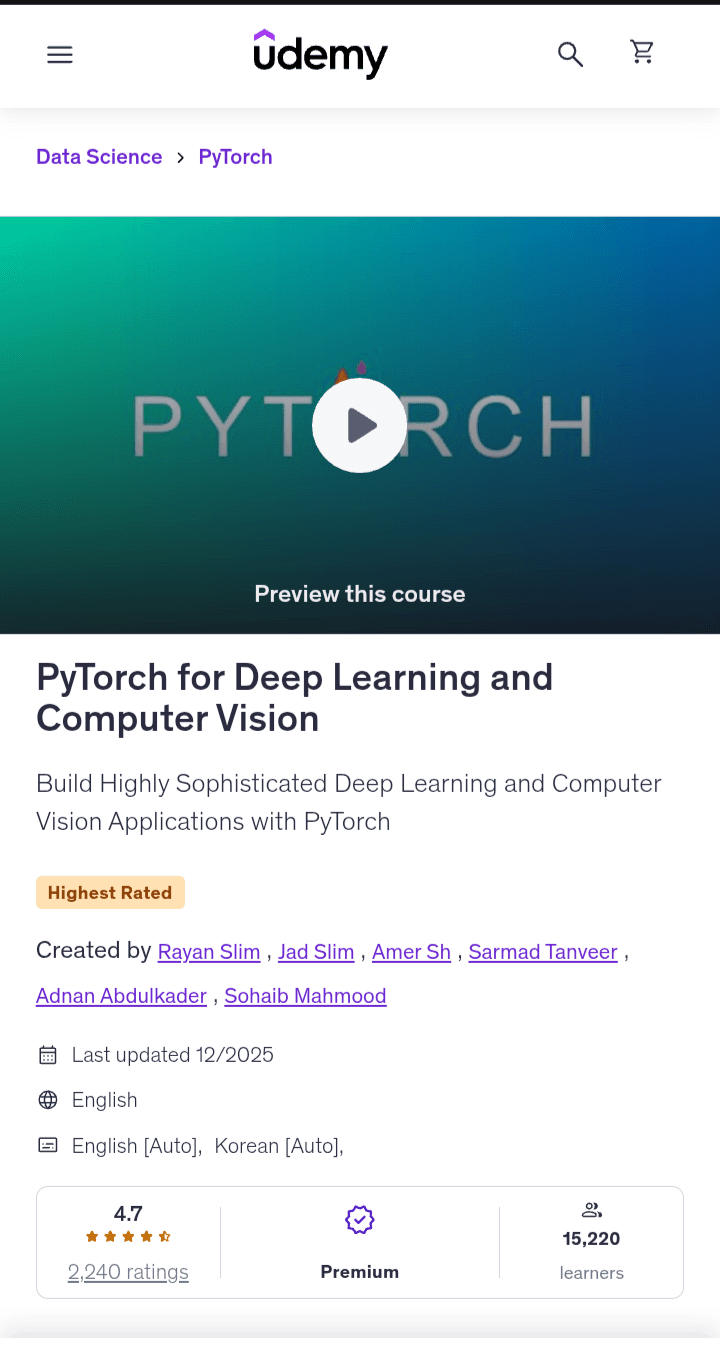
9. PyTorch for Deep Learning and Computer Vision (Rayan Slim, Udemy) – Best for Computer Vision Specialization
Who it’s for
If your main interest in deep learning is computer vision, specifically image classification, style transfer, and object recognition, this course is built exactly for that.
It’s aimed at complete beginners with no programming or math background, making it one of the more accessible entry points on this list, and has attracted over 44,000 students.
What you’ll learn
The course starts at the true fundamentals: tensors, linear models, and perceptrons, before progressing to deep networks.
From there, it moves into using pre-trained models, transfer learning, and neural style transfer.
Hands-on projects range from linear regression through ten-class image classification using convolutional neural networks.
Topics covered
Tensor operations (creation, indexing, slicing, reshaping), linear and logistic regression, perceptrons, CNNs, pre-trained model usage, transfer learning, and neural style transfer applications.
Projects included
Multiple hands-on builds culminating in a full image classification project using CNNs, plus a style-transfer application, all with source code provided and available on GitHub.
Course length
Roughly 14.5 hours of video content, making it a fairly compact, focused course compared to the larger bootcamps on this list.
Strengths
Genuinely beginner-friendly with a clear “learn by doing” teaching style, tightly focused on computer vision rather than trying to cover everything, and backed by a large, active student base with full source code access.
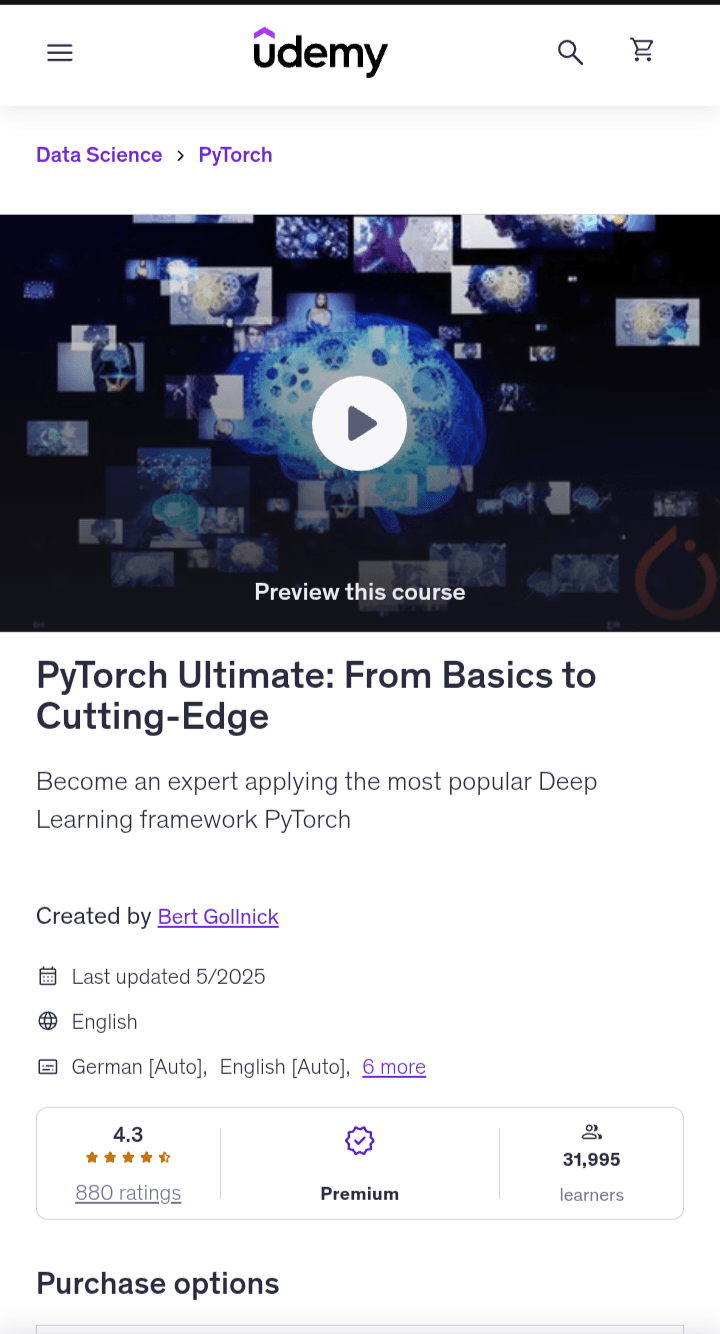
10. PyTorch Ultimate: From Basics to Cutting-Edge (Bert Gollnick, Udemy) – Best for Coverage of Cutting-Edge Architectures
Who it’s for
This is the Udemy version of the same Packt curriculum featured earlier on Coursera, and it suits Python developers, aspiring data scientists, and ML engineers who want a single course that stretches from fundamentals all the way to genuinely modern architectures, not just CNNs and RNNs, but Transformers, YOLOv7, and even a ChatGPT-style build.
What you’ll learn
The course opens with an optional (but recommended) “neural network from scratch” module before moving into core machine learning concepts and PyTorch fundamentals.
From there, it works through regression, classification, CNNs for image and audio classification, RNNs for sequential data, and graph neural networks for structured data.
The standout is its coverage of state-of-the-art territory: GANs, Transformers, YOLOv7 for object detection, and NLP applications including building a chatbot.
Topics covered
Data preparation, model training and evaluation, CNNs, RNNs, GANs, recommender systems, NLP, semi-supervised learning, model debugging, and model deployment.
Projects included
The course is structured around hands-on challenges where you attempt each problem yourself before the instructor walks through his solution, reinforcing active problem-solving rather than passive copying.
Course length
Around 19 hours of video content.
Strengths
Excellent breadth-to-depth ratio for its length, genuinely current architecture coverage (YOLOv7, Transformers) that many beginner courses skip, and a “solve it yourself first” teaching approach that builds real problem-solving skills.
PyTorch Courses Compared: Which One Should You Choose?
Choose Practical Deep Learning: Master PyTorch in 15 Days course if you’re completely new to deep learning
This Course assumes zero programming or math background and gets you building real projects fast.
Choose the PyTorch for Deep Learning Bootcamp course if you already know Python
PyTorch for Deep Learning Bootcamp (Neagoie & Bourke) skips the basics and dives straight into PyTorch’s mechanics, including tensors, training loops, and paper replication across 52+ hours.
Choose this course if you know machine learning but not PyTorch
Deep Learning with PyTorch (IBM) won’t re-explain what regression is. It assumes ML fundamentals and focuses purely on translating them into PyTorch code.
Choose this course if you want to build AI projects
PyTorch Ultimate 2024 (Packt) is the strongest project generator here – image, audio, and object detection models, plus real deployment with Flask.
Choose this course if you want to specialize in computer vision
PyTorch for Deep Learning and Computer Vision (Rayan Slim) skips NLP and reinforcement learning entirely to go deeper on CNNs, transfer learning, and style transfer.
Choose this course if you’re interested in NLP or generative AI
PyTorch: Deep Learning and Artificial Intelligence (Lazy Programmer) ties its curriculum directly to how tools like ChatGPT and Stable Diffusion work, covering NLP, GANs, and transformers.
Can You Learn PyTorch Without Knowing Machine Learning?
Short answer: not really, and not efficiently. PyTorch is a tool for building ML models. Without basic ML concepts, you’ll be typing code you don’t understand. But “learn ML first” doesn’t mean stopping for months. Here’s how to sequence it based on where you stand.
| Your starting point | What to do |
|---|---|
| Python beginner | Learn Python fundamentals first (functions, loops, classes). PyTorch code will otherwise feel like a foreign language. |
| Python comfortable, no ML | Take a short ML fundamentals crash course, then start PyTorch alongside it. |
| Some ML, new to PyTorch | Jump straight into a PyTorch beginner course; you already understand the “why,” just not the “how.” |
| Experienced with ML | Skip straight to PyTorch. You’ll pick up its syntax and workflow quickly since the underlying concepts are already familiar. |
The mistake most beginners make is trying to learn Python, ML theory, and PyTorch all at once. That’s what causes overwhelm, not PyTorch itself.
A Beginner-Friendly PyTorch Learning Path
Courses teach you PyTorch, but PyTorch is one stop on a longer road. Here’s the full path, step by step.
Step 1: Python fundamentals
Functions, loops, classes, lists, and dictionaries. Don’t skip this; shaky Python makes everything downstream harder.
Step 2: NumPy + basic data handling
Arrays, indexing, and reshaping. PyTorch tensors behave a lot like NumPy arrays, so this step pays off directly.
Step 3: Machine learning fundamentals
Regression, classification, and a conceptual grasp of how models learn from data.
Step 4: PyTorch tensors and datasets
Creating tensors, manipulating them, and loading data using PyTorch’s Dataset and DataLoader classes.
Step 5: Neural networks
Building your first models with nn.Module – layers, activation functions, and forward passes.
Step 6: Training and evaluation
Loss functions, gradient descent, backpropagation, and how to measure whether your model is actually learning.
Step 7: Computer vision/NLP
Apply what you’ve learned to a specific domain – CNNs for images, or tokenization and embeddings for text.
Step 8: Build portfolio projects
Take on 2-3 original projects using your own data or twist on a dataset. This is what actually proves your skills.
Step 9: Explore transformers and modern AI
Attention mechanisms, Transformers, and how today’s LLMs and generative models build on everything you’ve just learned.
Frequently Asked Questions About PyTorch Courses
Is PyTorch good for beginners?
Yes, its Python-like syntax and dynamic computation graph make debugging intuitive, which is why most beginner-friendly courses and tutorials use it today.
Can I learn PyTorch without knowing Python?
No. PyTorch is Python-based; you need functions, loops, and classes down first, or you’ll struggle to understand any code you write.
Is PyTorch easier than TensorFlow?
For beginners, generally yes. PyTorch’s dynamic graphs let you print and debug mid-execution, making it feel more like writing regular Python code.
How much math do I need to learn PyTorch?
Conceptual comfort with vectors, matrices, and derivatives suffices. You don’t need to solve equations by hand; understanding why training works matters more.
Can I get a job after learning PyTorch?
Yes, especially paired with a portfolio. Roles like ML Engineer or AI Engineer frequently list PyTorch as a required or preferred skill.
What should I learn after PyTorch?
Explore Transformers, attention mechanisms, and Hugging Face for NLP/generative AI, or deepen computer vision skills with advanced architectures like ResNet and Vision Transformers.
Final Verdict: Which PyTorch Course Should a Beginner Choose?
If you only take one course from this list, make it the PyTorch for Deep Learning Professional Certificate (DeepLearning.AI).
It balances structured fundamentals with real depth, taking you from tensors to deployment with a recognized credential attached.
Want something faster and more hands-on? PyTorch Ultimate 2024 packs an equally strong curriculum into a fraction of the time.
Truly new to coding? Start with Practical Deep Learning: Master PyTorch in 15 Days instead.
There’s no universal “best”; just the best match for where you’re starting and where you want to go.
Related Articles
Keras vs PyTorch: Which is the Best Framework for You?
Top 10 Udemy Courses for Aspiring Data Scientists
Best SQL Courses for Beginners That Are Actually Worth It
How to Learn Data Science Without A Degree – A Complete Roadmap

TechnicalStudies was started by Neeladrinath with one simple idea — give Indian students a reliable place to figure out what’s actually worth their time and money. Every recommendation here is backed by careful research, real student feedback, and honest analysis. We cover online courses, laptops, smartwatches, software deals, and learning resources — all looked at from a student’s perspective, so you can spend less time guessing and more time learning.