Machine learning isn’t just a buzzword anymore; it’s the engine behind the products you use every day.
From Netflix recommendations to fraud detection on your bank account, ML is quietly running the world. And right now, companies are paying top dollar for people who understand how it works.
But here’s where most beginners go wrong: they Google “best machine learning courses,” click the first result, and either drown in math they weren’t ready for, or breeze through something so basic it teaches them nothing useful.
Choosing the wrong course doesn’t just waste your time. It kills your momentum.
A genuinely beginner-friendly ML course does three things well: it builds your intuition before throwing equations at you, it uses real datasets instead of toy examples, and it shows you where the skill actually takes you career-wise.
In this guide, you’ll find courses that actually deliver on that, whether you’re a complete newcomer, a student, someone switching careers, or just working with a tight budget. Free options, paid ones, and courses that come with a certificate worth putting on your resume.
Let’s find the one that fits you.
Quick Comparison of the Best Machine Learning Courses for Beginners
Before diving into detailed reviews, here’s a side-by-side look at every course in this guide so you can spot the right fit at a glance.
| Course | Platform | Level | Certificate | Best For |
|---|---|---|---|---|
| Machine Learning for All – University of London | Coursera | Beginner (No code) | Yes | Non-technical learners & curious beginners |
| Machine Learning Specialization – Andrew Ng | Coursera | Beginner | Yes | Career-focused beginners with basic coding skills |
| Machine Learning with Python – IBM | Coursera | Intermediate | Yes | Python users wanting job-ready ML skills |
| Mathematics for Machine Learning – Imperial College London | Coursera | Beginner–Intermediate | Yes | Learners who want to master the math behind ML |
| Machine Learning Specialization – University of Washington | Coursera | Intermediate | Yes | Developers who learn best through real-world case studies |
| Machine Learning A-Z – Kirill Eremenko & Hadelin de Ponteves | Udemy | Beginner–Intermediate | Yes | Learners who want ML + AWS deployment in one course |
| Complete ML & Data Science Bootcamp: Zero to Mastery – Andrei Neagoie & Daniel Bourke | Udemy | Beginner | Yes | Complete beginners who want project-driven learning |
| The Complete ML Course with Python – Codestars / Anthony NG | Udemy | Beginner | Yes | Portfolio builders who want 12 hands-on projects |
| Data Science & ML Fundamentals | Udemy | Beginner–Intermediate | Yes | Learners focused on regression, clustering & NLP depth |
| Machine Learning, Data Science & AI Engineering with Python – Frank Kane | Udemy | Intermediate | Yes | Programmers transitioning into ML + generative AI |
Best Machine Learning Courses for Beginners
1. Machine Learning for All – University of London – Coursera
Most machine learning courses assume you already know Python or can breeze through linear algebra.
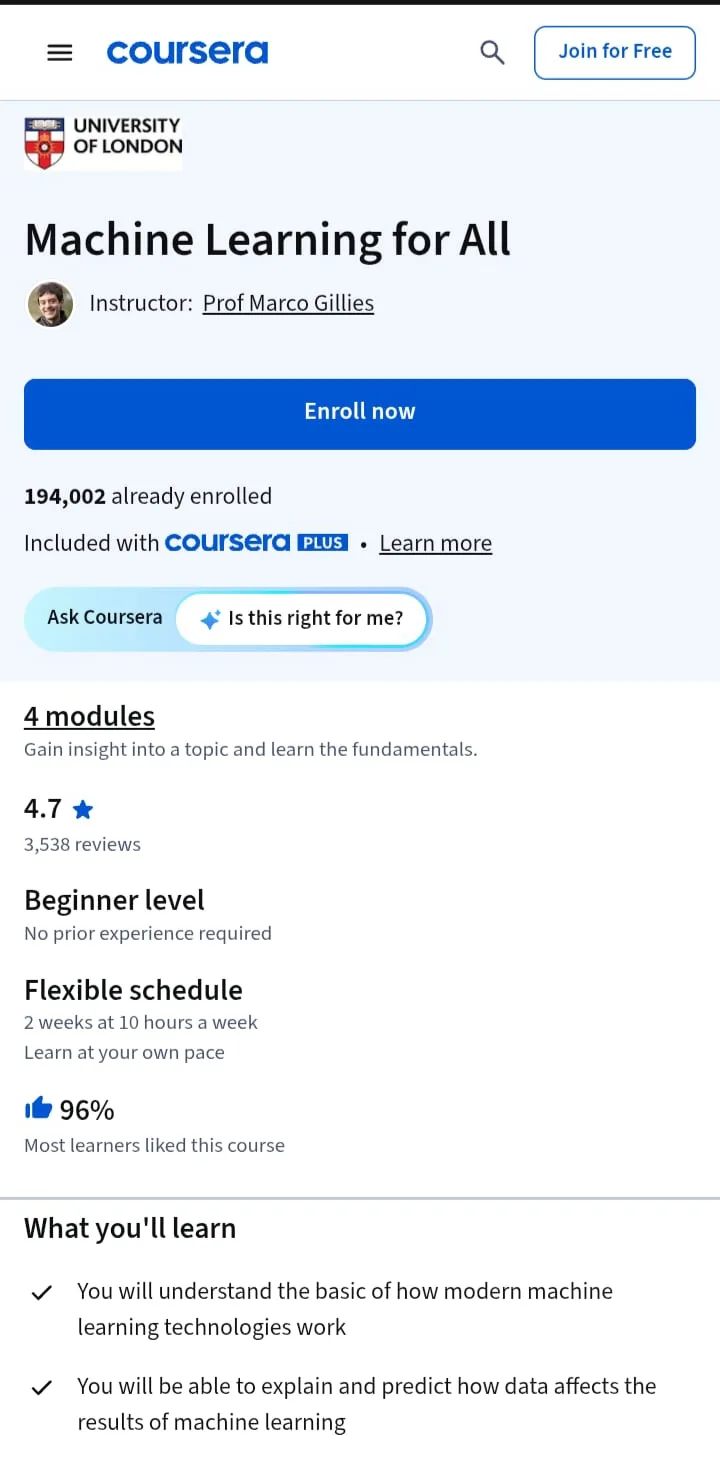
This one doesn’t, and that’s exactly what makes it stand out. Offered by the University of London and taught by Prof. Marco Gillies, Machine Learning for All was built from the ground up for people who have zero technical background. The name means what it says.
What You’ll Learn
You’ll walk away understanding how ML actually works under the hood, not at a coding level, but at a conceptual one.
The course covers how data shapes machine learning outcomes, what features are and why they matter, how to evaluate whether a model is working, and the real-world risks and ethical concerns around AI.
By the end, you’ll have hands-on experience training an image recognition model.
Course Structure
The course runs across 4 modules.
Module 1 covers ML fundamentals and gets you experimenting with a learning model right away.
Module 2 dives into data features and how representation affects results.
Module 3 walks you through testing and real-world applications, including the dangers of ML gone wrong.
Module 4 is where you collect your own dataset, train a model, and complete a full project from scratch. It’s a clean, logical progression that never leaves you lost.
Prerequisites
None. Seriously, no math, no programming, no prior tech experience needed.
Duration
Approximately 2 weeks at 10 hours per week. Flexible schedule, so you can move faster or slower based on your availability.
Certificate
Yes, a shareable Coursera certificate that you can add directly to your LinkedIn profile. Financial aid is available if cost is a concern.
Best For
Non-technical professionals, managers, students exploring AI for the first time, or anyone who wants to understand ML before committing to a technical deep-dive. If you’ve been curious about AI but intimidated by the math, start here.
2. Machine Learning Specialization – Andrew Ng (Stanford & DeepLearning.AI) – Coursera
If there’s one course that shows up in every serious conversation about learning machine learning, it’s this one.
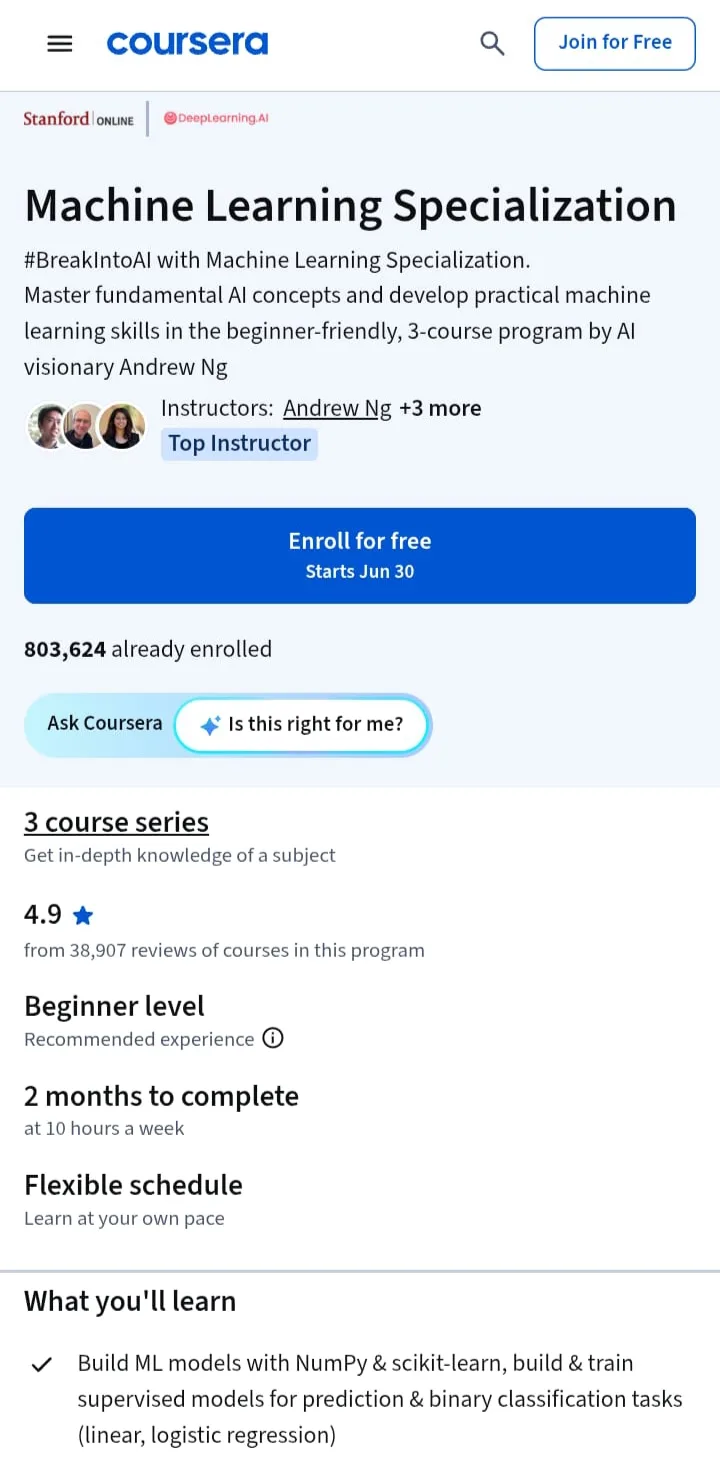
The Machine Learning Specialization by Andrew Ng, co-founder of Coursera, former head of Google Brain, and one of the most respected names in AI, has been taken by over 4.8 million learners since it first launched in 2012.
The updated version is sharper, more beginner-accessible, and built entirely around Python. It’s not just popular; it’s the benchmark everything else gets compared to.
What You’ll Learn
You’ll cover the full spectrum of foundational ML, including supervised learning (linear regression, logistic regression, neural networks, decision trees), unsupervised learning (clustering, anomaly detection, recommender systems), and reinforcement learning.
Beyond the algorithms, you’ll learn how working ML engineers in Silicon Valley actually approach model evaluation, data selection, and performance tuning. That practical, professional-grade perspective is what separates this from most beginner courses.
Course Structure
The specialization is split into 3 courses totalling roughly 95 hours of content.
Course 1 covers supervised learning using NumPy and scikit-learn.
Course 2 moves into neural networks with TensorFlow, decision trees, and random forests.
Course 3 wraps up with unsupervised learning, recommender systems, and a deep reinforcement learning model.
Each lesson starts with visual intuition before introducing code. The math is explained, but never gatekeeps your progress.
Prerequisites
Basic coding familiarity (loops, functions, conditionals) and high school-level math. No prior ML knowledge required. Python is used throughout, but the course eases you in.
Duration
Approximately 2 months at 10 hours per week, or around 3 weeks per course if you push harder.
Certificate
Yes, you will get a shareable specialization certificate upon completing all 3 courses, plus individual certificates for each course. Financial aid is available.
Best For
Beginners with some coding background who want a thorough, career-focused introduction to machine learning; not just theory, but the kind of practical know-how that holds up in job interviews and real projects.
3. Machine Learning with Python – IBM – Coursera
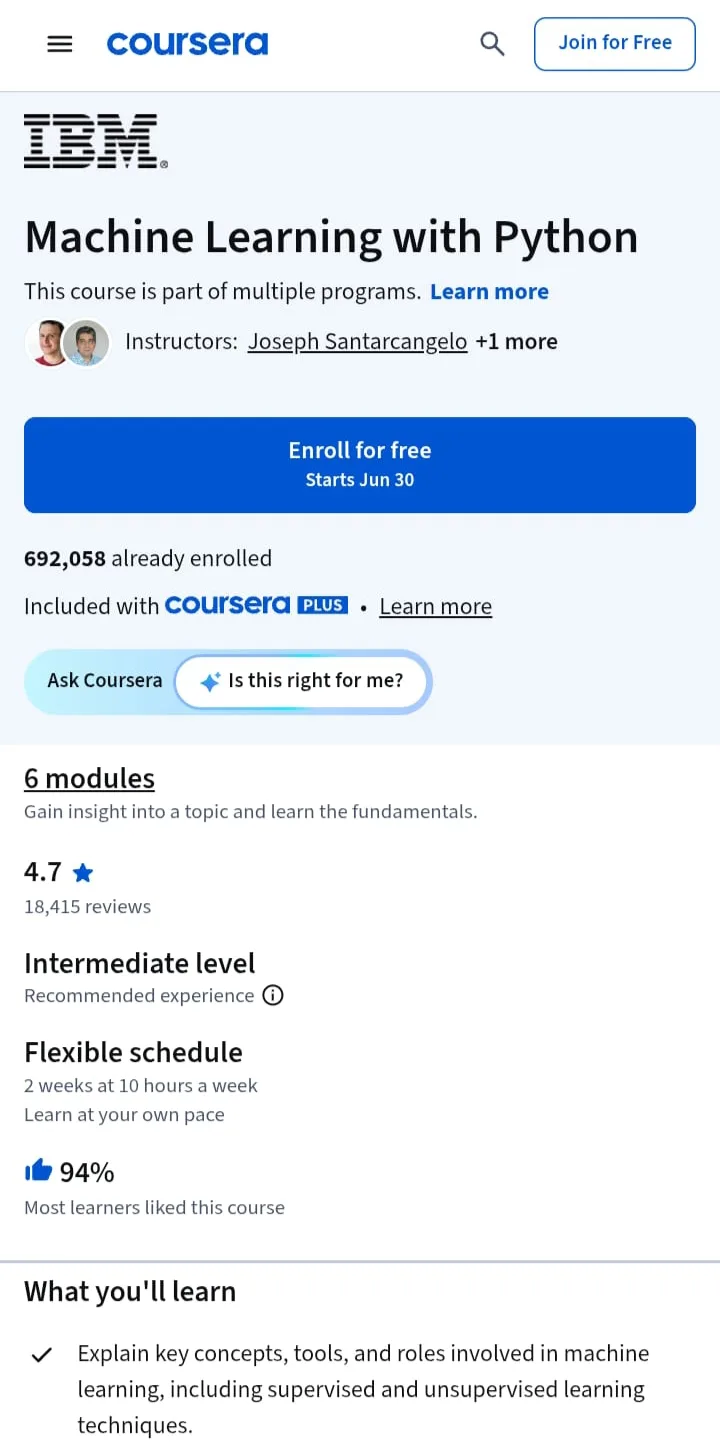
There’s a difference between understanding machine learning and actually being able to build with it. IBM’s Machine Learning with Python is squarely focused on the latter. This isn’t a theory-heavy course.
It’s a hands-on, Python-first program designed to get you writing real ML code using industry-standard tools.
What You’ll Learn
You’ll cover the full machine learning workflow from end to end, including regression (linear, multiple, polynomial, logistic), classification algorithms (decision trees, KNN, SVM, Random Forests, XGBoost), unsupervised methods (K-Means, DBSCAN, PCA, t-SNE, UMAP), and model evaluation techniques including cross-validation, regularization, and GridSearchCV pipeline optimization.
You’ll also learn to spot and avoid common pitfalls like data leakage.
Course Structure
The course runs across 6 modules.
Module 1 sets the foundation with ML concepts, tools, and the scikit-learn ecosystem.
Modules 2 and 3 tackle regression and supervised learning with heavy lab work, including a real credit card fraud detection exercise.
Module 4 covers unsupervised learning, Module 5 goes deep on model evaluation and validation, and Module 6 wraps up with two projects: a Titanic survival classifier and a rainfall prediction model built from real weather data.
Read Also: Best Python Courses for Beginners (Start Coding from Zero)
Prerequisites
Intermediate level: you should be comfortable with basic Python and have some familiarity with data concepts. It’s not designed for complete beginners but is very approachable if you’ve done a short Python course beforehand.
Duration
Approximately 2 weeks at 10 hours per week. Flexible, self-paced schedule.
Certificate
A shareable IBM certificate you can add to LinkedIn. It’s also part of the IBM AI Engineering Professional Certificate, so it counts toward a larger credential if you want to continue. Financial aid is available.
Best For
Learners who already have basic Python skills and want to move into practical, job-ready ML work quickly. If you’re targeting a data analyst or junior ML engineer role and need real project experience to show employers, this course delivers that.
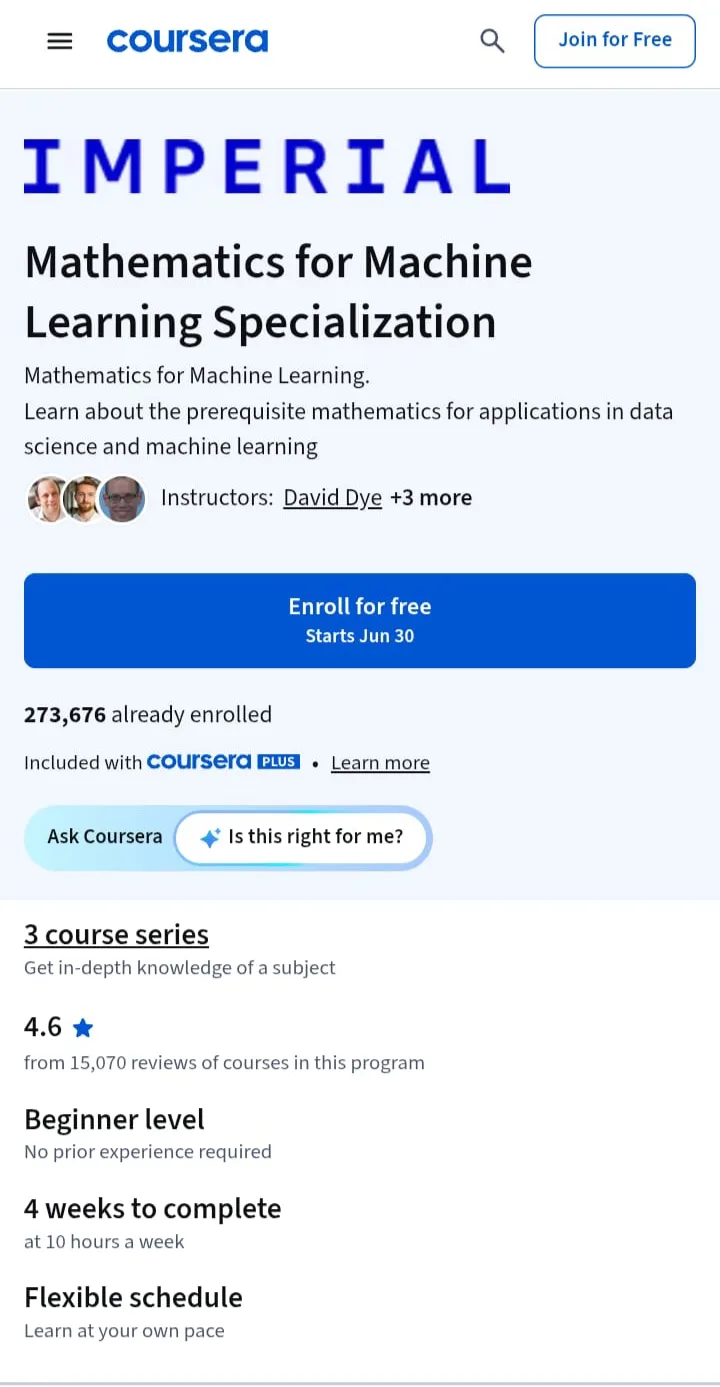
4. Mathematics for Machine Learning Specialization – Imperial College London – Coursera
Here’s the problem many beginners run into: they start an ML course, hit the first equation, and freeze.
Not because they’re not smart enough, but because nobody ever connected the math they learned in school to what it actually does inside a machine learning model.
This specialization from Imperial College London exists to fix exactly that. It doesn’t teach you ML directly. It builds the mathematical foundation that makes every ML concept click into place.
What You’ll Learn
The specialization covers three pillars of ML math: linear algebra, multivariate calculus, and dimensionality reduction via Principal Component Analysis (PCA).
You’ll learn how vectors and matrices relate to data, how calculus drives model optimization and neural network training, and how PCA compresses high-dimensional datasets into something workable.
Crucially, none of this is taught in the abstract; every concept is framed around how it shows up in real machine learning workflows.
Course Structure
Three courses, each building on the last.
Course 1 covers linear algebra, vectors, matrices, eigenvalues, eigenvectors, and includes a practical exercise on how the PageRank algorithm works.
Course 2 tackles multivariate calculus, walking through gradients, optimization, and how calculus underpins neural network training.
Course 3 applies everything to PCA using Python and NumPy, working with the real MNIST digit dataset. This is where math stops being theory and becomes a tool you can actually use.
Prerequisites
High school-level math is all you need for Courses 1 and 2. Course 3 requires basic Python and NumPy familiarity, so it’s worth picking those up first if you haven’t already.
Duration
Approximately 4 weeks at 10 hours per week, though the full specialization realistically takes 3 to 4 months at a comfortable pace of 3 to 4 hours per week.
Certificate
You will get a shareable Imperial College London specialization certificate upon completion. Financial aid is available.
Best For
Beginners who want to go deeper than surface-level ML, especially students, aspiring ML engineers, or anyone who’s tried an ML course before, got lost in the math, and wants to go back and build the foundation properly before moving forward.
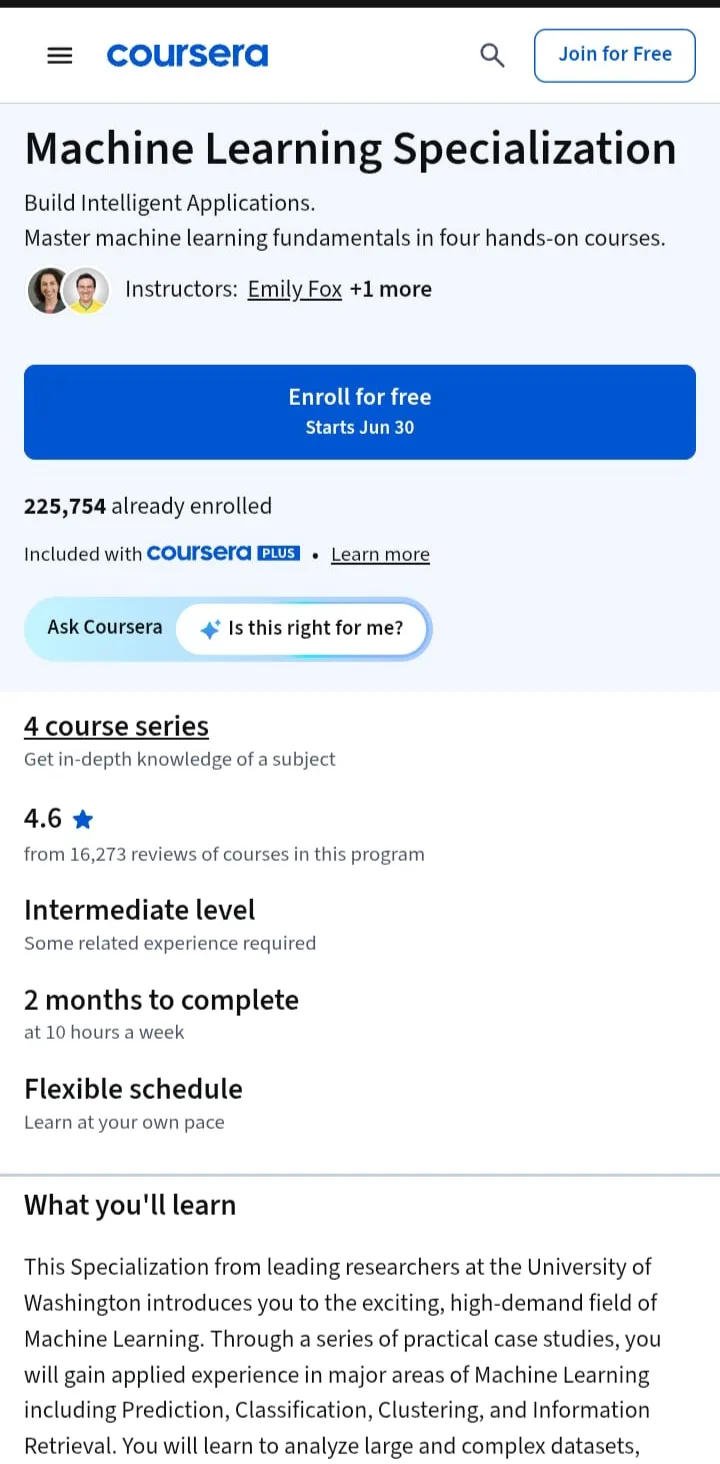
5. Machine Learning Specialization – University of Washington – Coursera
Most ML courses teach you algorithms. This one teaches you how to think like a machine learning practitioner.
Built by leading researchers at the University of Washington, Emily Fox and Carlos Guestrin, this 4-course specialization is structured entirely around real-world case studies.
Instead of abstract exercises, you’re working through problems like predicting house prices, analyzing product review sentiment, building document retrieval systems, and recommending products.
By the time you finish, you’ve not just studied ML; you’ve applied it across four distinct domains.
What You’ll Learn
You’ll get hands-on with the four core pillars of applied ML: prediction, classification, clustering, and information retrieval.
Along the way, you’ll work through regression models (including regularization and LASSO), classification techniques (logistic regression, decision trees, boosting), and unsupervised learning methods like K-Means, latent Dirichlet allocation, and expectation maximization.
There’s also solid coverage of Bayesian statistics and how to scale algorithms to large datasets using distributed computing concepts like MapReduce.
Course Structure
Four courses, each anchored to a specific ML domain.
Course 1 is a broad case-study-driven foundation that treats ML as a “black box” so you can understand the what before the how.
Course 2 dives into regression and feature selection.
Course 3 focuses on classification, including handling missing data and evaluating models with precision-recall metrics.
Course 4 rounds out with clustering and retrieval, including some genuinely advanced content on probabilistic models and approximate nearest neighbor search.
Prerequisites
Intermediate level. You’ll need basic Python programming skills and comfort with foundational math. This specialization is particularly well-suited to software engineers and data analysts looking to pivot into ML.
Duration
Approximately 2 months at 10 hours per week, though most learners complete it in around 8 months at a relaxed pace.
Certificate
Learners will get a shareable University of Washington specialization certificate upon completing all 4 courses. Financial aid is available.
Best For
Developers or analysts with some programming background who want to learn ML through real applications rather than theory-first lectures, especially if building end-to-end intelligent applications is the goal.
6. Machine Learning A-Z [2026]: ML, DL, AI with AWS, Python & R – Kirill Eremenko & Hadelin de Ponteves – Udemy
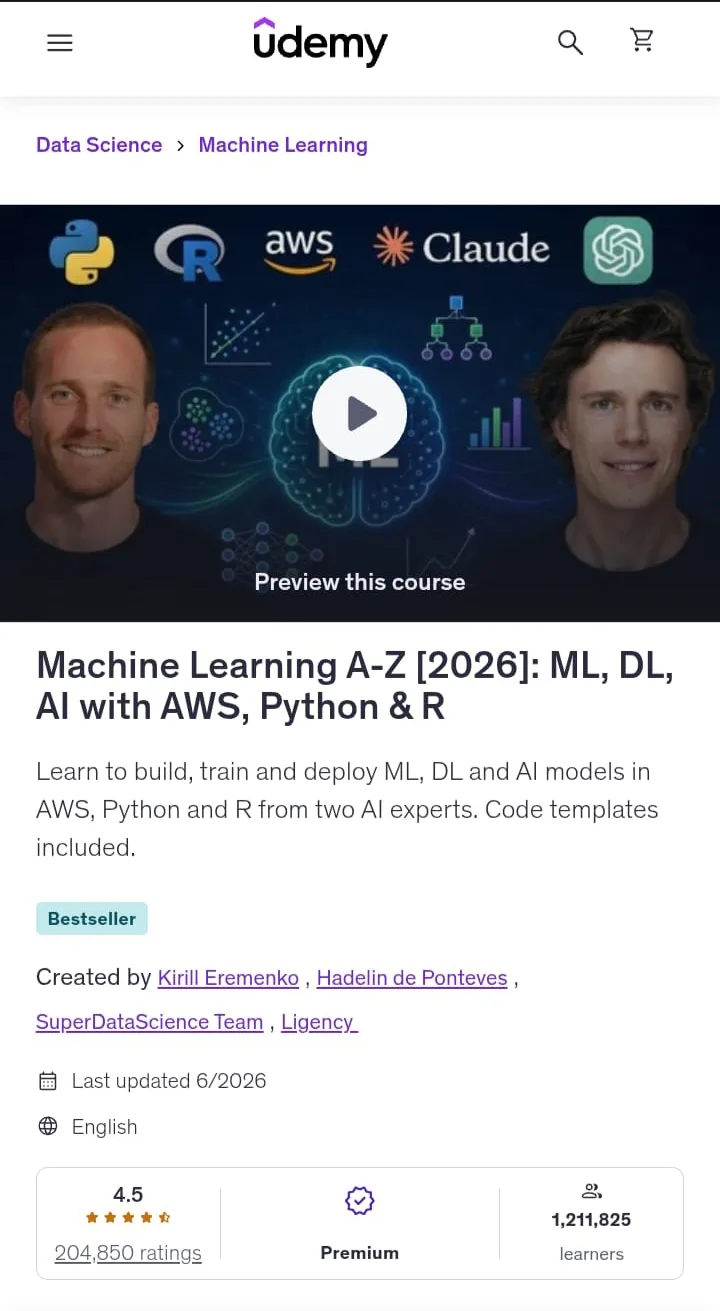
Machine Learning A-Z is one of the most purchased ML courses on the internet, and for good reason. It’s not just a course; it’s practically an encyclopedia.
Taught by Kirill Eremenko and Hadelin de Ponteves, two experienced data science educators, this course was built to be comprehensive without being intimidating.
And the 2026 update now includes a full AWS track, making it one of the few beginner courses that also covers how to deploy ML models in production.
What You’ll Learn
The breadth here is genuinely impressive.
You’ll cover data preprocessing, regression (6 types), classification (7 models), clustering, association rule learning, reinforcement learning, NLP, deep learning (ANNs and CNNs), dimensionality reduction, and model selection with XGBoost and boosting.
The new AWS modules go further: preprocessing with SageMaker, model development using LightGBM and CatBoost, deployment strategies (serverless, real-time, asynchronous), CI/CD pipelines for ML workflows, and responsible AI monitoring in production.
That’s a full ML engineer skill stack in one course.
Course Structure
15 parts, 476 lectures, and just over 49 hours of content in total.
Each section is self-contained; you can take the course front to back or jump directly into the part that’s most relevant to your goals right now.
All exercises are based on real-world case studies. Both Python and R code templates are included and downloadable, so you can apply what you learn to your own projects immediately.
AWS tutorials are separate from the Python/R tracks, so you can pick what fits your career path.
Prerequisites
High school-level math and basic programming awareness. The course is structured to bring beginners up to speed quickly, though having some familiarity with Python beforehand will make the early sections smoother.
Also Check: Udemy Courses for Aspiring Data Scientists
Duration
49+ hours of video content. At a pace of 10 hours per week, expect to spend around 5 to 6 weeks on it.
Certificate
Learners will get a Udemy certificate of completion. While it’s not a university credential, it’s widely recognized among recruiters familiar with the platform and solid proof of commitment when paired with portfolio projects.
Best For
Beginners and intermediate learners who want a single, no-compromise course that takes them from data preprocessing all the way to model deployment on AWS, especially those targeting data scientist or ML engineer roles and wanting to avoid juggling five different courses to get there.
7. Complete Machine Learning & Data Science Bootcamp: Zero to Mastery – Andrei Neagoie & Daniel Bourke – Udemy
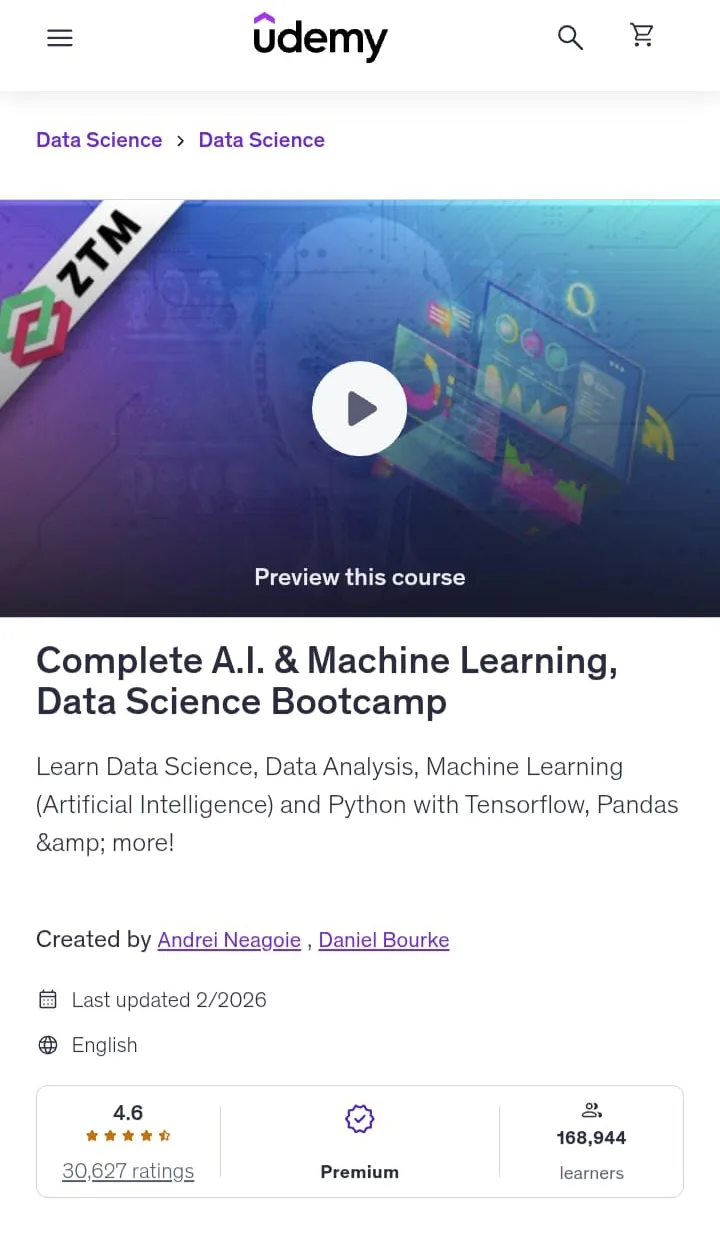
What makes this course different from most on this list is who built it. Andrei Neagoie is one of Udemy’s highest-rated instructors with over a million students taught across his courses.
Daniel Bourke is a self-taught ML engineer who worked at one of Australia’s fastest-growing AI agencies, building real models for healthcare and insurance companies before switching to teaching.
Between them, you get both the structured pedagogy of an expert instructor and the real-world grittiness of someone who learned ML the hard way and knows exactly where beginners get stuck.
What You’ll Learn
The course covers the full data science and ML pipeline: Python fundamentals, NumPy, Pandas, Matplotlib, Scikit-learn, TensorFlow 2.0, deep learning, transfer learning, and neural networks.
Alongside the technical toolkit, you’ll work through a framework for how to approach ML problems, which is something most courses overlook entirely.
You’ll also learn data engineering concepts and how tools like Hadoop, Spark, and Kafka fit into the larger industry picture.
Course Structure
The course runs approximately 45 hours across 384 lessons. It’s built around two distinct learning paths: one starting from absolute zero (including Python from scratch, taught by Andrei), and one that skips straight into ML for those who already know how to code.
Three end-to-end milestone projects anchor the curriculum.
You’re not just following along; you’re building complete workflows the way a working ML engineer actually would. All code, notebooks, and materials are publicly available on GitHub, and the first 10 hours are freely watchable on YouTube if you want to test the teaching style before buying.
Prerequisites
No prior experience is needed, not even math or statistics. The dual-path structure means both complete beginners and developers looking to pivot into ML are well served without either group sitting through content they don’t need.
Duration
45 hours of video content. At 8 to 10 hours per week, expect 5 to 6 weeks to complete it comfortably, though the project work will add time depending on how deep you go.
Certificate
You will receive a Udemy certificate of completion. You can also add Zero To Mastery Academy to the education section of your LinkedIn profile.
Best For
Complete beginners who want a single, project-driven course that takes them from zero Python knowledge to building real ML workflows, especially those who want to understand the why behind what they’re doing, not just watch someone code for hours.
8. The Complete Machine Learning Course with Python – Codestars by Rob Percival & Anthony NG – Udemy
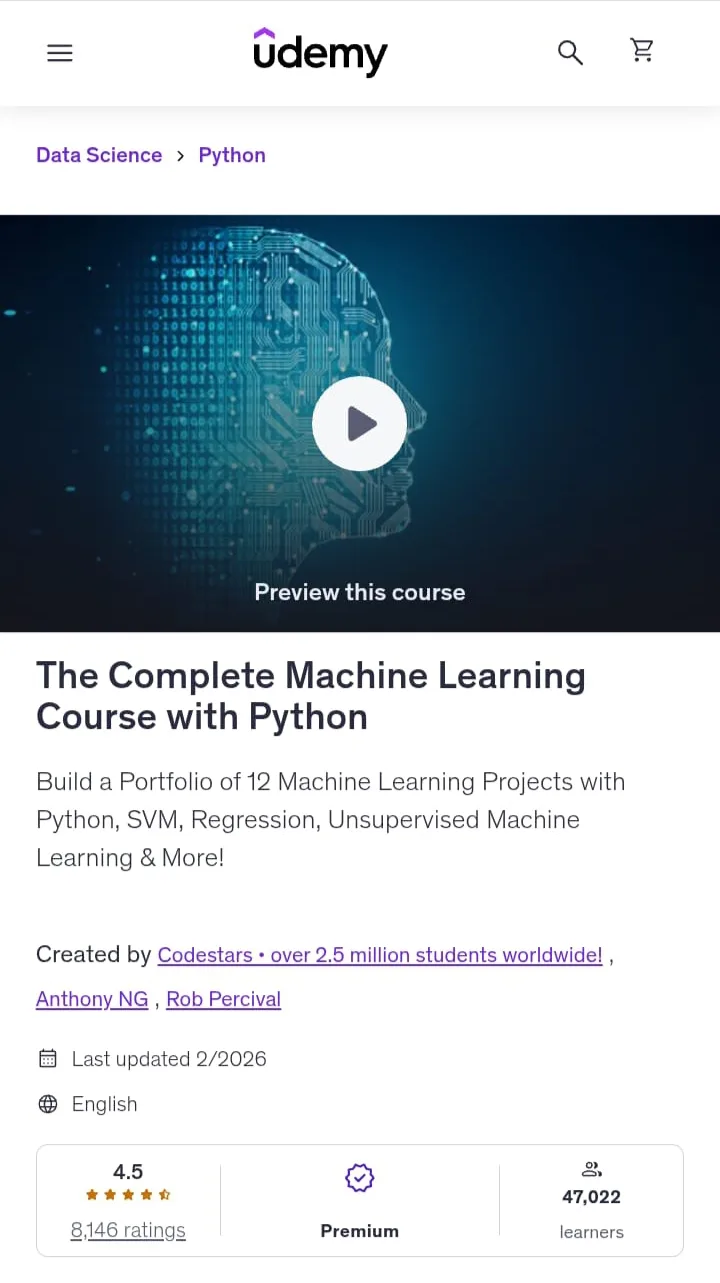
Rob Percival built Codestars around a single teaching philosophy: learn by building real projects, not by watching theory slide after theory slide.
This course, delivered by Anthony NG, a Senior Lecturer from Singapore with years of experience in financial data analysis and algorithmic trading, brings that same project-first approach to machine learning.
The result is a course that’s deliberately hands-on and accessible, built for people who want to see ML working on real problems before they worry about the math behind it.
What You’ll Learn
You’ll work through the core ML toolkit in Python: regression, classification, clustering, and unsupervised learning, and go beyond the basics into deep learning with neural networks and computer vision with CNNs.
Performance metrics get real attention here: R-squared, MSE, accuracy, confusion matrices, precision and recall are all covered with proper context for when to use which.
Bagging, boosting, and stacking are included for model combining. You’ll also work with Seaborn and Matplotlib to communicate findings visually, which matters more in real jobs than most courses acknowledge.
Course Structure
The course is built around 12 machine learning projects, each tackling a different domain and problem type.
You’ll train models to classify iris flowers, predict house prices, identify handwritten digits, detect cancer cells, flag employees likely to leave, and more.
Each algorithm is built with you step by step on screen, not handed to you as a finished template.
Prerequisites
No prior machine learning knowledge required. Basic Python familiarity is helpful but not strictly necessary. The course is also listed as a good stepping stone for intermediate-to-advanced Excel users who are ready to move into programming-based data work.
Duration
Approximately 16.5 to 18 hours of video content. Compact and focused; this isn’t a course that pads its runtime. At a pace of 5 to 6 hours per week, you can finish it in 3 to 4 weeks and walk away with a portfolio of 12 completed projects.
Certificate
The course provides learners with a standard Udemy certificate of completion. The course also qualifies for the Codestars Certificate Authority (CCA) credential, which requires passing a separate exam via the Codestars platform.
Best For
Beginners who want to build a tangible portfolio of ML projects quickly, without sitting through weeks of theory first. Particularly good for those who are visual learners or come from a finance or business background and want to see ML applied to real-world decisions fast.
9. Data Science and Machine Learning Fundamentals – Udemy
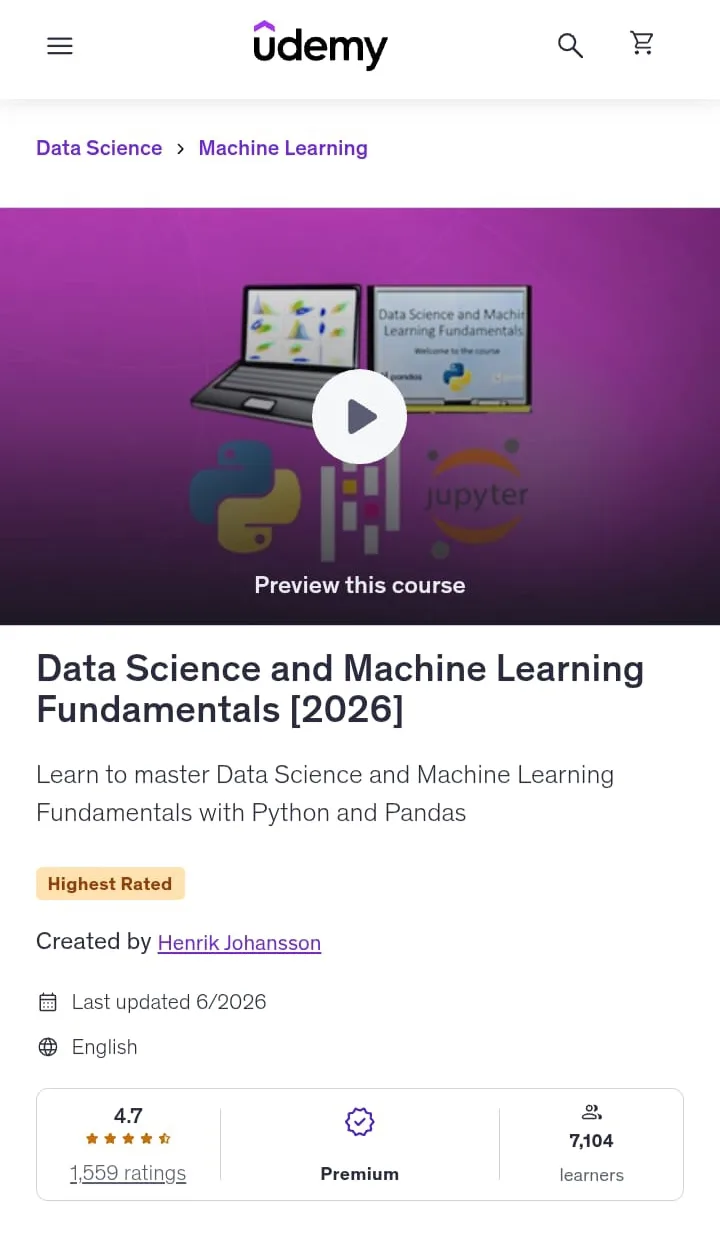
While most beginner ML courses pick one or two areas and go deep, this one takes a different approach.
It’s built to give you genuine working knowledge across the full breadth of data science and ML fundamentals in a single course.
It covers regression, classification, clustering, text mining, and sentiment analysis, all underpinned by solid theory and hands-on Python practice. What stands out is how seriously it treats regression.
The course claims to offer the most complete master-level regression content package on Udemy, going from basic linear models all the way up to advanced multivariate polynomial regression with automatic model building and AI-driven feature selection.
What You’ll Learn
You’ll cover supervised learning through regression and classification, unsupervised learning via seven clustering algorithms (from hierarchical models to density-based methods), and text analysis including text mining, emotion mining, and sentiment analysis on large-scale Twitter/X datasets with millions of records.
On the tooling side, you’ll get hands-on with Scikit-learn, Statsmodels, Matplotlib, and Seaborn. There’s also a cloud computing component.
You’ll learn to use the Anaconda Cloud Notebook, a browser-based Jupyter environment, which means zero local setup issues and the ability to learn from any device.
Course Structure
The course is organized around its five main pillars: regression and prediction, classification, cluster analysis, text mining, and emotion mining/sentiment analysis.
Each section balances practical theory with hands-on implementation, so you’re not just copying code, but building genuine intuition for why each algorithm works the way it does.
The optional Anaconda setup section (nearly an hour long) gives thorough coverage for those who want a local environment, while the cloud notebook option lets absolute beginners skip that friction entirely.
Prerequisites
No prior machine learning or data science experience required. The course is framed as suitable for both complete beginners and experienced data scientists who want to fill gaps or gain a deeper understanding of the fundamentals.
Basic familiarity with Python is helpful but not strictly required.
Duration
The course is self-paced with flexible access. Content depth suggests a multi-week commitment at a moderate learning pace. It’s substantive enough to serve as both an introduction and a reference you’ll return to.
Certificate
Yes, a standard Udemy certificate of completion with lifetime access to course materials, including any future updates.
Best For
Beginners who want genuine depth across all core ML areas, especially those with an interest in text analytics, NLP, and sentiment analysis alongside traditional regression and classification.
Also a strong choice for anyone who wants to approach ML from a solid theoretical foundation before jumping into deep learning.
10. Machine Learning, Data Science & AI Engineering with Python – Frank Kane (Sundog Education) – Udemy
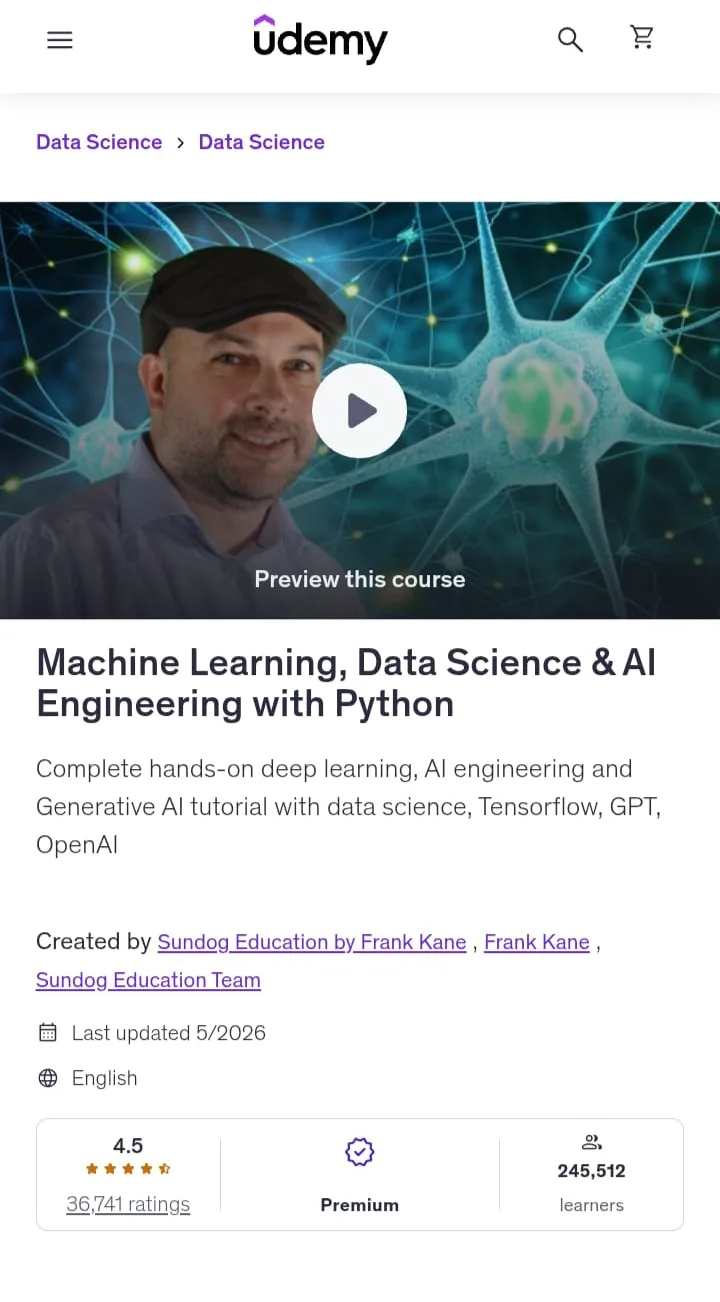
Frank Kane isn’t a career educator who learned ML from books.
He spent 9 years at Amazon and IMDb building the actual recommendation systems that delivered product and movie suggestions to hundreds of millions of customers, and he holds 26 patents in distributed computing, data mining, and machine learning.
When he teaches you how recommender systems work, he’s explaining something he built at scale for one of the world’s largest companies.
That real-world credibility runs through every part of this course, and it’s why over a million students have learned from him through Sundog Education.
What You’ll Learn
The course spans the full modern ML and AI stack. On the classical ML side: regression (linear, polynomial, multivariate), K-Means clustering, SVMs, KNN, decision trees, Naive Bayes, PCA, and collaborative filtering for building recommender systems.
On the deep learning side: neural networks with TensorFlow and Keras, image classification, sentiment analysis, and transfer learning.
The generative AI additions, added in recent updates, cover how ChatGPT works under the hood, the OpenAI API, Retrieval-Augmented Generation (RAG), variational autoencoders, GANs, and LLM agents using the OpenAI Agents SDK.
For scale, there’s also a section on Apache Spark’s MLLib for running ML on massive datasets. The topics were deliberately chosen by analysing actual data scientist job listings from major tech companies.
Course Structure
Over 145 lectures and 21+ hours of video content, built around practical Python projects and real-world use cases.
The course is divided into 17 structured sections, moving progressively from Python and statistics foundations through classical ML, deep learning, generative models, and finally big data with Apache Spark.
Every concept is reinforced with hands-on activities, so you’re not just watching; you’re running code from the first session. The movie recommender system project is a standout; it’s the kind of real application that actually ends up on resumes.
Prerequisites
Some prior coding or scripting experience is required. This isn’t a course for people who have never written a line of code. High school-level math is sufficient.
Data analysts and developers switching into ML are the core audience, though the Python crash course included helps bridge gaps for those with lighter scripting backgrounds.
Duration
21+ hours of video content across 145+ lectures. Focused and efficiently paced, Frank is known for respecting learners’ time and cutting straight to what matters rather than padding content.
Certificate
Yes, a standard Udemy certificate of completion with lifetime access. The course is regularly updated, so your access includes new content additions.
Best For
Programmers or analysts with some scripting experience who want a practitioner-level course taught by someone with genuine industry credentials, especially those who want classical ML, deep learning, and generative AI covered in a single course without having to jump between multiple resources.
Which Machine Learning Course Is Right for You?
No single course works for everyone. Your background, how much time you have, and what you’re trying to achieve all change the answer. Here’s a direct recommendation based on where you’re starting from.
For Complete Beginners
If you’ve never touched code and ML feels overwhelming, start with Machine Learning for All by the University of London.
It requires zero technical background, builds genuine conceptual understanding, and gets you training on a real model, no math, no Python, no excuses.
Once you’ve finished it, the Machine Learning Specialization by Andrew Ng is the natural next step.
For Students
Mathematics for Machine Learning by Imperial College London is the smartest move for students who want to go deep.
It builds the linear algebra and calculus foundation that makes every future ML course easier.
Pair it with IBM’s Machine Learning with Python for hands-on implementation skills that hold up in academic projects and internship applications.
For Working Professionals
Machine Learning A-Z by Kirill Eremenko and Hadelin de Ponteves covers the full pipeline from data preprocessing to AWS deployment, without requiring you to take five separate courses to get there. It’s built for people with limited time who need maximum coverage.
For Career Changers
The Machine Learning Specialization by Andrew Ng is the strongest signal you can show a hiring manager when switching fields.
It’s from Stanford and DeepLearning.AI, the certificate is widely recognized, and the curriculum mirrors what actual ML engineers use day to day, which matters when you’re competing against candidates with CS degrees.
Do You Need Coding Skills Before Learning Machine Learning?
The honest answer: it depends on the course, not the subject.
Some courses on this list, like Machine Learning for All, require zero coding. Others, like Frank Kane’s course, expect you to walk in with scripting experience. Most fall somewhere in the middle.
For the majority of beginner ML courses, basic Python is enough: loops, functions, and libraries like NumPy and Pandas. You don’t need advanced math either; high school algebra and statistics fundamentals cover 80% of what you’ll encounter early on.
Start with the course that matches where you are right now, not where you think you should be.
How Long Does It Take to Learn Machine Learning?
It depends entirely on your goal and your pace.
Casual learners exploring ML concepts can get a working understanding in 4 to 6 weeks at a few hours per week.
Students building academic foundations typically need 3 to 6 months to cover ML properly alongside math prerequisites.
Job seekers targeting their first ML role realistically need 6 to 12 months; enough time to complete a solid course, build 2 to 3 portfolio projects, and get comfortable explaining your work in interviews.
A practical roadmap: start with Python basics → ML fundamentals → hands-on projects → specialize. Don’t skip the projects. That’s where learning becomes employable.
Frequently Asked Questions
Which machine learning course is best for beginners?
Andrew Ng’s Machine Learning Specialization on Coursera is the most recommended starting point. It builds intuition before code, covers real workflows, and is trusted by hiring managers globally.
Can I learn machine learning without coding?
Yes. The University of London’s Machine Learning for All on Coursera requires zero coding. It teaches genuine ML concepts and lets you train a real model entirely without writing code.
Is Python required for machine learning?
Not to start, but practically, yes. Python is the industry standard for ML. Most job listings expect it, and nearly every professional ML tool is built around it.
Can I get a job after completing a machine learning course?
A course alone won’t land you a job, but a course plus 2 to 3 strong portfolio projects absolutely can. Employers hire for demonstrated skills, not certificates.
Final Verdict
After reviewing all ten courses on this list, three things are clear.
Non-technical? Machine Learning for All is genuinely the least intimidating entry point on the internet right now.
Want a credential that holds up in job interviews? Andrew Ng’s Specialization is still the one recruiters recognize without needing an explanation.
Ready to go from preprocessing to AWS deployment without juggling multiple courses? Machine Learning A-Z covers that entire journey under one roof.
You now have more information than most people who’ve been “thinking about learning ML” for months.
Pick one course from this list, open it today, and run the first piece of code. That single action separates learners from people who just read about learning.
Related Articles
Deep Learning Vs Machine Learning: What is The Difference?
Best Artificial Intelligence Courses Online
Best Deep Learning Courses Online
Best Free Python Courses on Udemy

TechnicalStudies was started by Neeladrinath with one simple idea — give Indian students a reliable place to figure out what’s actually worth their time and money. Every recommendation here is backed by careful research, real student feedback, and honest analysis. We cover online courses, laptops, smartwatches, software deals, and learning resources — all looked at from a student’s perspective, so you can spend less time guessing and more time learning.