Watching hours of deep learning tutorials feels productive until you try to build something from scratch and realize you can’t. That’s the trap of passive learning.
Project-based courses flip the script: you write real code, debug real errors, and walk away with something you actually built. That struggle is where the learning sticks.
So what separates a course worth your money from one that’s just another video library?
A few things: hands-on coding from day one, projects that mirror real-world problems (not toy datasets), active instructor support or community, and content that stays current with tools like PyTorch and TensorFlow rather than teaching outdated syntax.
This guide is for anyone ready to move past theory – beginners who want a structured path into AI, developers pivoting into machine learning roles, and self-taught learners tired of tutorial hell.
If you can write basic Python and want to actually build neural networks instead of just watching someone else do it, you’re in the right place.
To pick these courses, we looked at curriculum depth, project quality, instructor expertise, student outcomes, and value for money, not just star ratings. Let’s get into it.
How We Selected These Courses
Most “best courses” lists just reshuffle Udemy bestseller rankings. We didn’t do that. Each course on this list was evaluated against nine specific criteria, and courses that failed even one or two got cut regardless of enrollment numbers or reviews.
Project quality mattered most. We rejected courses where “projects” meant filling in three lines of pre-written code. A real project means you architect the model, choose hyperparameters, and debug your own mistakes.
Industry relevance filtered out courses teaching techniques nobody uses in production anymore, like a heavy focus on plain feedforward networks without touching transformers or CNNs.
Framework coverage was non-negotiable. If a course still centers entirely on Keras with no PyTorch exposure, it’s teaching yesterday’s job market.
Beginner friendliness was judged by whether math prerequisites were actually explained, not just assumed.
Instructor reputation came from checking actual publication history, industry experience, or production ML work, not just subscriber counts.
Community support meant checking if forums or Discord servers had active recent activity, not a graveyard of unanswered 2021 posts.
Certificate value was tested by seeing whether recruiters and LinkedIn actually recognize the credential, or if it’s just a PDF for your desktop folder.
Regular updates ruled out courses last touched before transformer architectures became mainstream.
Career applicability meant checking if graduates land interviews citing these specific skills, not vague “success story” testimonials.
Worth Checking: Best Machine Learning Courses for Beginners: Start Learning ML the Right Way
Quick Comparison Table – Best Deep Learning Courses with Hands-On Projects
| Course | Best For | Projects | Framework | Certificate | Duration | Level | Price |
|---|---|---|---|---|---|---|---|
| Deep Learning Specialization (DeepLearning.AI) | Early-career engineers wanting deep theoretical grounding | CNNs, style transfer, RNNs, NER/QA with Transformers | TensorFlow, Hugging Face | Yes (Coursera) | ~3 months, 10 hrs/wk | Intermediate | Coursera subscription |
| IBM Deep Learning with PyTorch, Keras & TensorFlow | Professionals pivoting into AI/DL engineering roles | Image classifiers, capstone geospatial classification | PyTorch, Keras, TensorFlow | Yes (Coursera/IBM) | ~2 months, 10 hrs/wk | Intermediate | Coursera subscription |
| PyTorch for Deep Learning (DeepLearning.AI) | Learners wanting deep PyTorch specialization + deployment | Text classification, image segmentation, paper-style architectures | PyTorch, ONNX, MLflow | Yes (Coursera) | ~2 months, 10 hrs/wk | Intermediate | Coursera subscription |
| Deep Learning with Python: CNN, ANN & RNN (EDUCBA) | True beginners wanting a fast, structured intro | Image classification, churn prediction, stock forecasting | TensorFlow, Keras | Yes (Coursera/EDUCBA) | ~4 weeks, 10 hrs/wk | Beginner | Coursera subscription |
| Learning Deep Learning (Pearson) | Devs wanting fundamentals bridged straight to LLMs | Image classification, translation, multimodal networks | TensorFlow, PyTorch | Yes (Coursera/Pearson) | ~4 weeks, 5 hrs/wk | Intermediate | Coursera subscription |
| A Deep Understanding of Deep Learning (Mike X. Cohen) | Learners who want the “why,” not just working code | ANN/CNN/RNN builds, GPU-based training | PyTorch, NumPy | Yes (Udemy) | Self-paced, 40+ hrs | Beginner–Advanced | One-time Udemy purchase |
| Deep Learning A-Z 2026 (Eremenko & de Ponteves) | Broad coverage of classic architectures in one course | Image/text classifiers, SOM, Boltzmann Machine, recommender systems | TensorFlow, PyTorch, AWS | Yes (Udemy) | Self-paced, ~22–23 hrs | Beginner–Intermediate | One-time Udemy purchase |
| PyTorch for Deep Learning Bootcamp (Neagoie & Bourke) | Job-ready PyTorch skills with real deployment experience | Transfer learning, experiment tracking, paper replication, live deployment | PyTorch (incl. 2.0/torch.compile) | Yes (Udemy) | Self-paced, comprehensive | Beginner–Advanced | One-time Udemy purchase |
| Tensorflow 2.0: Deep Learning & AI (Lazy Programmer) | Wide tour across CV, NLP, GANs, and reinforcement learning | NLP, recommender systems, GANs, stock trading bot | TensorFlow 2 | Yes (Udemy) | Self-paced, extensive | Beginner–Expert | One-time Udemy purchase |
| Practical Deep Learning: Master PyTorch in 15 Days (Seemann) | Absolute beginners wanting a clear daily roadmap | Price prediction, spam detection, digit/fashion classification, Gradio deployment | PyTorch, Gradio | Yes (Udemy) | 15-day structured plan | Beginner | One-time Udemy purchase |
Best Deep Learning Courses with Hands-On Projects
1. Deep Learning Specialization (DeepLearning.AI)
If you want the course that basically defines how the internet teaches deep learning, this is it.
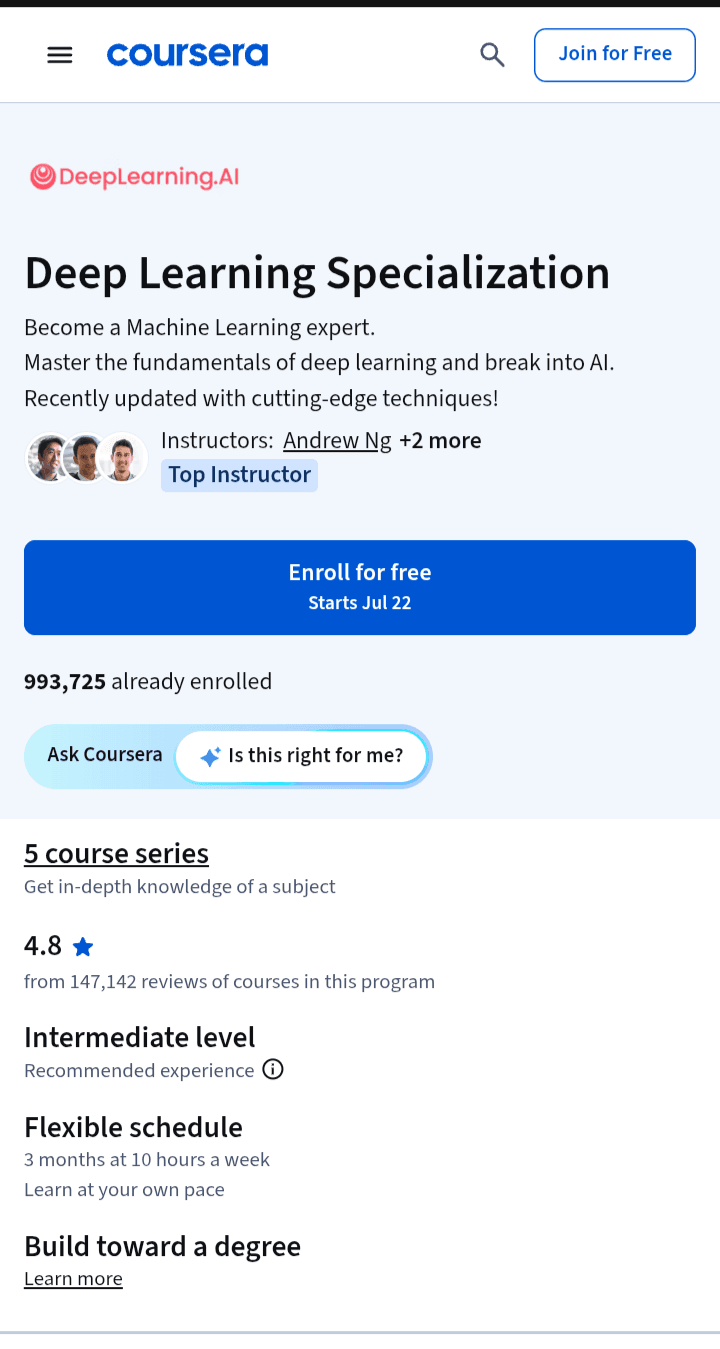
Created by Andrew Ng, alongside Kian Katanforoosh and Younes Bensouda Mourri, the Deep Learning Specialization is a foundational program built to help you understand the capabilities, challenges, and consequences of deep learning while preparing you to work on real AI systems.
It’s a five-course series, and as of its most recent update, every assignment and autograder across Courses 1, 2, 4, and 5 has been refactored for TensorFlow 2, with newer additions like MobileNet, U-Net, and Transformer architectures folded into the curriculum.
Skills you’ll learn
You’ll go from building your first neural network to architecting Convolutional Neural Networks, Recurrent Neural Networks, LSTMs, and Transformers, plus techniques like Dropout, BatchNorm, and Xavier/He initialization.
Hands-on projects
Course 4 has you building CNNs (including residual networks), applying them to visual detection and recognition tasks, and running neural style transfer to generate art.
Course 5 covers building RNNs and their variants like GRUs and LSTMs, applying them to character-level language modeling, and using HuggingFace tokenizers and transformer models for tasks like Named Entity Recognition and Question Answering.
Tools covered
TensorFlow and Hugging Face, taught through practical, applied coding rather than pure theory.
Time commitment
Roughly 3 months at 10 hours a week, spread across five courses (25–37 hours each individually).
Best for
Early-career software engineers or technical professionals who want to master fundamental deep learning concepts and gain practical, applicable skills. You’ll need basic Python and preferably some familiarity with linear algebra going in.
2. IBM Deep Learning with PyTorch, Keras and TensorFlow
If the DeepLearning.AI Specialization is the academic route, this IBM Professional Certificate is the framework-agnostic, job-market-focused alternative.
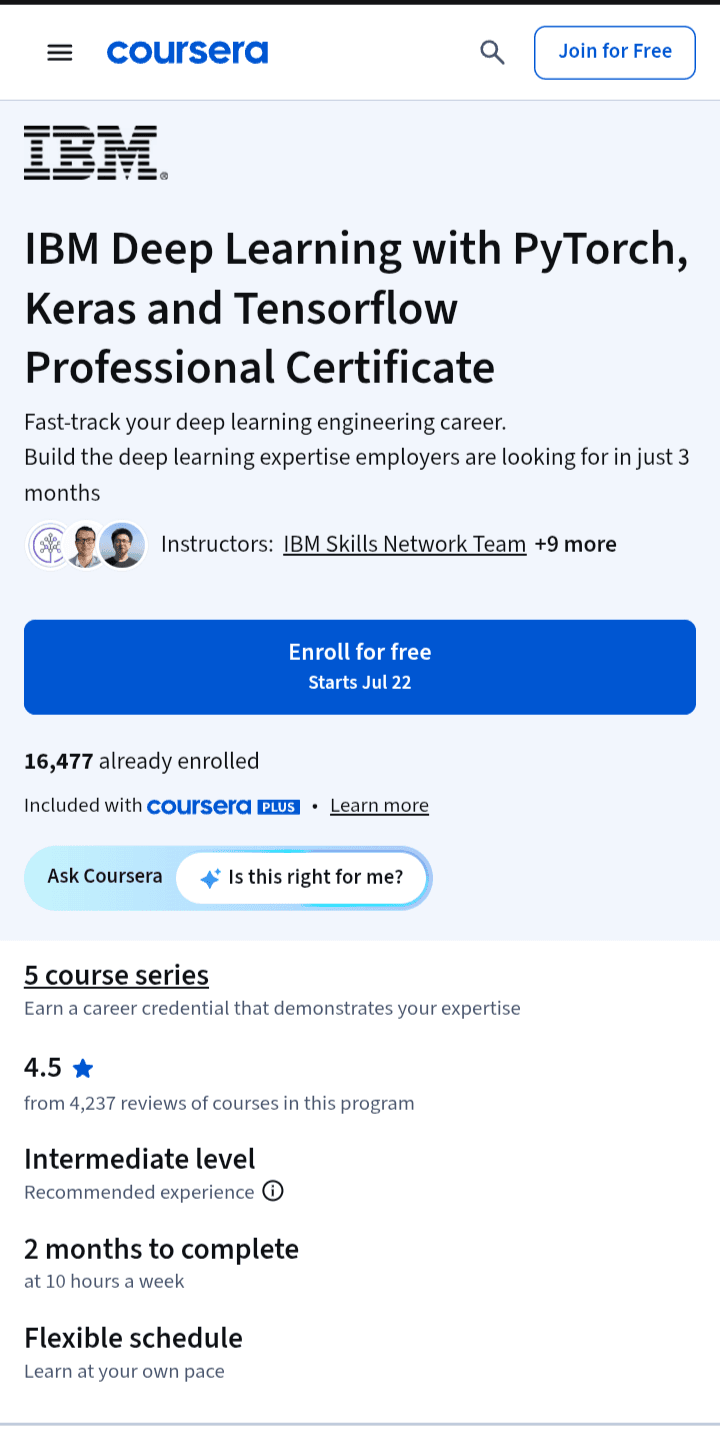
It’s a five-course series built around one core idea: employers don’t care which framework you know theoretically, and they want you fluent in all three major ones.
The program takes learners through Keras, PyTorch, and TensorFlow in sequence, ending in a capstone project you can actually put in a portfolio.
Skills you’ll learn
You’ll start with foundational neural network concepts and Keras basics, then move into building custom layers, integrating Keras with TensorFlow 2.x, and developing transformer models for sequential and time-series data.
On the PyTorch side, you’ll work with tensors, autograd, and DataLoader, building up from linear regression to full CNN architectures with dropout, weight initialization, and batch normalization.
Also Read: Keras vs PyTorch: which framework should you use?
Hands-on projects
This program leans hard into portfolio-building. You’ll construct deep learning models for regression and classification, build advanced CNNs and vision transformers, and in the final capstone, design a complete deep learning pipeline – data loading, augmentation, model validation – applied to real image classification problems, including geospatial land classification.
Tools covered
PyTorch, Keras, and TensorFlow, plus exposure to autoencoders and GANs.
Time commitment
Roughly 2 months at 10 hours a week, self-paced, included with Coursera Plus.
Best for
Professionals already working in adjacent roles, data scientists, software engineers, ML engineers, Python developers, who want to formally transition into an AI or deep learning engineering role and need multi-framework fluency to compete for those jobs.
3. PyTorch for Deep Learning
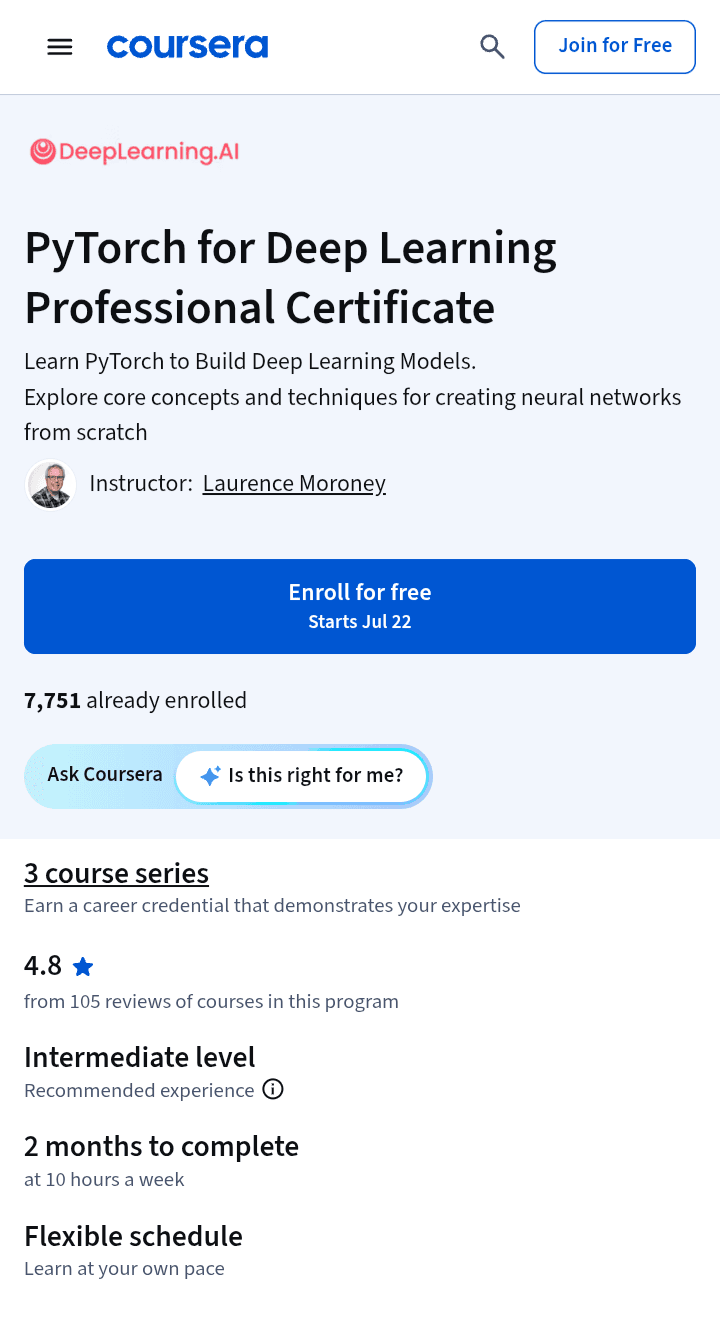
This is a three-course DeepLearning.AI series taught by Laurence Moroney, built entirely around the framework most research labs and production AI teams actually use.
Where the IBM certificate spreads across three frameworks, this one goes deep on a single tool, taking you from tensors and training loops all the way to deployment-ready model optimization.
Skills you’ll learn
You’ll master PyTorch’s core building blocks, tensors, autograd, and training pipelines, then move into transfer learning and fine-tuning for computer vision and NLP tasks.
The final course pushes into advanced territory: Siamese networks, ResNet, DenseNet, Transformers, and diffusion models, alongside model compression techniques like pruning and quantization.
Hands-on projects
You’ll build neural networks from scratch and construct a complete training pipeline in Course 1.
Course 2 has you working with TorchVision and Hugging Face to process image and text data, optimizing models through hyperparameter tuning.
By Course 3, you’re tackling portfolio-grade projects like text classification and image segmentation, then preparing trained models for real deployment using ONNX and MLflow.
Tools covered
PyTorch, TorchVision, Hugging Face, ONNX, and MLflow. A genuinely production-oriented toolkit rather than just classroom libraries.
Time commitment
About 2 months at 10 hours a week across three courses (24, 33, and 31 hours respectively).
Best for
Learners who already know they want to specialize in PyTorch specifically, whether that’s because their target job listings demand it or because they want deployment skills (not just model-building) baked into their learning path. Intermediate-level background recommended.
4. Deep Learning with Python: CNN, ANN & RNN (EDUCBA)
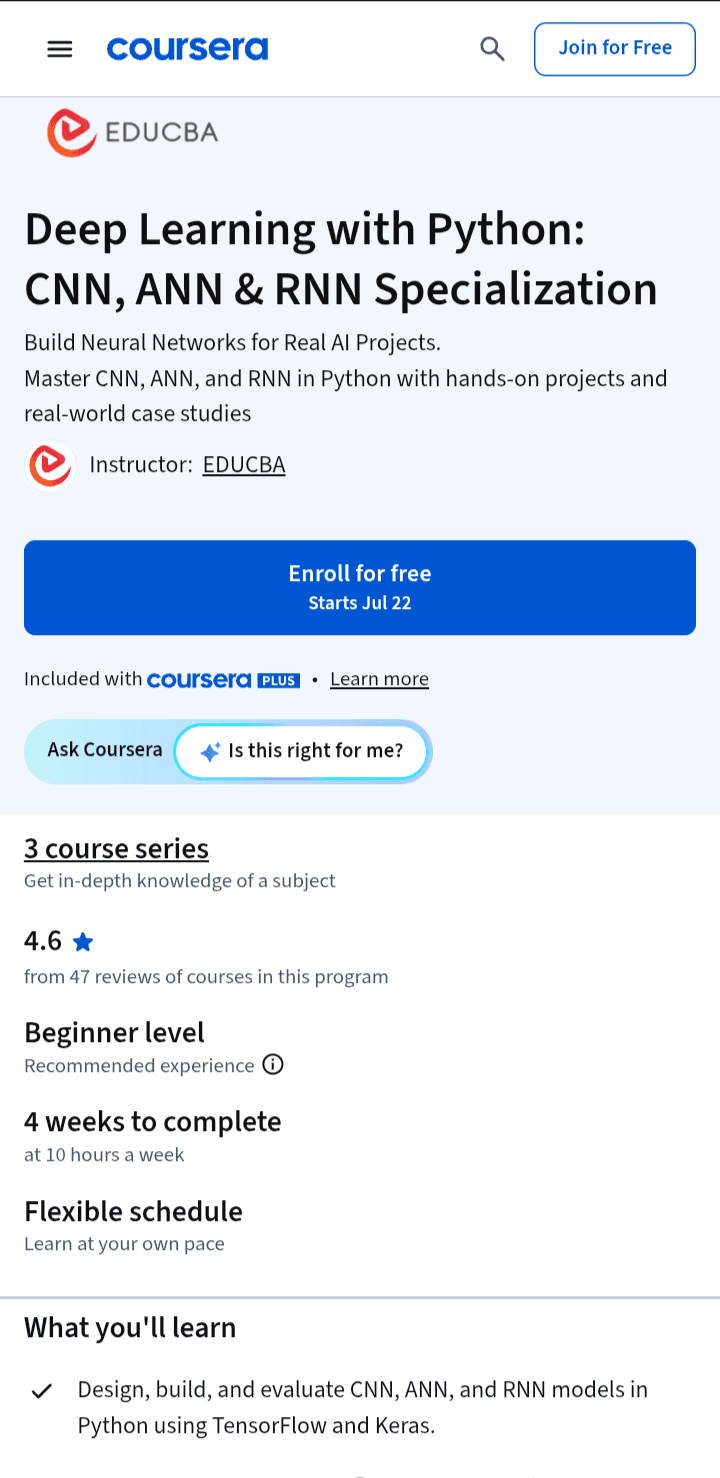
This EDUCBA specialization is built for one specific purpose: getting beginners comfortable with the three foundational neural network architectures fast.
It’s a compact, three-course series that trades the depth of programs like DeepLearning.AI’s Specialization for speed and directness, walking through ANNs, CNNs, and RNNs using bite-sized, project-anchored courses.
Skills you’ll learn
You’ll design, build, and evaluate CNN, ANN, and RNN models in Python using TensorFlow and Keras, along with preprocessing, feature engineering, and optimization techniques applied to real datasets rather than toy examples.
Hands-on projects
Each course centers on one concrete business or financial problem.
Course 1 has you preprocessing and augmenting image datasets to build and evaluate a CNN for image classification.
Course 2 shifts to structured data, building and optimizing an ANN for customer churn prediction, including handling imbalanced datasets.
Course 3 closes with an RNN using LSTM layers for stock price prediction, covering feature scaling, exploratory data analysis, and prediction visualization on real market data.
Tools covered
Python, TensorFlow, and Keras.
Time commitment
Listed as roughly 4 weeks at 10 hours a week, though Coursera’s FAQ also cites a lighter 5 – 6 weeks at 3 – 4 hours weekly, so pace is genuinely flexible depending on how deep you go into each project.
Best for
True beginners who want a fast, structured introduction to the three core neural network types without wading through a long, multi-month specialization first.
It’s a solid on-ramp before tackling something denser like the DeepLearning.AI or IBM programs.
5. Learning Deep Learning (Pearson)
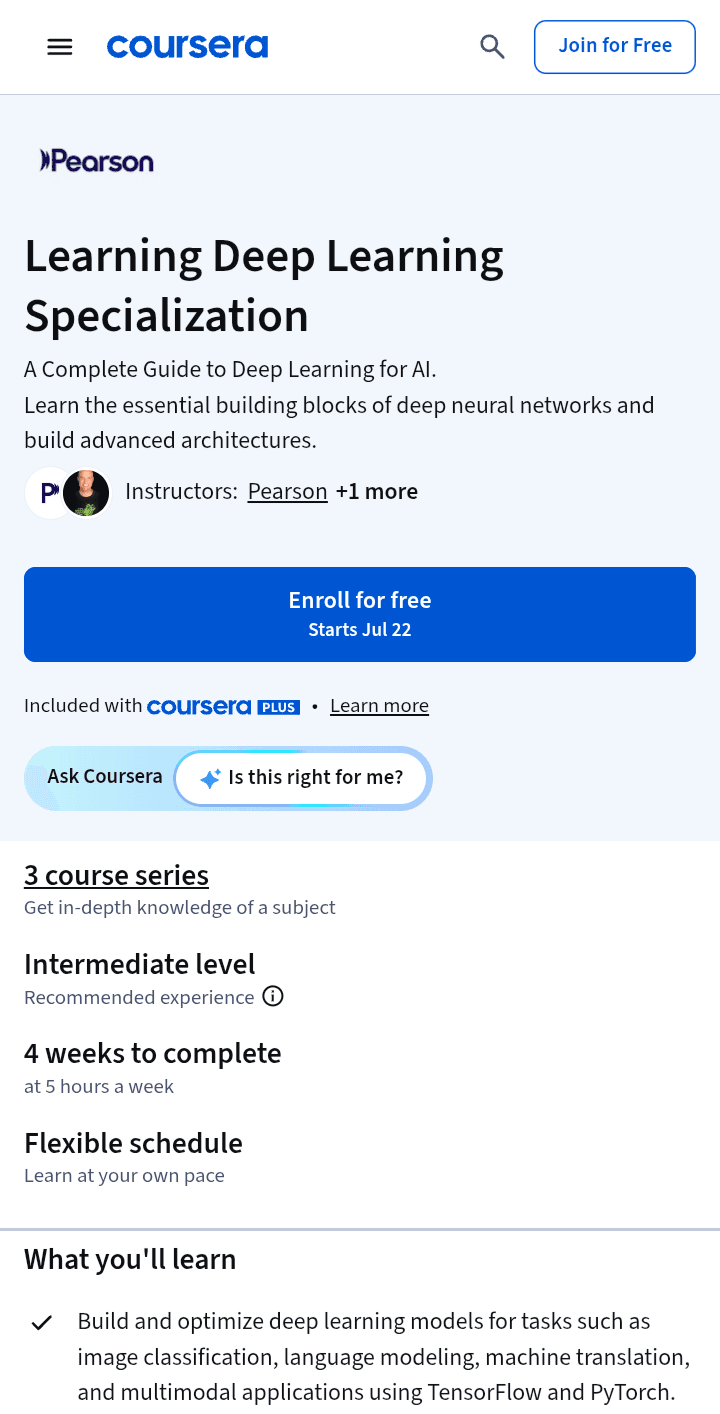
This one stands out for its scope: it’s the only course on this list that takes you all the way from basic perceptrons to large language models and multimodal AI in a single, tight three-course arc.
Built by Pearson and taught alongside author Magnus Ekman (based on the “Learning Deep Learning” book), this specialization moves fast, roughly 19 hours total, but doesn’t skip the modern stuff most beginner courses leave out.
Skills you’ll learn
You’ll cover neural network fundamentals and training algorithms first, then move into CNNs and RNNs with LSTMs, encoder-decoder architectures, and Transformers.
The final course goes further than most beginner-friendly programs by tackling large language models, multimodal networks that combine text and images, and multitask learning, plus the ethical considerations of deploying these models in the real world.
Also Check: 11 Data Science Mistakes Beginners Make (And How to Avoid Them)
Hands-on projects
Guided by real programming examples in both TensorFlow and PyTorch, you’ll build and evaluate neural networks, apply CNNs to advanced image classification, use RNNs for time-series forecasting and text autocompletion, develop neural language models with word embeddings, and design Transformer-based systems for machine translation.
Course 3 pushes into object detection, segmentation, and building multimodal networks that integrate multiple data types.
Tools covered
TensorFlow, PyTorch, and hands-on prompt engineering as part of the LLM-focused final unit.
Time commitment
About 4 weeks at 5 hours a week. Noticeably lighter than most specializations on this list, making it a good fit if you want breadth without a multi-month commitment.
Best for
Developers, data scientists, and analysts with some technical background who want one course that connects classic deep learning fundamentals directly to today’s LLM and multimodal AI landscape, rather than treating those as a separate, later topic.
6. A Deep Understanding of Deep Learning (with Python Intro)
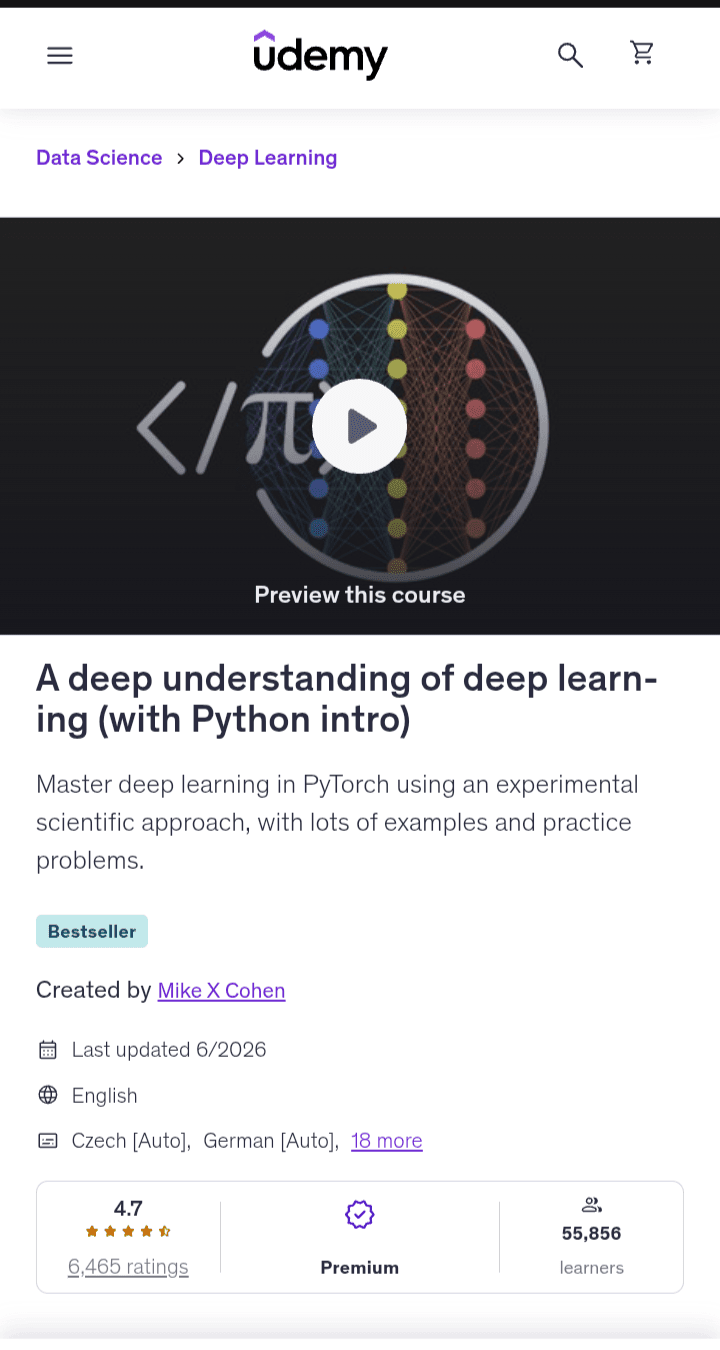
Created by Mike X. Cohen, a neuroscientist and computational science instructor, this Udemy course takes a completely different approach from the university-backed specializations above.
It’s not built to check certification boxes; it’s built to make you actually understand why deep learning works, not just how to copy-paste working code.
The course is explicit about who it isn’t for: if you want a quick overview with a handful of solved examples, look elsewhere.
This is for people who want to understand metaparameter selection, model evaluation, and how to adapt existing architectures to new problems.
Skills you’ll learn
You’ll build a genuine mathematical and conceptual foundation – gradient descent, calculus as it applies to neural networks, and the architectural differences between feedforward, convolutional, and recurrent networks.
Cohen calls this an “experimental scientific approach,” meaning you’re encouraged to test and probe models rather than just accept how they behave.
Hands-on projects
The course includes an 8+ hour Python tutorial built in, so true beginners aren’t locked out. From there, you’re building artificial neural networks and full models in PyTorch, working through practice problems, and using GPUs to speed up training.
Tools covered: Python, PyTorch, NumPy.
Time commitment
Self-paced, with substantial total video content (approx 58+ hours); no fixed weekly schedule since it’s a single lifetime-access purchase rather than a subscription model.
Best for
Learners who’ve already dabbled in deep learning tutorials and felt like something was missing. It suits people willing to slow down and treat deep learning as applied math rather than a copy-paste skill, and who want an active Q&A community for troubleshooting along the way.
7. Deep Learning A-Z 2026: Neural Networks, AI, AWS & LLM Prize
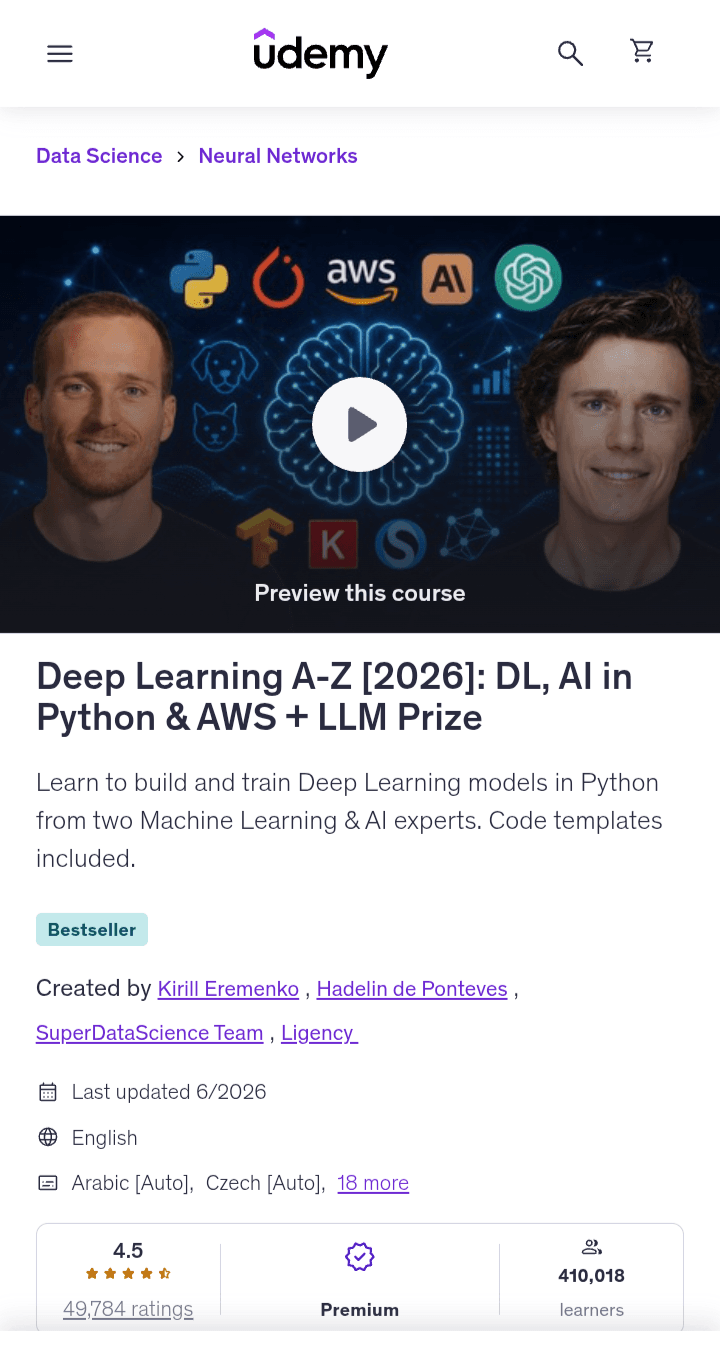
This is a six-part curriculum from Kirill Eremenko, Hadelin de Ponteves, and the SuperDataScience Team that covers nearly every major deep learning architecture in one package, from classic ANNs all the way to Boltzmann Machines and AutoEncoders.
It’s built around a clear philosophy: pair intuition-first explanations with immediate hands-on implementation, so you understand the “why” before touching code.
Skills you’ll learn
The course walks through Artificial Neural Networks, Convolutional Neural Networks, Recurrent Neural Networks, Self-Organizing Maps, Boltzmann Machines, and AutoEncoders – each introduced with an “intuition” module before the implementation module.
That structure means you’re not just memorizing syntax; you’re learning why each architecture exists and what problem it was built to solve.
Hands-on projects
This is where the course earns its reputation. You’ll build image and text classifiers (including a cats-vs-dogs image classifier you can test on your own photos), work with recurrent networks that use long-term memory via LSTMs for tasks like stock price prediction, build a Self-Organizing Map, construct a Boltzmann Machine in PyTorch, and finish by building two full recommender systems, one for e-commerce and one for movie recommendations, deployed with AWS integration across several modules.
Tools covered: Python, TensorFlow, PyTorch, and AWS for select deployment-focused sections.
Time commitment
Around 22 – 23 hours of on-demand video, self-paced with lifetime access, so no fixed weekly schedule, though the six-part structure lends itself well to working through it in stages.
Best for
Beginners and intermediate learners who want one broad, affordable course covering the full landscape of classic deep learning architectures, rather than a narrow deep-dive into a single framework.
It’s a strong pick if you want breadth and a large body of hands-on projects to reference later, though it leans more toward classic architectures than cutting-edge transformer/LLM-first coursework.
8. PyTorch for Deep Learning Bootcamp
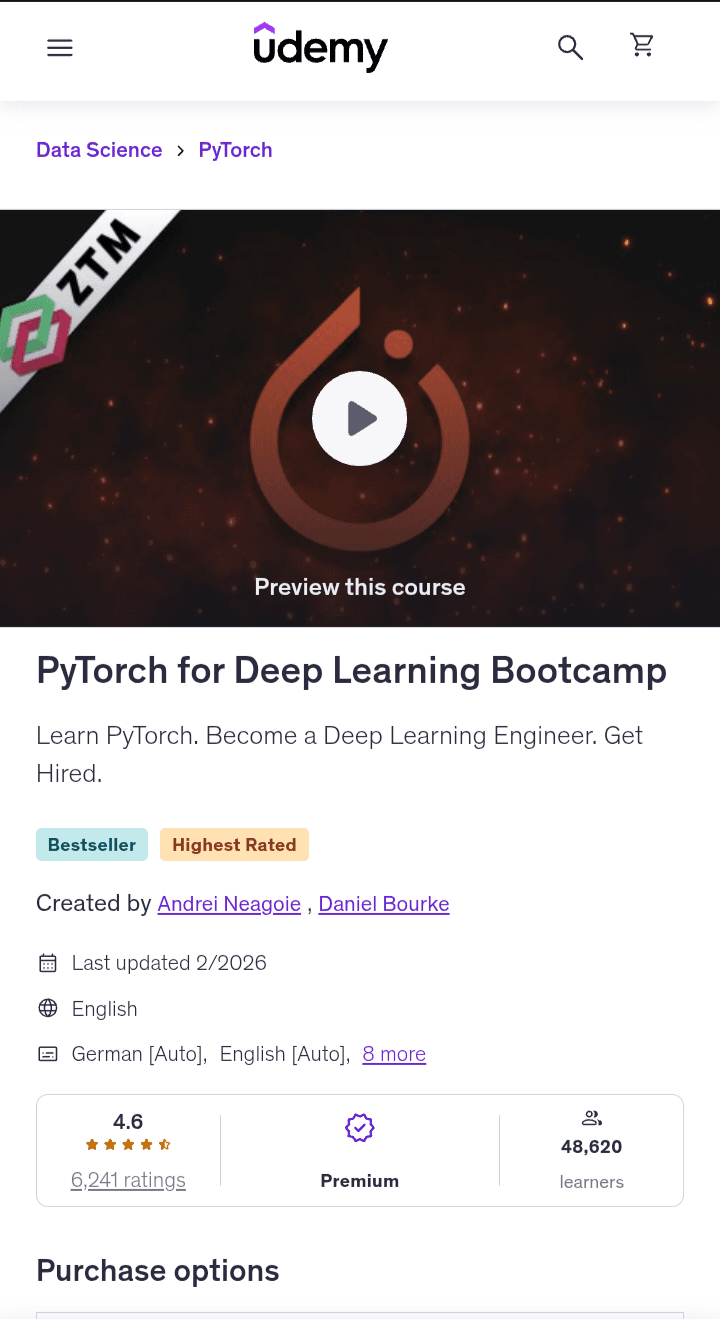
Created by Andrei Neagoie and Daniel Bourke, this is one of Udemy’s most popular deep learning bootcamps, and for good reason.
It’s built entirely around “learning by building,” with almost every module ending in a project you can point to. Bourke also maintains the course’s companion materials as a free online book at learnpytorch.io, so if you want to sample the content before enrolling, you actually can.
Skills you’ll learn
The course moves through PyTorch fundamentals (tensors, the core data structure behind everything in deep learning), building a full PyTorch workflow from scratch, neural network classification, computer vision, and working with custom datasets.
It also covers “going modular,” turning notebook code into reusable Python scripts, a skill most beginner courses skip entirely but that matters a lot in real engineering teams.
Hands-on projects
This is a heavily project-based course rather than a lecture-and-quiz format.
You’ll apply transfer learning to real image classification tasks, run experiment tracking to compare model performance, and even replicate a research paper’s architecture from scratch.
By the end, you’ll build and deploy your own custom-trained PyTorch model, so it’s publicly accessible, not just running locally in a notebook.
Tools covered: PyTorch, including PyTorch 2.0 and torch.compile, covered in a dedicated module.
Time commitment
Self-paced with lifetime access; it’s a lengthy, comprehensive bootcamp (the instructors describe it as intentionally thorough rather than a quick primer), so expect real weeks of study rather than a weekend project.
Best for
Learners who specifically want to become job-ready in PyTorch and care about deployment and production skills, not just model-building. It suits people comfortable with a “fair warning: this is comprehensive” pace, and who want a portfolio of real, deployable projects by the end rather than isolated notebook exercises.
9. TensorFlow 2.0: Deep Learning and Artificial Intelligence (Lazy Programmer)
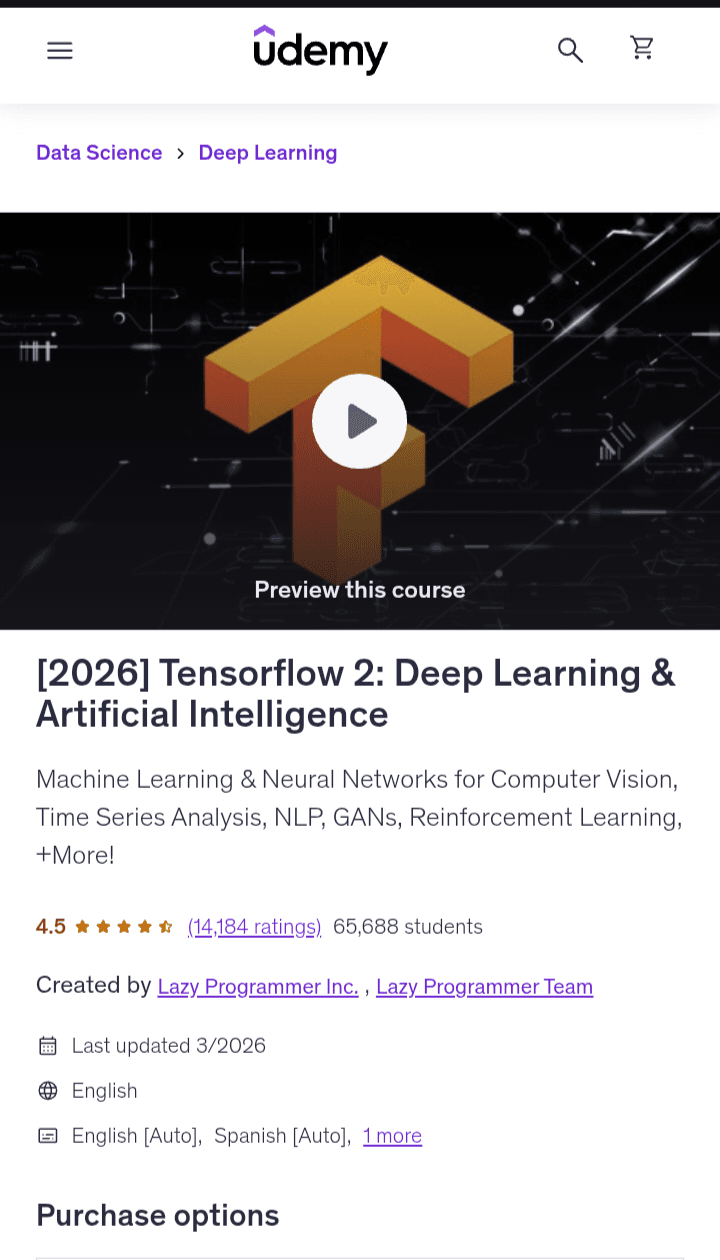
This is a broad and unique course from Lazy Programmer Inc., a well-known instructor duo in the Udemy AI space.
Where courses like the Complete TensorFlow 2 and Keras Bootcamp focus on depth in a few core skills, this one is explicitly built for breadth: it touches nearly every major deep learning application area in one package, from computer vision to reinforcement learning to GANs.
The instructor is upfront about the tradeoff: this course prioritizes building lots of real projects over deep theoretical dives, so if you want heavy math, this isn’t the one.
Skills you’ll learn
You’ll progress from basic machine learning models up through the major deep learning architectures like Deep Neural Networks, Convolutional Neural Networks for image processing, and Recurrent Neural Networks for sequence data.
Optional “in-depth” sections cover the theory side, like loss functions and different gradient descent approaches, for anyone who wants to go beyond just running the code.
Hands-on projects
This course is stacked with distinct, varied projects rather than one long build. You’ll work through Natural Language Processing tasks, build recommender systems, apply transfer learning to computer vision problems, construct Generative Adversarial Networks (GANs) that generate realistic images, and build a deep reinforcement learning stock trading bot, plus time series forecasting and stock price prediction projects that are new additions specific to this TensorFlow 2 version.
Tools covered: TensorFlow 2.0 and NumPy, with all major deep learning architecture types covered under one roof.
Time commitment
Self-paced with lifetime access (26+ hours); expect a substantial course given the sheer number of topic areas covered; this is not a weekend course.
Best for
Learners who already know Python and NumPy and want a fast, wide-ranging tour of deep learning’s major application areas like computer vision, NLP, GANs, recommender systems, and reinforcement learning. It suits people who prefer learning by seeing many different real projects.
10. Practical Deep Learning: Master PyTorch in 15 Days (Jannis Seemann)
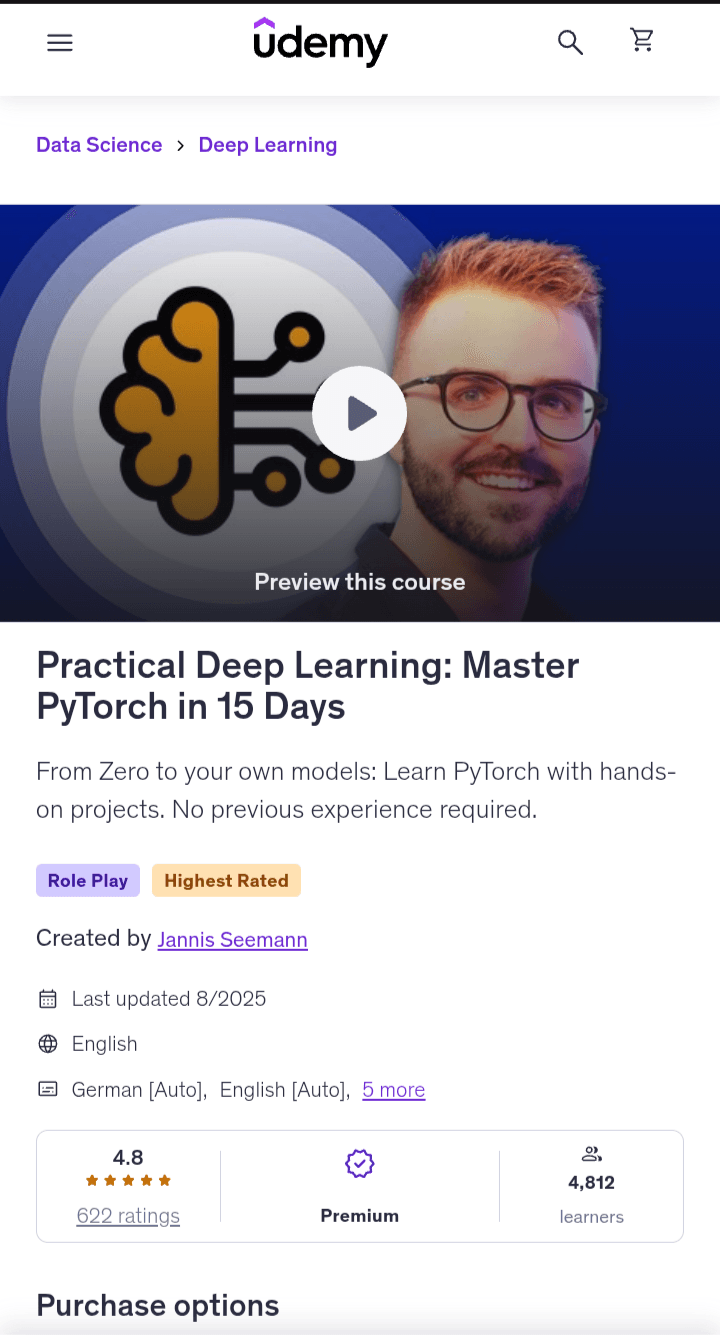
This is one of the most beginner-friendly, structure-obsessed courses on this list. Where other options ask you to figure out your own pace across dozens of hours of loosely connected content, Jannis Seemann’s course gives you a literal day-by-day roadmap, 15 days from zero PyTorch knowledge to deployed models, with no assumed prior experience required.
Skills you’ll learn
You’ll build up from single-neuron regression through full neural network classifiers and into convolutional networks and transfer learning.
The course deliberately paces conceptual difficulty against project difficulty, so each new architecture is introduced right when you’re ready to apply it, rather than front-loading theory.
Hands-on projects
This is where the day-by-day structure really shows its value.
Day 3 – 4 has you predicting used car prices with a single-neuron regression model.
Day 5 – 6 builds an SMS spam detector using a neuron classifier.
Day 7 – 8 predicts student exam results with a full neural network, followed by a loan approval classification exercise.
Day 9 – 10 tackles multi-class classification on handwritten digits, Day 11 – 12 moves to convolutional networks for fashion item classification, and Day 13 – 14 applies transfer learning with ResNet to a tire quality prediction task.
The course closes on Day 15 by teaching you to deploy your trained models as interactive apps using Gradio.
Tools covered: PyTorch and Gradio for deployment, with light exposure to data preprocessing techniques across images and text.
Time commitment
Structured as a 15-day plan, self-paced but built with a clear daily cadence; each “day” pairs a concept with a matching project, plus interactive quizzes and exams at key checkpoints (Day 6, Day 15) to test retention.
Best for
Absolute beginners who want a clear, low-overwhelm path into PyTorch without wading through a 40+ hour mega-course first. It’s especially strong for anyone who wants deployment experience baked in from day one.
Which Course Should You Choose?
If you’re not sure where to start, use this quick decision guide based on your background and goals.
| If you are… | Recommended Course |
|---|---|
| Complete beginner | Practical Deep Learning: Master PyTorch in 15 Days – a structured, day-by-day path with no prior experience required. |
| Python developer | Deep Learning A-Z 2026 – broad architecture coverage that builds directly on Python skills you already have. |
| Data scientist | IBM Deep Learning with PyTorch, Keras and TensorFlow – multi-framework fluency mapped directly to real job requirements. |
| College student | Deep Learning Specialization (DeepLearning.AI) – the most academically rigorous option, with ACE college credit recommendation. |
| AI engineer | PyTorch for Deep Learning (DeepLearning.AI) – advanced architectures plus real deployment skills (ONNX, MLflow). |
| Working professional | Learning Deep Learning (Pearson) – lighter weekly time commitment (5 hrs/week) that still covers LLMs and multimodal AI. |
| Career switcher | PyTorch for Deep Learning Bootcamp (Neagoie & Bourke) – job-focused, portfolio-building projects designed to get you hired. |
TensorFlow vs PyTorch: Which Will You Learn?
| TensorFlow | PyTorch | |
|---|---|---|
| Industry adoption | Larger installed base – around 37% market share and roughly 25,000+ companies, reflecting its head start in enterprise settings | Smaller but fast-growing footprint, around 26% market share and 17,000+ companies, gaining ground quickly |
| Research | Now a minority choice in academic papers | Dominant – cited in the clear majority of deep learning research papers, especially in NLP, vision-language models, and reinforcement learning |
| Ease of learning | More verbose, historically built around static graphs; has improved with eager execution and Keras integration but still feels less “native Python” | Feels like writing ordinary Python from the start – dynamic graphs make debugging intuitive, which is why most beginners now gravitate here first |
| Deployment | Stronger production tooling – TensorFlow Serving, TensorFlow Extended (TFX), and TensorFlow Lite for mobile/edge devices, plus tight Google Cloud TPU integration | Improving steadily (ONNX, TorchServe, ExecuTorch) but still has gaps in end-to-end MLOps tooling and mobile coverage compared to TensorFlow |
| Community | Long-established community with mature documentation, large GitHub presence, and strong ties to Google’s ecosystem | Rapidly growing community, boosted heavily by the Hugging Face ecosystem, where the vast majority of newly released pre-trained models ship PyTorch-first |
Want to know the detailed difference between TensorFlow and PyTorch? My TensorFlow and PyTorch comparison article will give you better insights.
How to Build an AI Portfolio While Learning
Finishing a course is great, but a certificate alone won’t get you hired. Employers want to see proof you can build things. The good news: every project you complete in these courses is raw material for a portfolio. You just need to package it right.
GitHub is your foundation. Push every project, even the small ones, like the spam classifier from a 15-day course, to its own repo with a clear README explaining what the model does, what dataset you used, and what results you got. Recruiters skim READMEs before they skim code, so treat that file like a mini pitch.
Kaggle lets you go beyond course exercises. Join a beginner-friendly competition using skills from your course (image classification and tabular prediction competitions are great starting points) and publish your notebook publicly. It shows you can apply what you learned to a dataset nobody handed you pre-cleaned.
Hugging Face is worth using once you’ve built anything with transformers or NLP. Upload a fine-tuned model to the Hub, even a small one. It’s free, and it puts your work in front of the same ecosystem researchers and engineers actually use.
A personal website ties everything together. A simple portfolio site with project summaries, live demo links (Gradio or Streamlit apps work well here), and links back to your GitHub repos turns scattered work into a coherent narrative.
LinkedIn is where you make it visible. Post short project breakdowns as you finish them; what problem you solved, what you learned, what you’d improve, instead of saving everything for one big “I finished my course!” post. Consistent, smaller posts build more traction over time.
Frequently Asked Questions
Which deep learning course is best for beginners?
Practical Deep Learning: Master PyTorch in 15 Days offers the gentlest entry point with structured daily lessons, real projects, and zero prior deep learning experience required.
Is TensorFlow or PyTorch better to learn first?
PyTorch, for most learners in 2026. It’s more intuitive, dominates research and LLM work, and transfers easily to TensorFlow once you understand core concepts.
Can I learn deep learning without machine learning?
Not recommended. Basic ML concepts, supervised learning, model evaluation, and overfitting form the foundation deep learning builds on directly.
Which certificate is most valuable?
DeepLearning.AI’s Deep Learning Specialization carries the most recognition, backed by Andrew Ng’s reputation and ACE college credit eligibility.
Which course is best for computer vision?
Course 4 of the Deep Learning Specialization or Deep Learning A-Z 2026 both offer strong, focused computer vision project work.
Which course is best for NLP?
PyTorch for Deep Learning (DeepLearning.AI) and Course 5 of the Deep Learning Specialization both go deep on Transformers and NLP tasks.
Final Verdict
Stop comparing courses. Start one today.
Best overall: Deep Learning Specialization by DeepLearning.AI. It’s the gold standard, trusted by employers, and backed by real credentials.
Best for total beginners: Practical Deep Learning: Master PyTorch in 15 Days. No experience needed, no overwhelm, just 15 focused days.
Best value for breadth: Deep Learning A-Z 2026. One purchase, nearly every major architecture covered.
None of these courses will change your career sitting in your browser tabs. Pick one tonight, enroll, and finish it before you even think about the next one.
The people landing AI roles aren’t the ones who found the “perfect” course. They’re the ones who actually finished a course and built something with it.
Related Articles
10 Best Python Courses for Beginners (Start Coding from Zero)
Deep Learning Vs Machine Learning: What is The Difference?
Top 10 Udemy Courses for Aspiring Data Scientists
Best Free Python Courses on Udemy

TechnicalStudies was started by Neeladrinath with one simple idea — give Indian students a reliable place to figure out what’s actually worth their time and money. Every recommendation here is backed by careful research, real student feedback, and honest analysis. We cover online courses, laptops, smartwatches, software deals, and learning resources — all looked at from a student’s perspective, so you can spend less time guessing and more time learning.