
If you want to learn JavaScript from scratch, you’ve picked the right language. In 2026, JavaScript remains the backbone of the web, powering everything from interactive websites to full-stack applications.
It’s the go-to language for frontend development, backend development with Node.js, web apps, freelancing gigs, and startup MVPs. No other language gives beginners such a direct path to building real things people can use.
But most beginners struggle to choose the right JavaScript course to start learning. With hundreds of JavaScript courses online, ranging from free YouTube tutorials to paid beginner JavaScript bootcamps, it’s easy to waste weeks on the wrong resource and make zero progress.
In this article, I will help you with this. Whether you’re eyeing the best JavaScript courses on Udemy, hunting for free JavaScript courses, or just trying to map out a JavaScript roadmap for beginners, you’ll find clear, honest recommendations here.
By the end, you’ll know exactly which course fits your goals and start learning.
Who Should Learn JavaScript?
JavaScript isn’t a niche skill; it’s one of the most versatile tools you can add to your resume. But let’s break down exactly who benefits most from picking it up.
Students and Beginners
If you’ve never written a single line of code, JavaScript is one of the friendliest starting points. It runs directly in the browser; no complex setup, no installations. You can write code and see results instantly, which makes the learning curve far less intimidating than most languages.
Future Frontend Developers
Want to build websites that actually do things? JavaScript is non-negotiable. Every button click, animation, form validation, and dynamic content update on the web is driven by JavaScript. Any JavaScript course for beginners will have frontend development at its core for good reason.
Aspiring Full-Stack Developers
With Node.js, JavaScript now runs on servers too. That means one language takes you from designing UI to handling databases and APIs. It’s the most efficient JavaScript course for web development paths available right now.
Freelancers and Web Designers
If you’re already building websites but relying on plugins for everything, learning JavaScript gives you real creative control. Clients pay significantly more for developers who can write custom functionality.
Quick Comparison Table
| Course | Platform | Best For | Projects | Certificate | Duration | Learning Style | Beginner Score |
|---|---|---|---|---|---|---|---|
| Programming with JavaScript | Coursera · Meta | Career credibility | Limited | Paid | ~46 hrs | Video + readings | 7 / 10 |
| Interactivity with JavaScript | Coursera · University of Michigan | Web designers | 2 guided projects | Paid | ~10 hrs | Lecture + labs | 7.5 / 10 |
| IBM Full-Stack JS Developer | Coursera · IBM | Full-stack path | Capstone app | Paid | ~4–6 months | Video + labs | 6 / 10 |
| JS with React, Node & MongoDB | Coursera · IBM | MERN stack | Per course | Paid | ~2–3 months | Video + labs | 5 / 10 |
| JavaScript for Beginners | Coursera · UC Davis | Absolute beginners | Guided builds | Paid | 2–3 months | Academic + labs | 9 / 10 |
| JavaScript Programming Essentials | Coursera · IBM | JS fundamentals | 1 final project | Paid | ~18 hrs | Video + labs | 6.5 / 10 |
| JavaScript: Complete Guide | Udemy · Academind | Deep JS theory | Demos + tasks | Included | 52+ hrs | Theory-first | 7.5 / 10 |
| Complete JavaScript Course | Udemy · Jonas Schmedtmann | Best overall | 6 real projects | Included | 71+ hrs | Project-first | 9.5 / 10 |
| Modern JavaScript From Scratch | Udemy · Brad Traversy | Hands-on learners | 10 projects | Included | 40+ hrs | Project-first | 9 / 10 |
| Learn JS in 2 Weeks | Udemy · Coding2GO | Quick starters | 2 projects | Included | 8.5 hrs | Video + exercises | 8.5 / 10 |
| JS Algorithms & Data Structures | Udemy · Colt Steele | Interview prep | Code challenges | Included | 22 hrs | CS-focused | 4 / 10 |
Best JavaScript courses for Beginners
1. Programming with JavaScript – Coursera (by Meta)
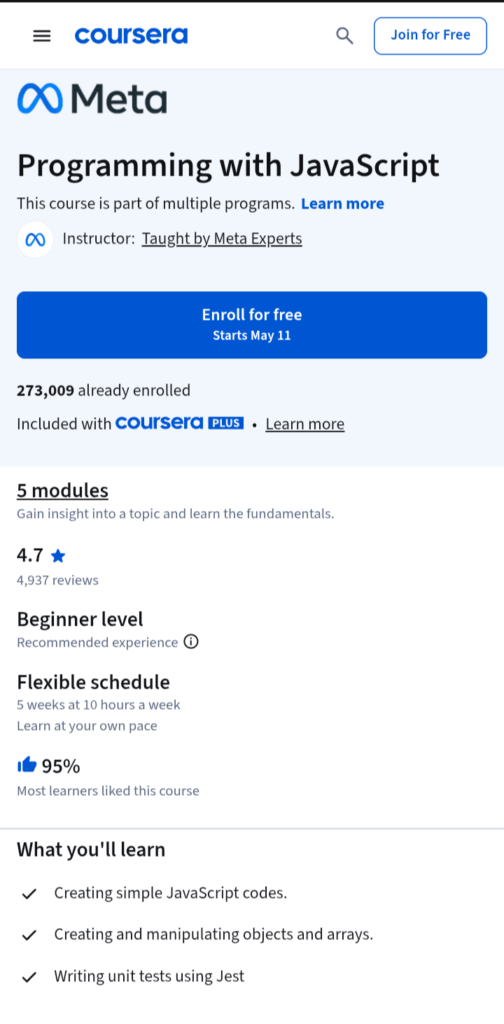
If you’re looking to learn JavaScript from scratch with the credibility of a world-class tech company behind it, this is one of the more compelling options among JavaScript courses online.
Offered by Meta, the company behind Facebook and Instagram, this course is part of the Meta Front-End Developer Professional Certificate and is built for people with zero prior coding experience.
What You Will Learn
The course moves from basic to intermediate JavaScript topics, covering variables, data types, conditional statements, loops, object methods, error handling, DOM manipulation, functional and OOP paradigms, recursion, scope, and unit testing with Jest.
By the end of the course, you’ll be able to work with core JavaScript fundamentals, manipulate the DOM, write clean functions and objects, handle errors, and apply test-driven development (TDD) using Jest.
Real Projects Included
This is where the course falls a little short. There are almost no practical, real-world applications or large projects to complete. The exercises are useful for reinforcing concepts, but you won’t walk away with portfolio-ready projects. If building real projects is your priority, pair this with external practice.
Teaching Style
The course uses a mix of video lectures, readings, and graded coding assignments. The teaching method builds from the fundamentals, which works well in the early stages.
However, as the course progresses, some topics are presented in heavily info-loaded short videos followed by long reading materials.
Pros
- Backed by Meta, which offers a strong brand recognition for your resume and LinkedIn
- Covers TDD with Jest, which is rare for a beginner JavaScript course for web development
- Self-paced and flexible, so it is ideal for people balancing work or study
Cons
- Limited real-world projects mean you’ll need to supplement with outside practice
Ideal Learner Type
This course is a great fit for complete beginners who want a structured, credentialed introduction to JavaScript, especially those following the JavaScript roadmap for beginners toward a front-end development career.
Who Should Avoid This Course
Skip this if you’re looking for a project-heavy, hands-on experience from day one. It’s also not the right pick if you want to go deep on advanced JavaScript patterns or prepare for technical interviews.
2. Interactivity with JavaScript – Coursera (by University of Michigan)
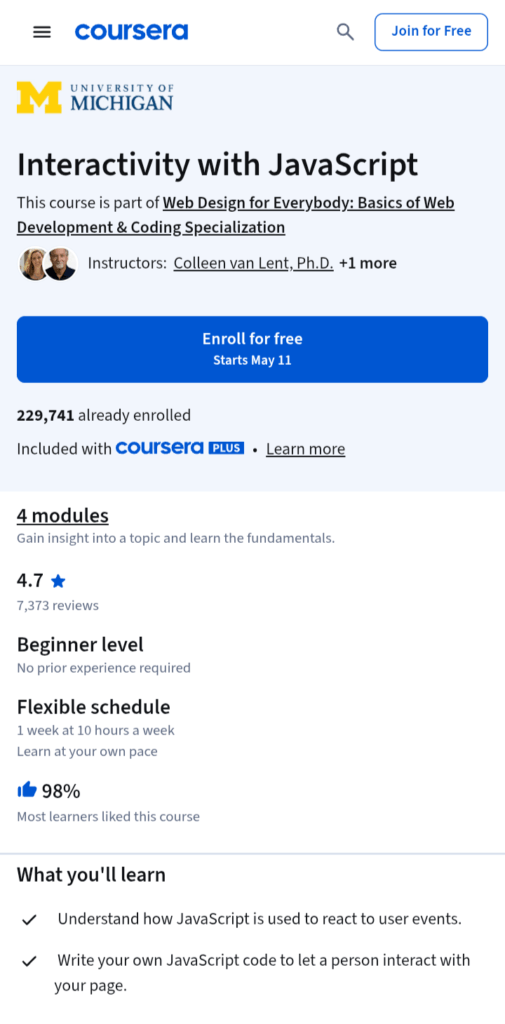
Not every beginner needs a 60-hour deep dive to get started. Sometimes you just need a clean, focused introduction that gets you writing real JavaScript as quickly as possible. That’s exactly what this course from the University of Michigan delivers.
It’s one of the more quietly underrated JavaScript courses on Coursera, and for a specific type of learner, it’s a near-perfect starting point.
What You Will Learn
In this beginner-friendly course, you will learn JavaScript in the context of adding interaction to a website, with the language itself covered in a focused, introductory way.
It’s the third course in the Web Design for Everybody specialization, so it builds naturally on HTML and CSS rather than treating JavaScript as an isolated subject.
The course covers the basics of the JavaScript language, variables, looping, functions, and debugging tools, and teaches you how to work with the DOM to react to common events like page loads, mouse clicks, and keyboard input. You’ll also learn how JavaScript can introduce accessibility issues.
Related: Best React Courses On Coursera
Real Projects Included
The course wraps up with a hands-on project that involves building an interactive photo gallery with keyboard accessibility support.
Teaching Style
Dr. Colleen van Lent is the clear highlight of this course. She explains everything in depth throughout the weeks, and reviewers consistently praise her patience and her ability to pitch concepts well to students who are brand new to web programming.
She doesn’t just show you how to write code; she makes sure you understand why you’re doing it that way.
Pros
- Taught by an experienced academic instructor from a top-ranked university
- JavaScript is taught in the context of real web pages
- Part of a structured specialization, making it easy to continue learning
Cons
- No coverage of backend development, APIs, or anything beyond frontend DOM interaction
Ideal Learner Type
This is the right course if you already have some HTML and CSS under your belt and want to add JavaScript interactivity to web pages without being overwhelmed.
Who Should Avoid This Course
If you’re starting from absolute zero with no HTML/CSS background, begin elsewhere. And if your goal is a JavaScript course for web development at a professional level, this course will leave you wanting much more. It’s a gentle introduction, not a career launcher on its own.
3. IBM Full-Stack JavaScript Developer Professional Certificate – Coursera (by IBM)
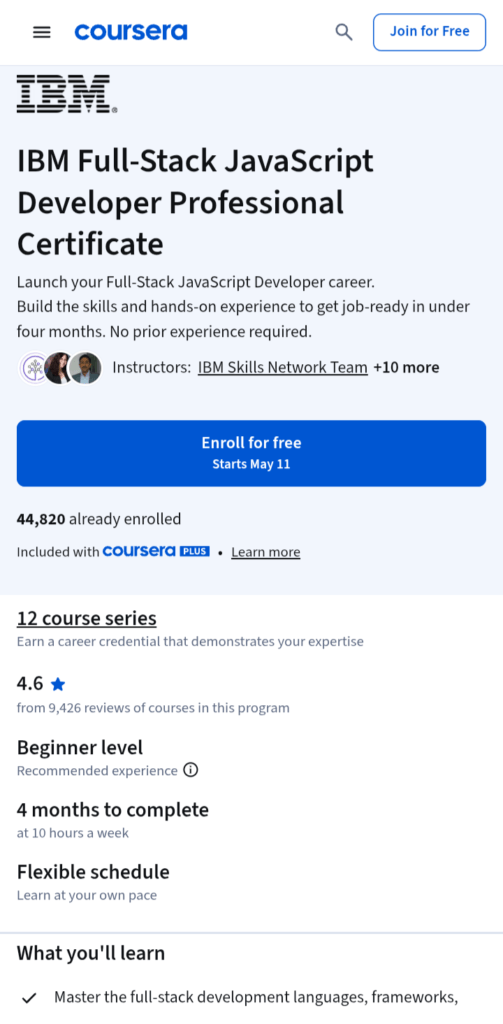
If your goal is to go all the way, from writing your first line of JavaScript to deploying a full-stack application on the cloud, this is one of the most ambitious beginner JavaScript bootcamp programs available on Coursera.
IBM doesn’t do things halfway, and the scope of this certificate reflects that.
What You Will Learn
This is a multi-course professional certificate, not a single course. The program covers HTML, CSS, GitHub, JavaScript, Node.js, Express, React, DevOps, Containers, Docker, Kubernetes, NoSQL databases, Microservices, Serverless computing, and more. That’s an enormous JavaScript roadmap for beginners compressed into a single program.
You’ll move through front-end fundamentals, build backend services with Node.js and Express, work with MongoDB and RESTful APIs, and learn cloud deployment concepts.
The capstone requires you to architect a full application, create a dynamic frontend with React, communicate with a NoSQL MongoDB database, configure CI/CD pipelines, deploy serverless functions, and launch the entire solution on the cloud using Kubernetes.
On paper, that’s a genuinely impressive set of skills for a beginner JavaScript course for web development to cover.
Real Projects Included
The curriculum walks you through HTML, CSS, JavaScript, Node.js, React, and DevOps principles with small, guided projects throughout. The program culminates in a capstone where you build a “Gift-Link” full-stack application, developing frontend pages, connecting backend services to a MongoDB database, and applying Agile practices throughout.
Teaching Style
The program provides step-by-step instructional guidance through videos followed by hands-on labs to practice what you learn. The format is practical and structured, though IBM’s courses tend to prioritise coverage over depth.
Pros
- One of the most comprehensive JavaScript courses online
- Includes cloud deployment, Docker, Kubernetes, and CI/CD
- Fully self-paced; accessible via Coursera Plus
- Capstone project produces a deployable, portfolio-worthy application
Cons
- Context-switching between 15+ technologies makes it hard to develop deep expertise in any one area.
Ideal Learner Type
This certificate is best suited for motivated self-learners who understand that the program is a structured learning path, not a shortcut to employment.
Related: Front-End Vs Back-End Development: Roles, Skills & Career Differences Explained
Who Should Avoid This Course
If you’re a complete beginner hoping this certificate alone will get you hired, you need to go in with realistic expectations. Without a degree, this certificate puts career changers in a weak position in today’s competitive developer market unless paired with a strong portfolio and additional interview prep.
4. JavaScript Programming with React, Node & MongoDB – Coursera (by IBM)
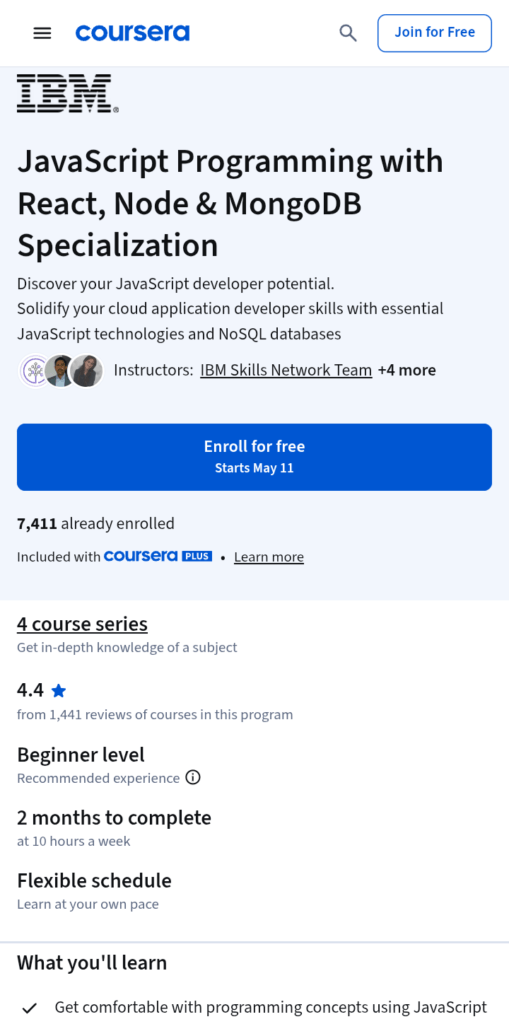
If you’ve already got some JavaScript basics down and want to level up into full-stack development, this IBM specialization is one of the more focused options among JavaScript courses online for that specific transition.
Unlike the broader IBM Full-Stack certificate reviewed earlier, this specialization has a tighter scope; it’s built around three of the most in-demand technologies in the JavaScript ecosystem: React, Node.js, and MongoDB.
What You Will Learn
You’ll learn to get comfortable with core JavaScript programming concepts, write Node.js RESTful APIs using the Express framework, create dynamic front-end web applications with React, and develop best practices to deploy, scale, and optimise applications.
The MongoDB course specifically focuses on constructing RESTful APIs using Node.js and the Express framework to communicate with NoSQL databases, handling errors and communicating them to the front end, and applying backend optimisation and scaling techniques for cloud-native deployment.
Real Projects Included
Throughout the program, you develop several applications using these various technologies, and upon completing the full program, you’ll have a portfolio of JavaScript projects to provide confidence heading into interviews.
Each course ends with a hands-on final project, so you’re consistently building rather than just watching. The capstone brings everything together into a deployable full-stack application.
Teaching Style
The course uses a combination of instructional videos and assessments to cover concepts, with practice and graded assessments reinforcing what you learn through hands-on labs and a final project. IBM’s instructional style is methodical and structured.
Pros
- Tightly focused on three of the most relevant technologies in the modern JavaScript course for the web development stack: React, Node, and MongoDB.
- Each course produces a project artifact, which means you build a portfolio as you go.
- Cloud deployment and backend scaling concepts included.
Cons
- Not suitable for complete beginners as prior JavaScript and HTML/CSS knowledge is required.
Ideal Learner Type
This specialization is the right fit for developers who already understand JavaScript basics and are ready to follow a JavaScript roadmap for beginners into full-stack territory.
Who Should Avoid This Course
Skip this if you’re a complete beginner. The learning curve will be steep without a solid JavaScript foundation.
5. JavaScript for Beginners Specialization – Coursera (by University of California, Davis)
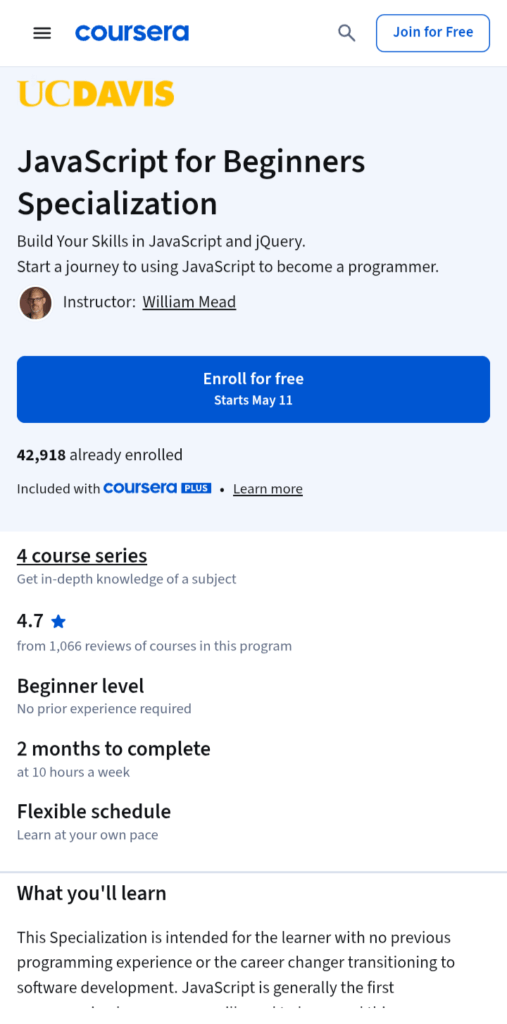
This 4-course specialization from UC Davis is a popular beginner-friendly JavaScript course. It’s designed for learners with no previous programming experience and career changers transitioning into software development, and the curriculum is paced to match that promise.
What You Will Learn
Course 1 covers working with a code editor, selection control structures, loops, and core programming structures. Course 2 introduces jQuery and explores DOM manipulation through animation.
Course 3 goes deeper into interactivity with increasingly complex jQuery scripts and plugins.
The final course, Data Manipulation in JavaScript, covers validation basics, jQuery form validation, arrow functions, asynchronous functions, and the JavaScript event loop, giving you a solid taste of modern JavaScript before you finish the program.
Real Projects Included
Learners follow along with the instructor and apply their learning through a series of low-stakes challenges and projects throughout each course. Course 2 centres on building a landing page-style website using jQuery elements. Course 3 includes building a game from scratch.
Teaching Style
William Mead, a Continuing Lecturer at UC Davis’s design programme, is the sole instructor across all four courses. His approach is calm, methodical, and genuinely beginner-aware. Learners describe his delivery as exactly what an absolute beginner needs, with a solid basic understanding of JS and a calm presentation style.
Pros
- Calm, patient instructor who genuinely understands how beginners think.
- Truly zero prerequisites.
- A University credential from a top-ranked institution adds credibility.
Cons
- Not suitable as a standalone course for anyone targeting a professional JavaScript course for a web development role without additional learning.
Ideal Learner Type
This specialization is a near-perfect fit for absolute beginners who want to learn JavaScript from scratch at a gentle, academic pace.
Who Should Avoid This Course
If you already know basic JavaScript and want to move into frameworks, backends, or real-world apps, this specialization will feel too slow.
6. JavaScript Programming Essentials – Coursera (by IBM)
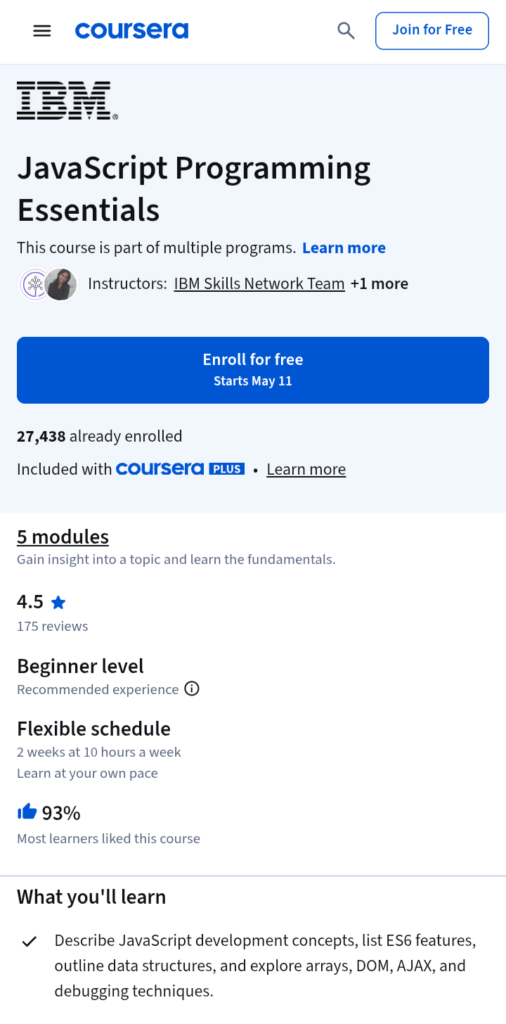
Think of this course as IBM’s focused, single-course entry point into JavaScript; the kind of resource you turn to when you want a solid, practical foundation without committing to a full multi-course specialization right away.
It sits at the intersection of beginner JavaScript bootcamp depth and professional IBM structure, and it punches above its weight for what it covers.
What You Will Learn
The curriculum is well-rounded for a JavaScript course for beginners with some web background.
You’ll cover variables, data types, operators, closures, hoisting, ECMAScript, events, arrays, objects, string manipulation, the math and date objects, classes, debugging with try-catch blocks, and more.
Later modules cover JSON, synchronous vs asynchronous programming, AJAX, XMLHttpRequest, callbacks, promises, and the Fetch API. That’s a genuinely comprehensive tour of the language essentials.
Real Projects Included
Throughout the course, step-by-step instructional guidance through videos is followed by hands-on labs, and the course concludes with a final project where you build a dynamic website to showcase your newly acquired JavaScript programming skills.
Teaching Style
IBM’s format here follows step-by-step instructional videos, followed by hands-on labs and graded assessments. It’s methodical and thorough. Learners who completed the course highlight the strength of the debugging techniques, DOM manipulation depth, and AJAX coverage as standout elements, which suggests the instructional quality lands well for the target audience.
Pros
- Covers modern JavaScript, including ES6 features, async/await, promises, and the Fetch API
- Hands-on labs in every module reinforce learning consistently throughout the course
- IBM credential adds professional weight to your resume and LinkedIn profile
Cons
- The final project is guided, not independent
Ideal Learner Type
This course is the sweet spot for someone who already has HTML and CSS experience and wants a structured, IBM-backed path to JavaScript fluency before jumping into a larger program.
Who Should Avoid This Course
Complete beginners with no web development background should start elsewhere. The prerequisite gap will make this harder than it needs to be.
7. JavaScript – The Complete Guide (Beginner + Advanced) – Udemy (by Maximilian Schwarzmüller)
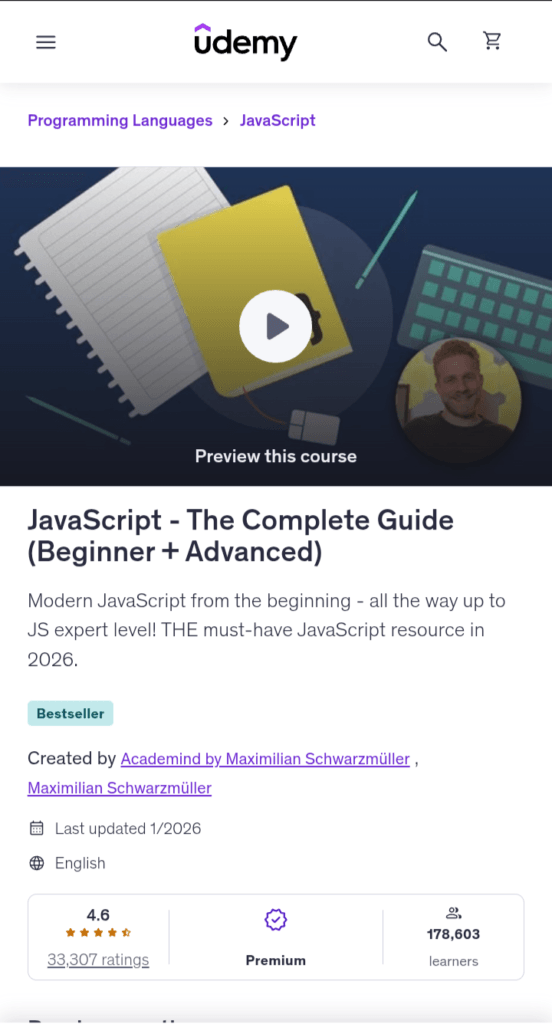
If there’s one name that comes up every single time someone asks for the best JavaScript courses on Udemy, it’s Maximilian Schwarzmüller, widely known as “Max” from Academind. This course is his definitive answer to the question of how to learn JavaScript from scratch all the way to expert level, and it earns that reputation for good reason.
What You Will Learn
The curriculum spans an impressive arc. You move from basic concepts like variables and loops through to advanced topics like closures and prototypical inheritance, covering ES6, the module system, and real-world application design patterns. Beyond the core language, you also cover security, performance optimisation, and testing.
Real Projects Included
The course is packed with examples, demos, projects, assignments, and quizzes. The projects aren’t the centrepiece in the way they are in Jonas Schmedtmann’s course, but they’re practical and purposeful.
Teaching Style
Max is exceptionally clear and methodical. Nothing is glossed over, and every concept is explained thoroughly, which is both the course’s greatest strength and, for some learners, its biggest challenge.
He’s considered hands-down one of the best instructors on Udemy, and his ability to explain complex JavaScript internals is what sets this course apart from shallower alternatives.
Pros
- Over 52.5 hours of content, regularly updated.
- Covers topics almost no other beginner course touches: meta-programming, performance optimisation, security, and testing.
- Max covers both modern and legacy JavaScript syntax, so you can confidently work in any codebase.
Cons
- Less project-heavy than other top alternatives in the JavaScript course for the web development space.
Ideal Learner Type
This course is built for learners who want genuine mastery of the JavaScript language. It’s ideal for developers who’ve tried other resources and felt like they were missing the deeper understanding of how things actually work.
Who Should Avoid This Course
If your primary learning style is project-based and you get bored without building something tangible every few lessons, this course will test your patience.
And if you need hand-holding through a gentle JavaScript roadmap for beginners before tackling something this comprehensive, start with a shorter foundation course first.
8. The Complete JavaScript Course 2025: From Zero to Expert! – Udemy (by Jonas Schmedtmann)
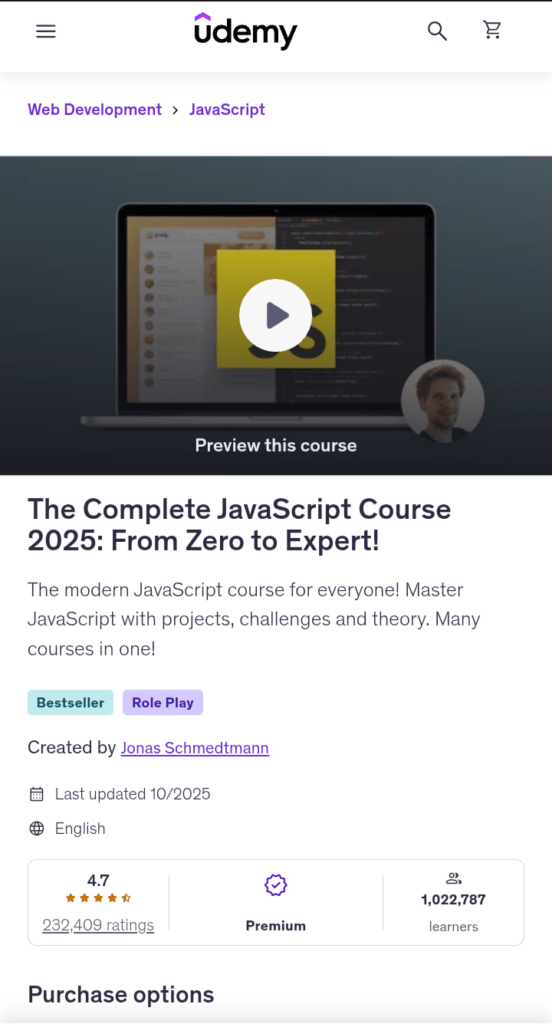
If you ask any serious developer which is the single best JavaScript course for beginners on Udemy, the answer is almost always the same: Jonas Schmedtmann’s Complete JavaScript Course.
It’s because Jonas has cracked the formula that most courses miss: the perfect balance between theory that actually explains why, and projects that prove you can apply it.
What You Will Learn
You’ll master JavaScript fundamentals, including variables, if/else, operators, boolean logic, functions, arrays, objects, loops, strings, and progress to become job-ready by understanding how JavaScript really works behind the scenes.
Along the way, you’ll cover DOM manipulation, event handling, OOP with classes and prototypes, asynchronous JavaScript with promises and async/await, the Fetch API, and modern development workflows with NPM, Webpack, Babel, and ES6 modules.
Jonas goes beyond what other JavaScript courses teach you, including concepts like how JavaScript actually executes, the event loop, and closures, which are genuinely some of the clearest explanations you’ll find anywhere on the internet.
Real Projects Included
The course includes six real-world projects and 50+ coding challenges that reinforce key concepts through hands-on practice.
These aren’t toy apps; they’re polished, professional applications. Projects include Bankist (an interactive banking app using advanced arrays and DOM manipulation), Mapty (a workout tracker using geolocation and OOP), and Forkify (a recipe search app using the Fetch API, async/await, and ES6 modules).
Teaching Style
Jonas has a rare gift. His explanations are enthusiastic, deeply clear, and never condescending. He’s been teaching this bestselling course since 2016 to over 850,000 developers, always listening to feedback and understanding exactly how students actually learn.
It’s a unique blend of real-world projects, deep explanations, theory lectures, and challenges.
Pros
- Six real-world, portfolio-ready projects that go far beyond what most beginner JavaScript bootcamp courses offer.
- The undisputed #1 best JavaScript course on Udemy.
- Downloadable starter and final code for every section.
Cons
- With such a large student base, direct interaction with Jonas can be limited.
Ideal Learner Type
This is the go-to recommendation for anyone serious about following a complete JavaScript roadmap for beginners from zero to job-ready.
Who Should Avoid This Course
If you just want a quick taste of JavaScript before deciding whether to commit further, 71 hours is not the right starting point. Grab something shorter first.
9. Modern JavaScript From The Beginning 2.0 – Udemy (by Brad Traversy)
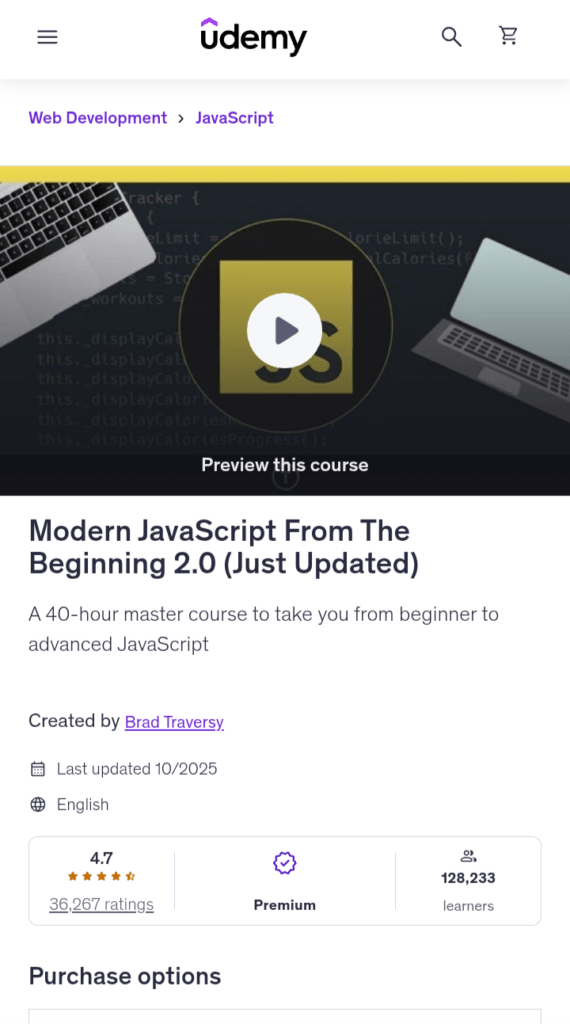
Brad Traversy has built one of the most loyal followings in the web development teaching world. His Traversy Media YouTube channel has introduced millions of developers to modern web technologies with zero fluff and maximum clarity.
This Udemy course is the full, structured version of that same approach, and it’s earned its place firmly among the best JavaScript courses on Udemy for developers who learn best by building things.
What You Will Learn
The curriculum is wide and practical. You’ll cover basics and fundamentals, data structures including arrays, objects, maps, sets, stacks & queues, DOM manipulation, OOP with constructor functions, prototypes, classes, inheritance, getters and setters, async JS with the Fetch API, callbacks and promises, modules and tooling, unit testing algorithms with Jest, and Node.js with Express.
The course also goes into how JavaScript works under the hood, including execution context, the call stack, and the event loop.
Real Projects Included
This is Brad’s signature strength, and it shows. The course includes 10 real-world projects built with pure JavaScript; no frameworks.
Projects include a Shopping List app, a Flix Movie App using a public API with search, pagination, and a custom router, a Tracalorie OOP project using classes, private properties, static methods, local storage, and Bootstrap, and a full-stack app using Express, MongoDB, Webpack, and custom modules.
Teaching Style
Brad is the gold standard for relaxed, practical teaching. Learners consistently describe him as an amazing instructor whose explanations are super easy to grasp and who explains things step by step, making even complex topics easy to follow. He’s very clear and concise, goes into the small details, and keeps a well-organised file structure throughout.
Pros
- Rare inclusion of unit testing with Jest and full-stack development with Node/Express/MongoDB
- Brad’s relaxed, practical style makes dense content feel approachable
- Starter and final code provided for every section, plus GitHub repo links
- Covers both frontend and backend JavaScript
Cons
- The full-stack section at the end goes quickly and may feel rushed for complete beginners with no backend exposure
Ideal Learner Type
This course is perfect for hands-on learners who prefer building projects over watching lectures. It’s especially well-suited for career switchers and self-taught developers who get bored with theory-heavy approaches and want to see real, working applications come to life early and often.
Who Should Avoid This Course
If your primary goal is deep JavaScript theory and language internals, understanding the why at a conceptual level before touching projects, Jonas Schmedtmann’s course will serve you better.
10. Learn JavaScript in 2 Weeks (Complete JavaScript Bootcamp) – Udemy (by Coding2GO)
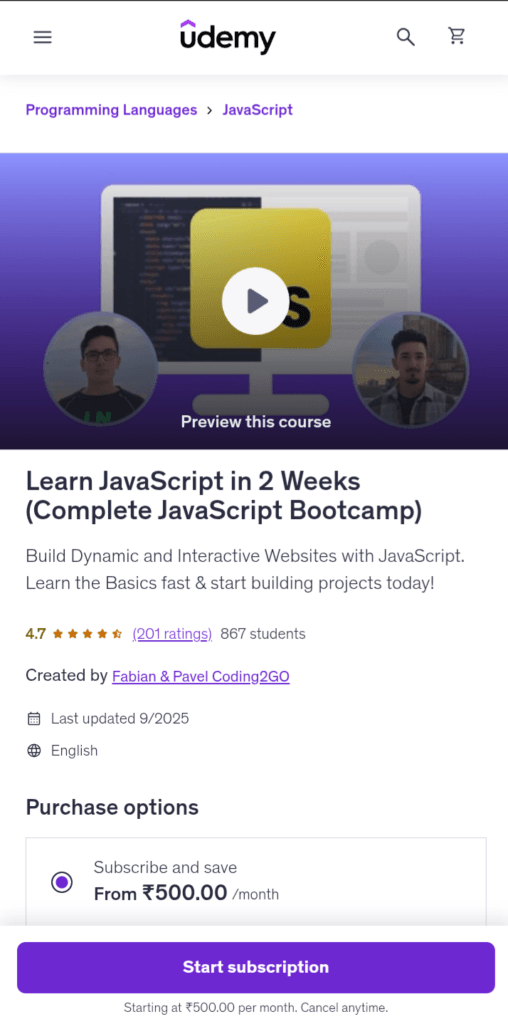
Not every beginner has months to commit to a 70-hour course. Some people need a clear, fast, no-fluff path into JavaScript, and that’s the exact gap this course from Fabian and Pavel of Coding2GO is designed to fill.
Coming from a YouTube background where they’ve helped thousands of learners build web development skills, they’ve taken that same approachable style and packaged it into a structured Udemy course.
What You Will Learn
You’ll cover data types, conditionals, loops, functions, arrays, objects, DOM manipulation, events, and forms.
Specific topics include the difference between var, let, and const, hoisting and scope, nested conditionals, advanced array methods like map, filter, and reduce, and how to work with input fields to interact with users.
The course also includes a quick HTML and CSS primer for those who aren’t fully comfortable with the basics yet.
Real Projects Included
Projects include a Cookie Clicker clone to learn DOM basics practically and a To-Do application that stores user data. They’re not the most complex projects you’ll find across JavaScript courses on Udemy, but they’re purposeful.
Teaching Style
Fabian and Pavel come from a YouTube content background, and it shows in the best possible way. Their teaching style is focused on breaking down complex concepts into simple, digestible lessons, prioritising clarity, practicality, and efficiency so you can apply what you learn to real-world scenarios as soon as possible.
Pros
- Includes coding exercises and quizzes throughout, not just at the end.
- Includes a bonus HTML and CSS section.
- At just over 8 hours, it’s one of the most time-efficient JavaScript courses for beginners that still covers meaningful ground.
Cons
- Relatively newer course with fewer reviews and less social proof than the established giants like Jonas Schmedtmann or Brad Traversy.
Ideal Learner Type
This course is ideal for the learner who’s been overwhelmed by longer courses and needs a win. It’s perfect for complete beginners who want to learn JavaScript from scratch in a focused, engaging way without committing 70 hours upfront.
Related: Python Vs. JavaScript: What Is the Difference?
Who Should Avoid This Course
If you’re serious about becoming a professional JavaScript developer and want a single course to take you all the way from beginner to job-ready, this course isn’t long or deep enough to get you there alone.
11. JavaScript Algorithms and Data Structures Masterclass – Udemy (by Colt Steele)
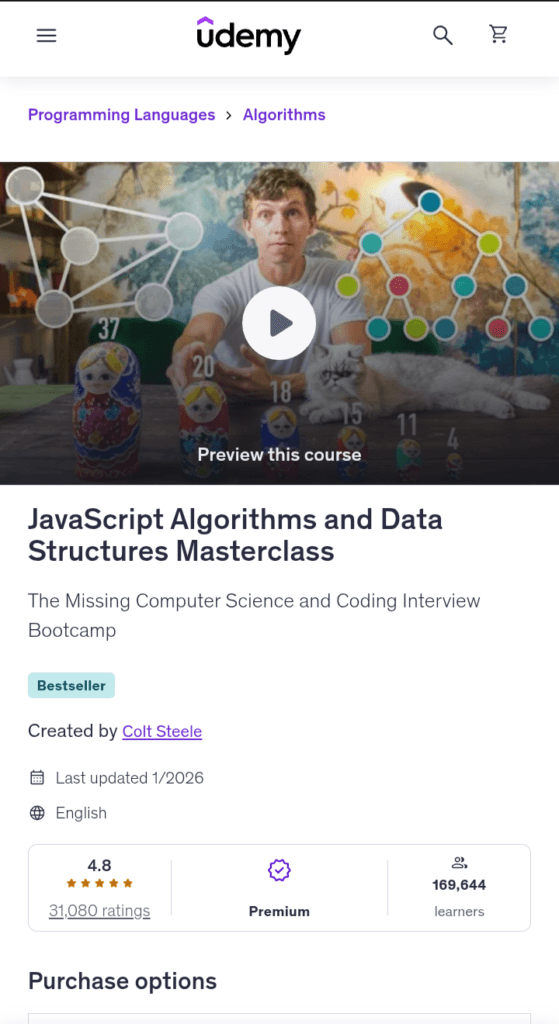
Every other course in this list teaches you how to write JavaScript. This one teaches you how to think like a computer scientist with JavaScript, and that’s a fundamentally different skill.
Colt Steele’s JavaScript Algorithms and Data Structures Masterclass is the most recommended resource for self-taught developers who want to fill the one gap that consistently holds them back from landing developer jobs at serious companies: technical interview preparation.
What You Will Learn
The curriculum is genuinely comprehensive for its category. You’ll learn to analyse your code’s time and space complexity using Big O notation, master recursion, apply a 5-step approach to solving difficult coding problems, implement popular searching algorithms, and write 6 different sorting algorithms: Bubble, Selection, Insertion, Quick, Merge, and Radix Sort.
Data structures covered include singly and doubly linked lists, stacks, queues, binary search trees, binary heaps, priority queues, hash tables, and graphs.
The course culminates with Dijkstra’s Shortest Path Algorithm, which builds on multiple earlier concepts, followed by a Dynamic Programming section covering memoization and tabulation using the Fibonacci sequence as a working example.
Real Projects Included
This isn’t a project-based course in the traditional sense. Instead of building web apps, you build each data structure from scratch as JavaScript classes, implementing every method; adding data to a Stack, removing from a Queue, traversing a Tree, reversing a Linked List.
Teaching Style
Colt Steele has a gift for making dry, academic material feel approachable. He has really accessible explanations for everything and goes slowly enough for people without a traditional CS background to follow along.
He uses a storytelling approach to introduce recursion, visual walkthroughs for sorting algorithms, and step-by-step debugging examples throughout.
Pros
- Covers advanced topics like Heaps, Graphs, Dijkstra’s Algorithm, and Dynamic Programming.
- Colt’s in-person bootcamp background means the content reflects what actually gets asked in real interviews.
- Includes solution walkthroughs and downloadable resources for every section.
Cons
- Not suitable for absolute beginners. You need solid JavaScript fundamentals first.
Ideal Learner Type
This course is built for JavaScript developers who can write code but can’t confidently answer technical interview questions.
Who Should Avoid This Course
Complete beginners with no JavaScript background shouldn’t touch this course yet. Come back after finishing a solid fundamentals course.
Best YouTube Channels for Learning JavaScript
Not everyone learns best through paid courses. Sometimes the best JavaScript resource you’ll find is completely free, and these four YouTube channels consistently deliver some of the highest-quality JavaScript content on the internet.
Traversy Media
Brad Traversy’s channel is the gold standard for practical, no-nonsense web development tutorials. His JavaScript crash courses and project-based videos are perfect for beginners who want to see real code in action without the fluff. A natural companion to his Udemy course.
Mosh Hamedani
Mosh breaks down complex JavaScript concepts with a clean, structured teaching style that feels almost classroom-like. His videos are especially strong for beginners who need concepts explained slowly and clearly before jumping into code.
SuperSimpleDev
As the name suggests, the focus here is radical simplicity. SuperSimpleDev’s JavaScript tutorials are built for absolute beginners who’ve felt left behind by other resources. The pace is deliberate, the explanations are patient, and the channel has earned a fiercely loyal following because of it.
Kevin Powell
While primarily known for CSS, Kevin’s content regularly crosses into JavaScript territory, especially around DOM manipulation and frontend interactivity. For anyone following a JavaScript course for web development, his channel fills crucial gaps that pure JS tutorials often skip.
Beginner JavaScript Projects You Should Build
Reading about JavaScript is one thing. Building with it is what actually makes concepts stick. These seven projects are the perfect bridge between finishing a course and feeling confident enough to apply for jobs or take on freelance work. Each one targets specific skills that come up constantly in real development.
Related: 10 Practical Web Development Projects For Beginners – Start Building Today
To-Do App
The classic starting point for a reason. Building a To-Do app forces you to work with DOM manipulation, event listeners, and local storage. It sounds basic, but doing it from scratch without a tutorial teaches you more than following along ever will.
Weather App
This one introduces you to working with APIs and asynchronous JavaScript. You’ll make real HTTP requests, handle responses, and display live data, which is exactly the kind of skill employers look for in a JavaScript course for web development candidates. Bonus: it looks impressive in a portfolio.
Calculator App
Don’t underestimate this one. A calculator requires clean logic, careful handling of edge cases, and thoughtful UI interaction. It’s a great exercise in writing organised, readable JavaScript without relying on any libraries or external data.
Quiz App
A quiz app pushes you to work with arrays of objects, dynamic rendering, state management, and score tracking. It’s one of the best projects for practising how to structure your data before you write a single line of DOM code.
Expense Tracker
This project levels up your skills with CRUD operations, data manipulation, and real-time UI updates. If you’ve been following a JavaScript roadmap for beginners, this is where things start feeling genuinely professional.
Portfolio Website
Your portfolio is your most important project. Adding JavaScript for smooth scrolling, animations, a contact form, and dynamic content turns a static page into a living demonstration of your skills.
Notes App
A Notes app combines everything: creating, editing, deleting, and persisting data with local storage. It’s the ideal capstone project before moving on to frameworks like React, and it’s practical enough that you might actually use it yourself.
Frequently Asked Questions
Which JavaScript course is best for complete beginners?
Jonas Schmedtmann’s Complete JavaScript Course on Udemy is the most consistently recommended starting point. The UC Davis JavaScript for Beginners specialization on Coursera is the gentlest alternative if you prefer a slower academic pace.
Can I learn JavaScript without coding experience?
Yes, and JavaScript is actually one of the better first languages to start with. It runs directly in the browser, gives instant visual feedback, and doesn’t require complex environment setup.
Is JavaScript enough to get a job?
No, JavaScript alone won’t get you hired. You need to learn at least one framework, such as React, alongside Git, basic API knowledge, and a portfolio of real projects.
Should I learn HTML and CSS before JavaScript?
Yes, and not just technically but practically. JavaScript’s primary job in the browser is manipulating HTML elements and CSS styles. Without understanding what you’re manipulating, JavaScript concepts like DOM traversal and event listeners won’t make intuitive sense.
Can I learn JavaScript on my own?
Entirely. Most working JavaScript developers are self-taught. The ecosystem is exceptional for independent learners.
Which JavaScript course has the best projects?
Jonas Schmedtmann’s Complete JavaScript Course wins here. Bankist, Mapty, and Forkify are polished, real-world applications that go far beyond typical beginner exercises. Brad Traversy’s Modern JavaScript From The Beginning 2.0 comes close with 10 solid projects, including a full-stack app. Both are among the best JavaScript courses on Udemy, specifically because they treat projects as the primary learning vehicle, not an afterthought.
What should I learn after JavaScript?
React is the clearest next step for frontend development. Alongside React, learn Git properly, REST APIs, and basic TypeScript. If full-stack development appeals to you, add Node.js and Express next.
Final Verdict
Finally, I will say that all JavaScript courses in this list are for beginners, and you need to choose the one that suits your learning style and requirements.
Learning JavaScript feels impossible right before it clicks, and that feeling is universal. Every developer you admire has sat in front of a screen, wondering if they’re just not smart enough for this. They weren’t missing intelligence. They were missing repetition and time. The confusion you feel right now isn’t a sign to stop. It’s a sign you’re exactly where you’re supposed to be.
So pick a course and start learning today.
Related Articles
Best Python Courses for Beginners (Start Coding from Zero)
How to Choose the Right Course?
Best Java Courses for Beginners
Java Vs. JavaScript: What is the Difference
Best NextJS Courses and Certifications for Developers

TechnicalStudies was started by Neeladrinath with one simple idea — give Indian students a reliable place to figure out what’s actually worth their time and money. Every recommendation here is backed by careful research, real student feedback, and honest analysis. We cover online courses, laptops, smartwatches, software deals, and learning resources — all looked at from a student’s perspective, so you can spend less time guessing and more time learning.