
SQL isn’t going anywhere. While programming trends come and go, SQL has quietly stayed at the center of how businesses store, access, and make decisions with data.
Whether you’re eyeing a career in data analytics, trying to have smarter conversations with your engineering team, or just tired of asking someone else to “pull the numbers,” SQL is the skill that gets you there.
It’s also one of the few technical skills that pays off almost immediately. You can write a useful query within your first hour of learning.
This guide is for actual beginners. Not people brushing up on skills they half-remember from college, but people starting from zero – marketers, analysts, product managers, career switchers, or anyone who’s decided it’s time to stop being intimidated by databases.
To find the best SQL courses for beginners, we didn’t just skim course titles or trust star ratings blindly.
Each course on this list was evaluated on how well it explains fundamentals, how much hands-on practice it offers, whether it uses real (not toy) datasets, and how it holds up against learner reviews and completion rates.
If a course made the cut, it’s because it actually teaches, not just talks.
Quick Comparison Table – Best SQL Courses for Beginners
If you’re short on time, here’s how all ten courses stack up side by side.
| Course | Platform | Best For | Skill Level | Duration | Certificate |
|---|---|---|---|---|---|
| Learn SQL Basics for Data Science (UC Davis) | Coursera | Beginners wanting a university-backed, project-based path into data science | Beginner | ~2 months (10 hrs/wk) | Yes |
| SQL for Data Analysis and Business Insights | Coursera | Beginners who want modern tools (Jupyter, Git, AI-assisted SQL) | Beginner – Intermediate | ~4 weeks (10 hrs/wk) | Yes |
| SQL From Beginner to Advanced (LearnKartS) | Coursera | Hindi-speaking beginners wanting a complete path incl. security & interviews | Beginner | ~4 weeks (10 hrs/wk) | Yes |
| Introduction to SQL (University of Michigan) | Coursera | Beginners comfortable with local server setup, headed toward web dev | Beginner – Intermediate | ~2 weeks (10 hrs/wk) | Yes |
| SQL: A Practical Introduction (IBM) | Coursera | True beginners wanting hands-on, cloud-based practice | Beginner | ~2 weeks (10 hrs/wk) | Yes |
| The Complete SQL Bootcamp (30 Hours) | Udemy | Visual learners wanting one long, thorough course | Beginner | ~30 hours | Yes |
| The Ultimate MySQL Bootcamp (Colt Steele) | Udemy | Beginners wanting an approachable, humor-forward teaching style | Beginner | ~21 hours | Yes |
| Complete Data Analyst Bootcamp (Krish Naik) | Udemy | Beginners wanting SQL as part of a full analyst skillset (Python, Power BI) | Beginner | ~89 hours | Yes |
| SQL – MySQL for Data Analytics & BI (365 Careers) | Udemy | Beginners targeting SQL-specific job titles (DBA, BI analyst) | Beginner | ~10.5 hours | Yes |
| SQL for Data Analysis: Beginner MySQL BI (Maven Analytics) | Udemy | Beginners who want one cohesive real-world business case study | Beginner | Self-paced | Yes |
Best SQL Courses for Beginners
1. Learn SQL Basics for Data Science (Coursera – UC Davis)
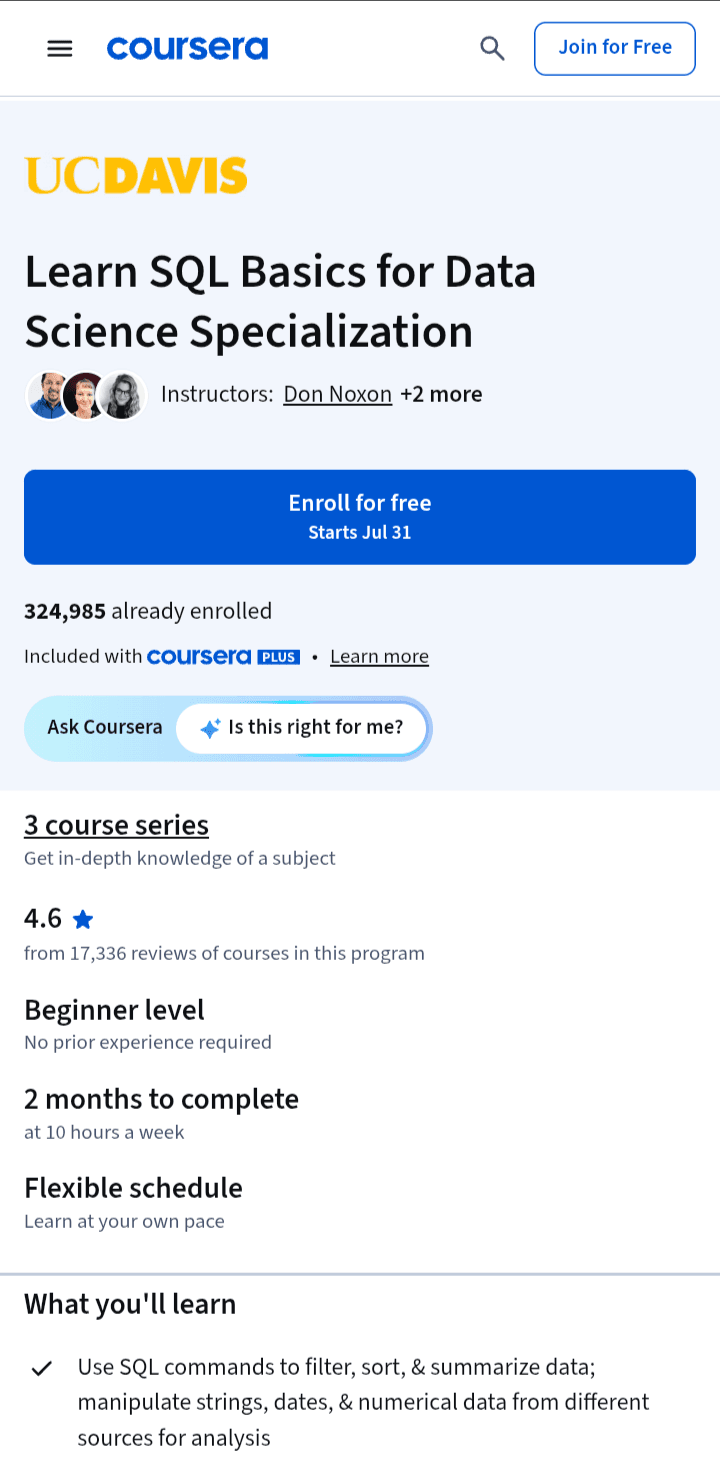
This specialization from UC Davis is built for people who’ve never written a line of code and want to walk away with real, job-ready SQL skills.
Rather than teaching SQL in isolation, it frames every lesson around actual data science use cases, so you’re learning to think like an analyst from day one, not just memorizing syntax.
What You’ll Learn
You’ll go from writing your first SELECT statement to filtering, sorting, and summarizing data, manipulating strings and dates, and combining multiple queries using UNION.
By the final course, you’ll be validating datasets, cleaning messy data, and even touching on basic A/B testing frameworks.
Best For
Complete beginners who want structure and a university-backed curriculum, especially those eventually aiming for data analytics or data science roles.
It’s also a solid fit if you like project-based learning over passive video-watching.
Key Topics Covered
- SQL fundamentals (SELECT, WHERE, ORDER BY, GROUP BY)
- Data filtering, sorting, and summarizing
- String, date, and numeric functions
- Data validation and cleaning
- Problem-solving strategies and debugging
- A capstone project where you propose, execute, and present your own analysis
Duration
The specialization spans 3 courses and takes roughly 2 months at 10 hours/week, though Coursera notes it can stretch to 4–6 months depending on your pace. The courses run 16, 10, and 35 hours respectively.
Certificate
Yes, you’ll earn a shareable career certificate from UC Davis upon completion, which you can add directly to LinkedIn or your resume.
2. SQL for Data Analysis and Business Insights (Coursera)
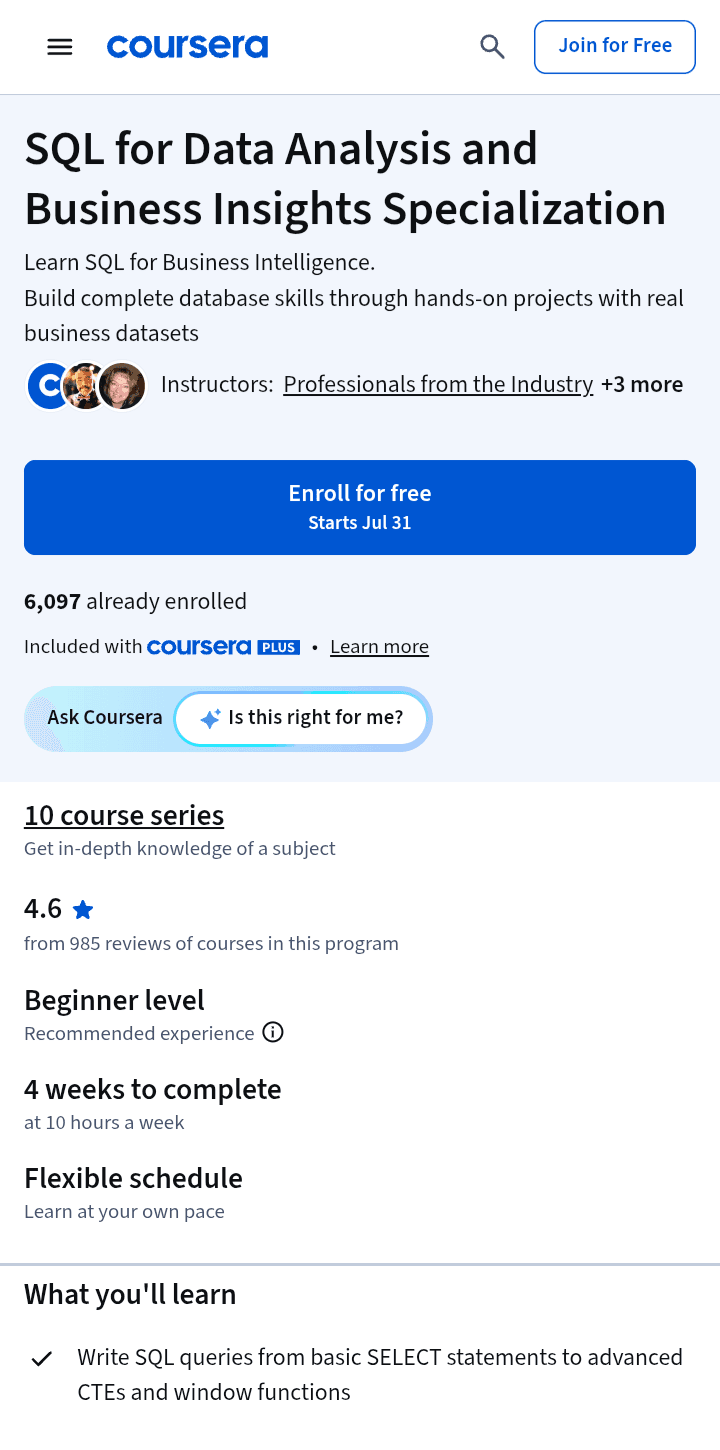
This is one of Coursera’s more recently updated specializations, and it feels built for the way people actually work with data today: inside Jupyter notebooks, alongside Git and GitHub, and increasingly with AI tools assisting query optimization.
It takes you from zero to genuinely advanced SQL across 10 bite-sized courses, using real business datasets like BookCycle, TechMart, Northwind Traders, and Mint Classics.
What You’ll Learn
You’ll start with basic SELECT and WHERE statements, then move through joins, aggregations, window functions, and CTEs, before landing on data cleaning, schema design, CRUD operations, and query performance tuning.
A standout feature is the deliberate inclusion of AI-assisted query optimization that most beginner SQL courses still ignore.
Best For
Beginners who want a modern, tool-rich learning experience and don’t mind a longer, modular path.
It’s especially useful for aspiring data analysts who want portfolio-ready projects, not just certificates.
Key Topics Covered
- SQL fundamentals in Jupyter Notebooks
- Filtering, sorting, aggregating, and joining data
- Window functions and Common Table Expressions (CTEs)
- Data cleaning, schema design, and CRUD operations
- Git/GitHub version control for SQL projects
- AI-assisted query optimization
- Real business case studies (retail, sales, inventory)
Duration
Coursera lists it as roughly 4 weeks at 10 hours/week, spread across 10 courses ranging from 1 to 8 hours each, so you can go course-by-course at your own pace.
Certificate
Yes, a shareable career certificate from Coursera upon completing the full specialization.
3. SQL From Beginner to Advanced (Coursera – LearnKartS)
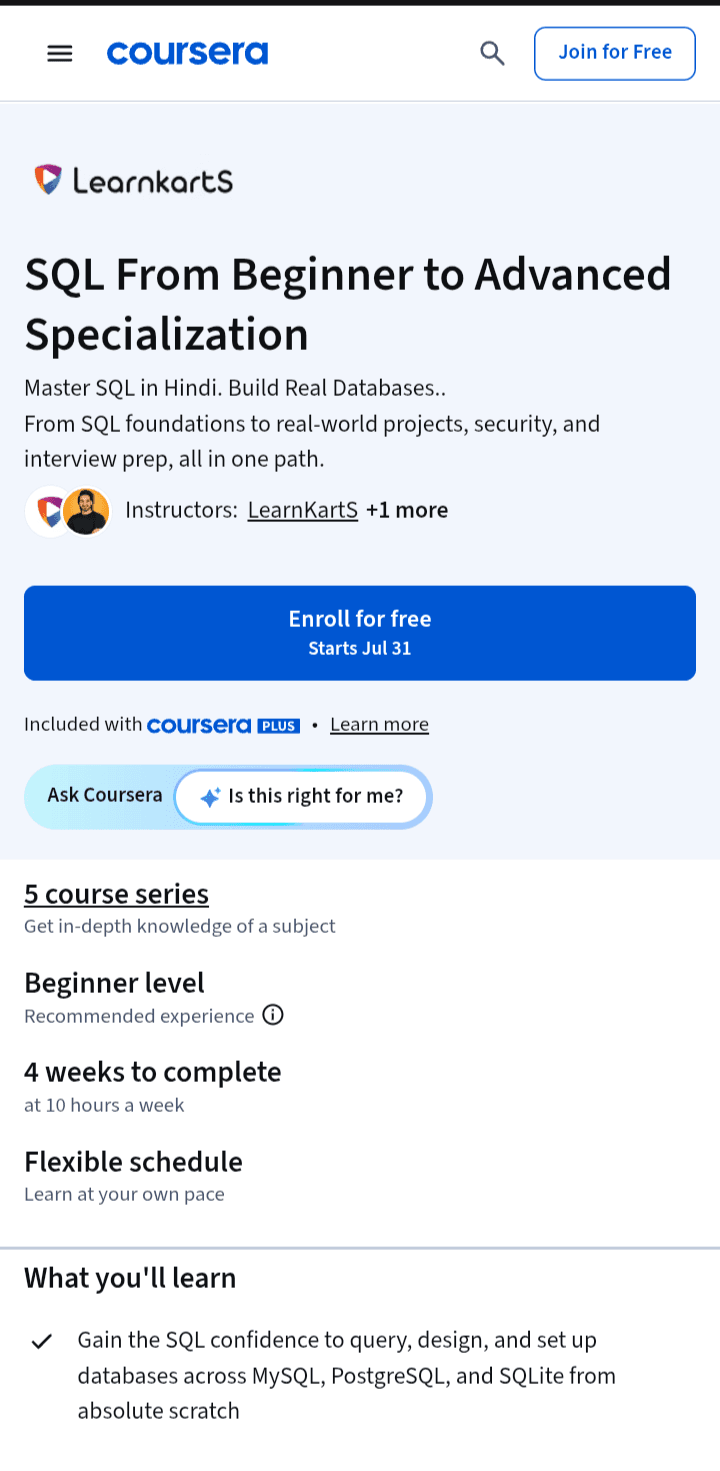
Offered by LearnKartS and taught entirely in Hindi, this specialization is built for learners who understand technical concepts more deeply in their native language. It doesn’t stop at query-writing.
It covers database design, security, and even interview preparation, making it one of the more complete beginner-to-job-ready paths on this list.
What You’ll Learn
You’ll set up MySQL, PostgreSQL, and SQLite from scratch on both Windows and macOS, then move into ER diagrams and normalization (1NF through BCNF), all six JOIN types, subqueries, DML operations, and aggregation.
Later courses cover stored procedures, triggers, window functions, CTEs, and database security, including SQL injection prevention and role-based access control.
Also Check: 10 Best Python Courses for Beginners (Start Coding from Zero)
Best For
Hindi-speaking beginners, career switchers, and working professionals in India who want technical concepts to “land the first time” rather than getting lost in translation.
It’s also a strong fit for anyone who wants a genuinely complete path, not just querying, but database design and security too.
Key Topics Covered
- Database setup across MySQL, PostgreSQL, and SQLite
- ER diagrams and normalization (1NF–BCNF)
- Six JOIN types, subqueries, and DML operations
- Aggregation, Views, Indexes, and transactions (COMMIT/ROLLBACK)
- Stored procedures, triggers, UDFs, window functions, and CTEs
- SQL injection prevention and RBAC
- Five real-world database projects (e-commerce, hospital, school, bookstore, food delivery)
- Interview preparation for data roles
Duration
5 courses, roughly 4 weeks at 10 hours/week, with individual courses ranging from 3–4 hours each.
Certificate
Yes, you will receive a shareable career certificate from LearnKartS after completing the course.
4. Introduction to Structured Query Language (SQL) (Coursera – University of Michigan)
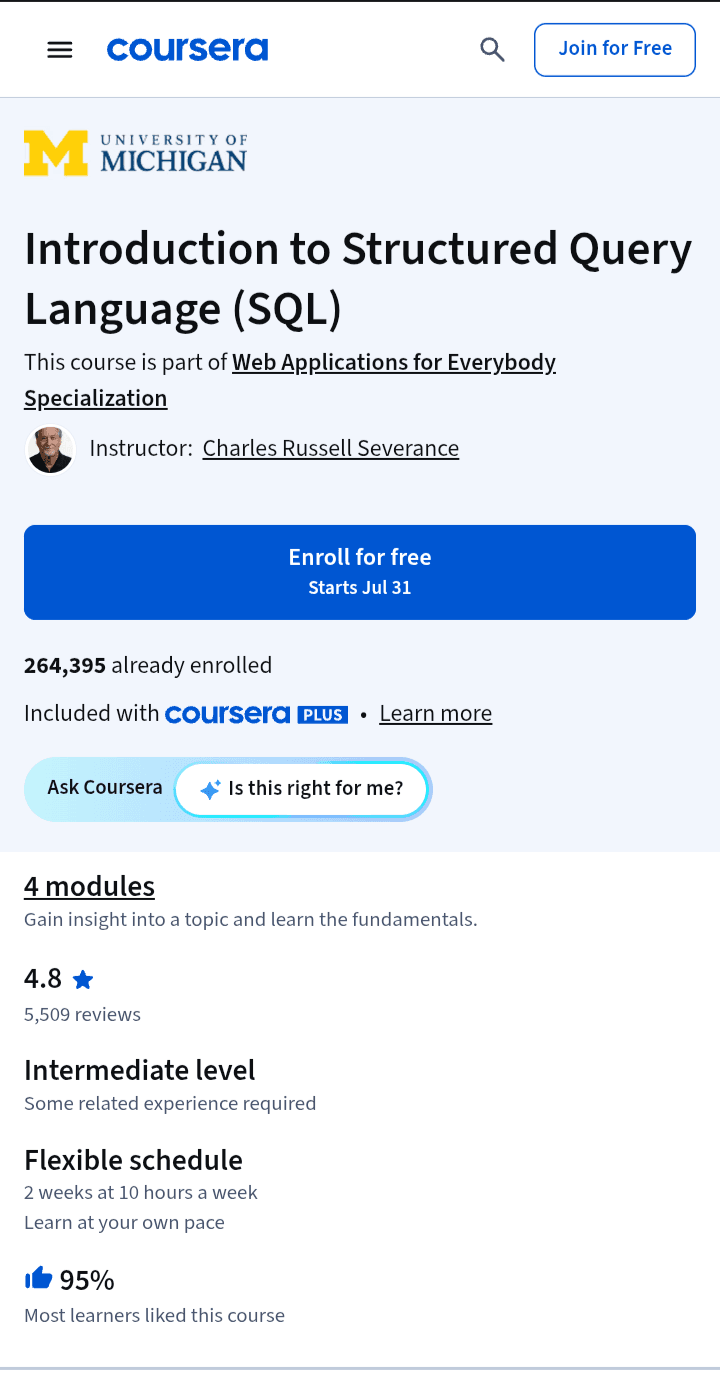
Taught by Dr. Chuck (Charles Severance) of the University of Michigan, this course is part of the larger “Web Applications for Everybody” specialization.
It’s less about pure data analysis and more about understanding SQL in the context of building real web applications, meaning you’ll also touch on local server setup and PHP integration along the way.
What You’ll Learn
You’ll start by installing a text editor and a local development environment (MAMP or XAMPP), then move into single-table SQL queries and core syntax.
From there, the course covers relational database design across multiple tables, foreign keys, and JOIN operations, finishing with how to model many-to-many relationships.
Best For
Learners who want to understand SQL as part of the bigger web development picture, not just as a standalone querying skill.
It suits people comfortable installing local server software, or those planning to build actual database-backed applications rather than just analyze spreadsheets.
Key Topics Covered
- Local development environment setup (MAMP/XAMPP)
- Basic SQL syntax and single-table queries
- Data types, keys, and indexes
- Relational database design and normalization
- Foreign keys and JOIN operations
- Modeling many-to-many relationships
Duration
4 modules, roughly 2 weeks at 10 hours/week, totaling about 17 hours of content.
Certificate
You will receive a shareable certificate from the University of Michigan, and it counts toward the “Web Applications for Everybody” specialization.
5. SQL: A Practical Introduction for Querying Databases (Coursera – IBM)
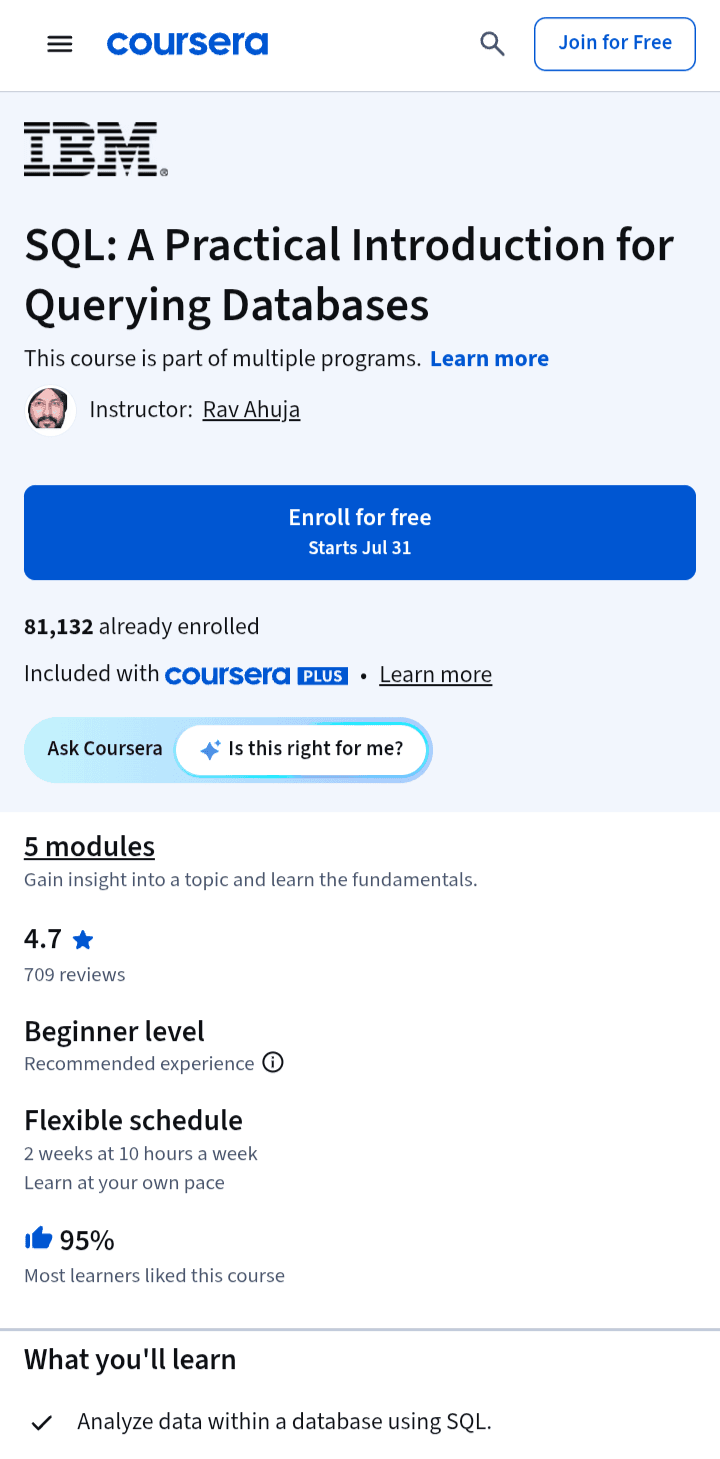
Taught by IBM’s Rav Ahuja, this course lives up to its “practical” name. It skips the theory-heavy approach and gets you writing real SQL against a live cloud database almost immediately.
No prior knowledge of databases, SQL, or programming is required, making it one of the more genuinely beginner-accessible options on this list.
What You’ll Learn
You’ll start with basic CRUD operations (CREATE, SELECT, INSERT, UPDATE, DELETE), then move into filtering, sorting, and aggregating data. From there, you’ll work with built-in functions, sub-selects, nested queries, and JOINs across multiple tables.
An optional fifth module goes further into views, transactions, and stored procedures for anyone eyeing a data engineering path.
Best For
True beginners who want hands-on practice over passive lecture-watching, and anyone considering IBM’s broader Data Science or Data Engineering professional certificates, since this course plugs directly into those tracks.
It’s also a great pick if you want your skills to transfer cleanly across multiple database systems, not just one.
Key Topics Covered
- CRUD operations (CREATE, SELECT, INSERT, UPDATE, DELETE)
- Filtering, sorting, and grouping data
- Built-in functions, date/time functions
- Sub-queries and nested SELECTs
- Working with multiple tables and JOINs
- Views, transactions, and stored procedures (advanced module)
- A final project using real Chicago city datasets
Duration
5 modules, roughly 2 weeks at 10 hours/week. Around 20 hours of content total, including hands-on labs and a final project/exam.
Certificate
The course provides a shareable certificate from IBM, and the course counts toward multiple IBM professional certificate programs on Coursera.
6. The Complete SQL Bootcamp (30 Hours): Go from Zero to Hero (Udemy)
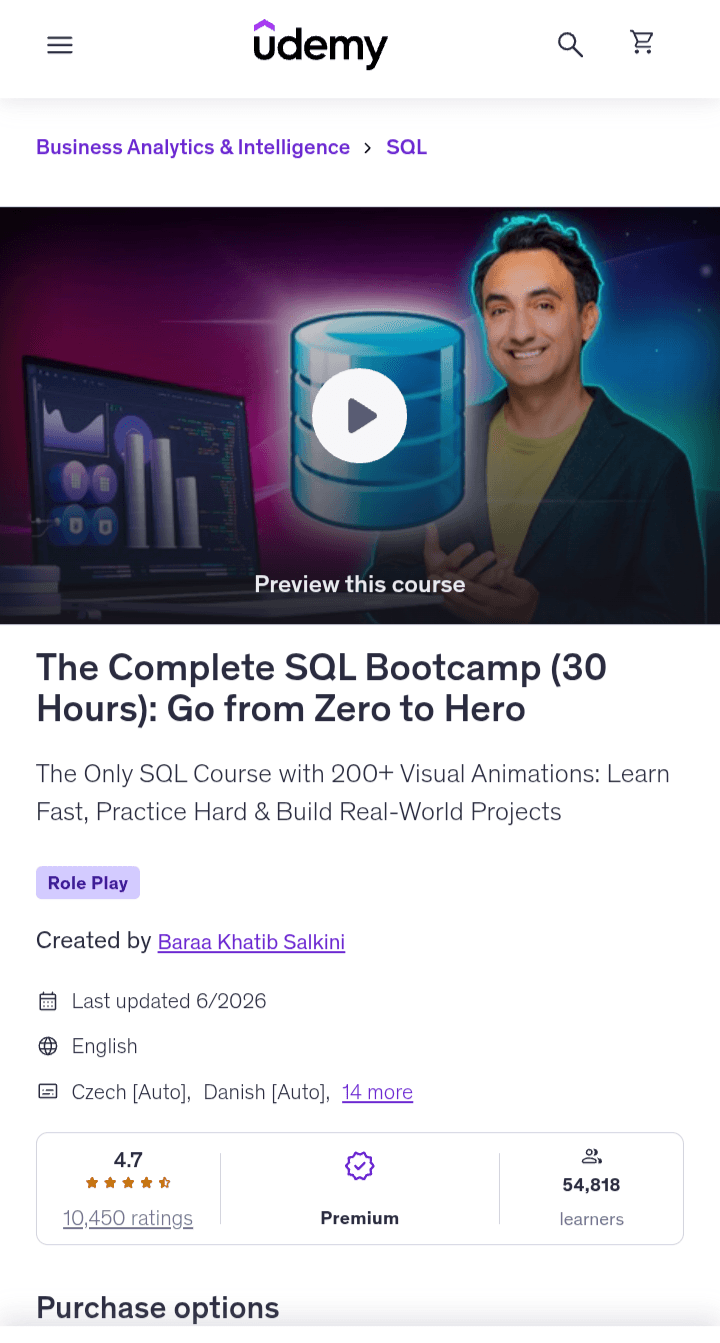
This is Udemy’s heavyweight option – nearly 30 hours of content spread across 29 sections and 301 lectures.
What sets it apart is its visual teaching style: the instructor uses over 200 custom hand-drawn animations to show how SQL actually works behind the scenes, rather than just talking through syntax.
The course is built on more than 15 years of real-world data experience at companies like Mercedes-Benz and Bosch, so the examples lean enterprise-grade rather than academic.
What You’ll Learn
You’ll cover the fundamentals of what SQL is, how databases work, and why SQL matters for working with data, then move into querying with SELECT, FROM, WHERE, GROUP BY, HAVING, and ORDER BY, and combining tables using JOINs, UNION, INTERSECT, and EXCEPT.
The course also dives into string, numeric, date/time functions, and CASE logic, plus modern additions like using ChatGPT and GitHub Copilot to generate, explain, optimize, and debug SQL.
Also Read: 10 Best ChatGPT Courses for Beginners With No AI Experience
Best For
Visual learners and complete beginners who want one long, thorough course rather than a multi-part specialization.
It’s also a strong pick for anyone who wants exposure to enterprise-style projects, like building a data warehouse from scratch.
Key Topics Covered
- SQL fundamentals and database concepts
- SELECT, WHERE, GROUP BY, HAVING, ORDER BY
- JOINs, UNION, INTERSECT, EXCEPT
- String, numeric, date/time functions, CASE logic
- Window functions, CTEs, query optimization
- AI-assisted SQL with ChatGPT and GitHub Copilot
- Real projects: data warehousing, exploratory data analysis, query performance tuning
Duration
Roughly 30 hours of on-demand video (29h 43m listed), self-paced.
Certificate
Yes, upon completion, you will get a Udemy certificate.
7. The Ultimate MySQL Bootcamp: Go from SQL Beginner to Expert (Udemy)
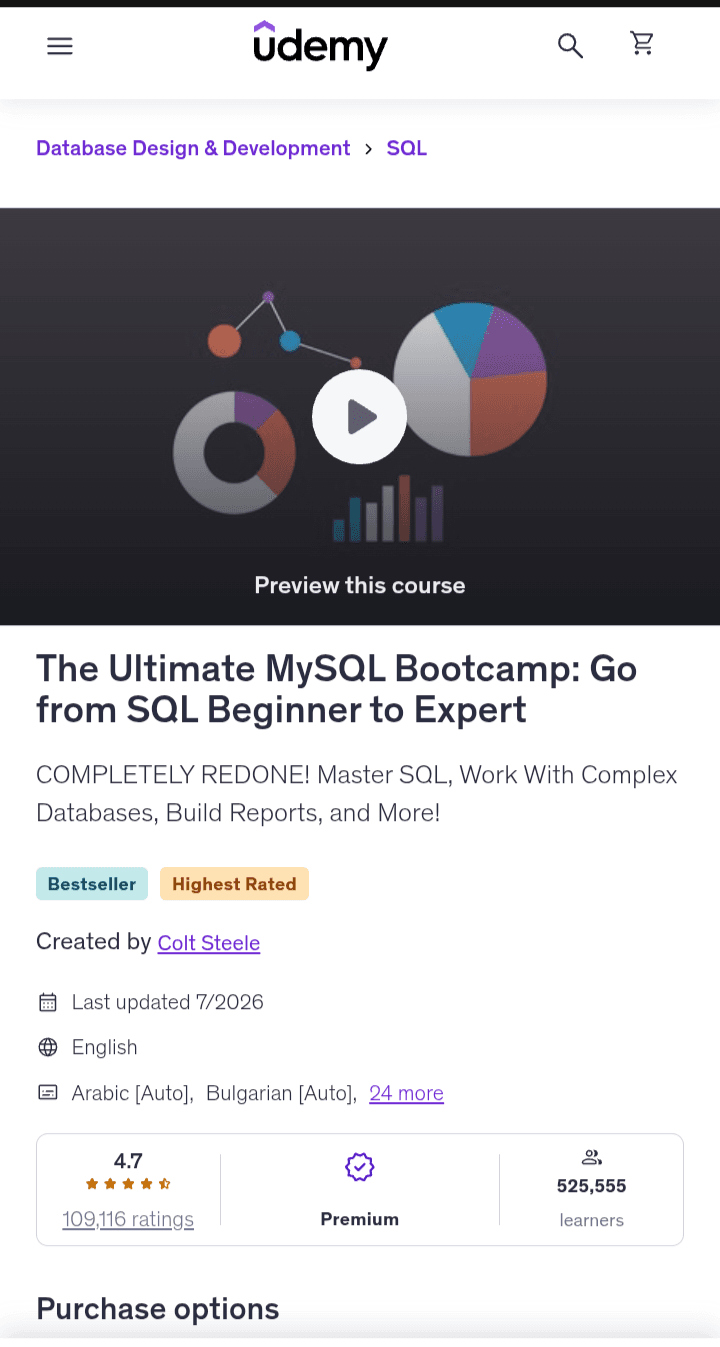
Taught by Colt Steele, known for his widely popular Web Developer Bootcamp, this course was completely rebuilt from the ground up with over 325 new videos, now running on MySQL 8.x and covering newer topics like Window Functions, Views, and SQL modes.
It’s designed for people who feel genuinely intimidated by databases, framing itself as a gentle but comprehensive introduction rather than a firehose of technical jargon.
What You’ll Learn
You’ll build a solid foundation in database concepts, then apply SQL to real-world challenges like finding a website’s power users, calculating top students, spotting bots, and identifying which hashtags drive the most engagement.
The course also covers aggregate functions, CRUD operations, and database triggers, with some lessons touching on connecting SQL to Node.js for application development.
Best For
Complete beginners who want a genuinely approachable, humor-forward teaching style rather than a dry technical lecture.
It’s a great fit for non-developers, including marketers, founders, or sales professionals, who want to build real confidence with data before going deeper.
Key Topics Covered
- SQL and database fundamentals
- CRUD operations and aggregate functions
- JOINs, subqueries, and multi-table queries
- Window functions, Views, SQL modes
- Database triggers
- Real-world projects (power users, top performers, trend analysis)
Duration
Roughly 21 hours of video content, plus 140 supporting articles and 23 downloadable resources.
Certificate
Yes, a Udemy certificate of completion.
8. Complete Data Analyst Bootcamp From Basics to Advanced (Udemy – Krish Naik)
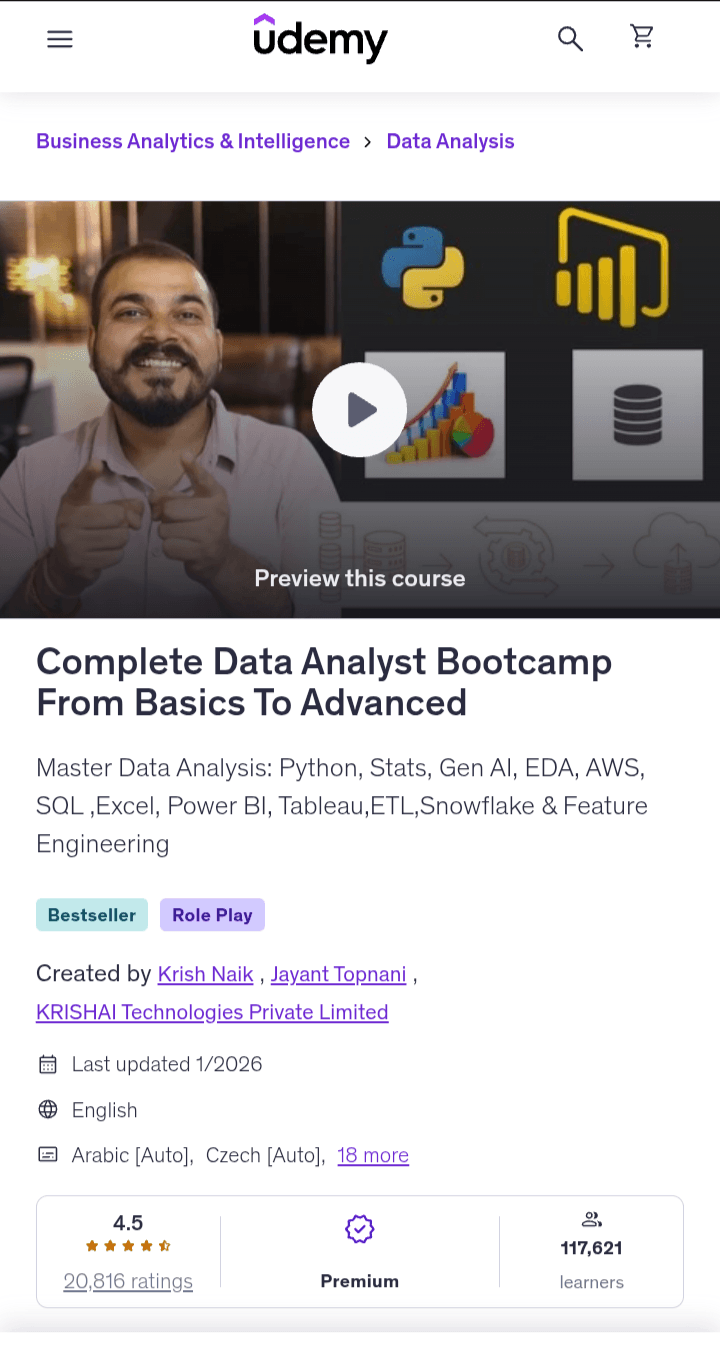
Taught by Krish Naik, a well-known instructor in the data science space, this is a sprawling 89-hour course with 391 downloadable resources that treats SQL as one piece of a much bigger data analyst toolkit, alongside Python, statistics, Power BI, and feature engineering.
It’s less “learn SQL” and more “become a data analyst, and SQL is a core part of that.”
What You’ll Learn
The SQL module specifically guides you from SQL basics to advanced querying techniques, teaching you to retrieve, manipulate, and aggregate data efficiently using SQL Server so you can work with large datasets and perform sophisticated analysis.
Beyond SQL, you’ll also work through Python for data manipulation using Pandas and NumPy, core statistics like hypothesis testing and inferential statistics, and Power BI for dashboards and reporting using DAX.
Related: Best Free Python Courses on Udemy
Best For
Beginners who want SQL taught in context, as part of a full data analyst skill set, rather than in isolation.
It’s a strong choice if your end goal is a data analyst job and you’d rather learn everything (SQL, Python, BI tools) in one structured path instead of stitching together separate courses.
Key Topics Covered
- SQL fundamentals through advanced querying (SQL Server)
- Python programming for data analysis (Pandas, NumPy)
- Statistics for data science (descriptive, inferential, hypothesis testing)
- Exploratory Data Analysis (EDA)
- Power BI dashboards and DAX
- Real-world reporting projects
Duration
Approximately 89 hours of video content with 391 downloadable resources, self-paced.
Certificate
Yes, a certificate of completion is issued upon finishing the course.
9. SQL – MySQL for Data Analytics and Business Intelligence (Udemy – 365 Careers)
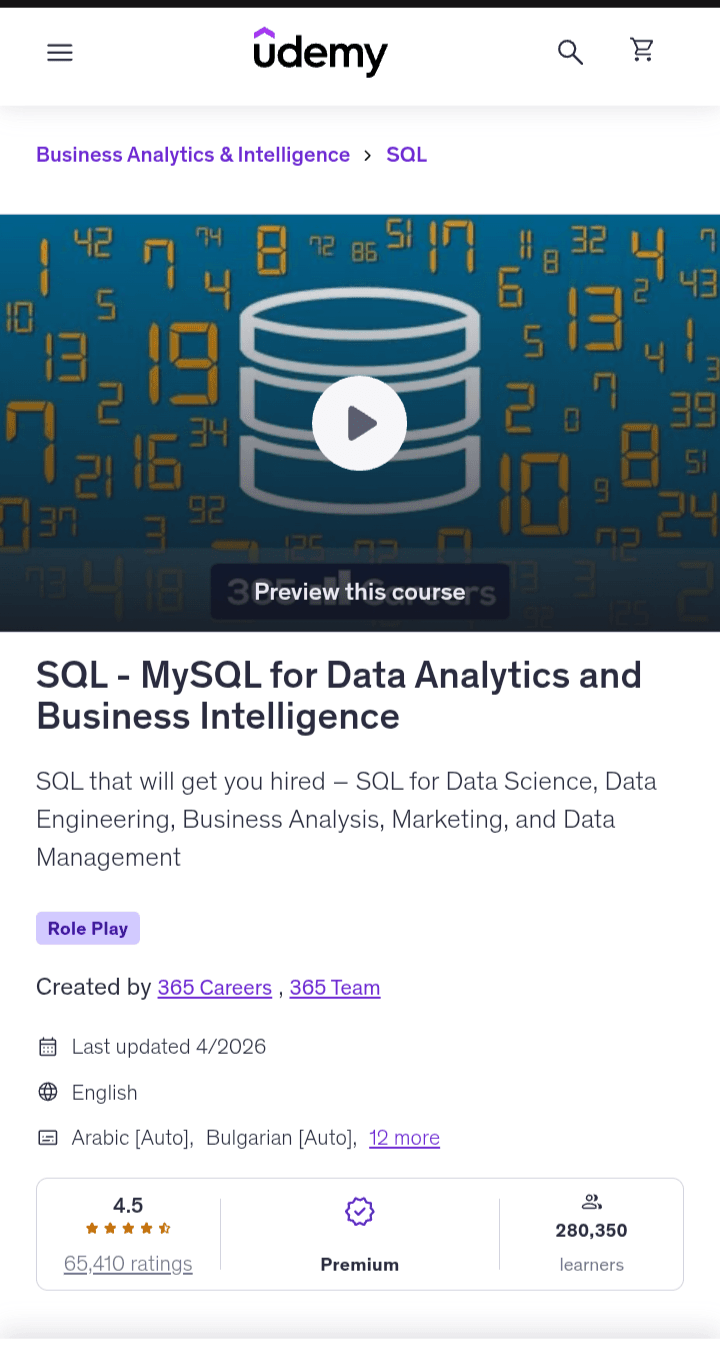
Created by 365 Careers, an education platform focused on data science and finance learners, this course positions itself as prep for real job roles: SQL developer, database administrator, business analyst, and business intelligence positions.
It leans practical and career-oriented rather than academic, with a heavy emphasis on writing clean, efficient queries.
What You’ll Learn
You’ll build up from core querying to taking full control of your dataset, inserting, updating, and deleting records, while working confidently with constraints and relating data tables.
The course then moves into more advanced programming concepts like triggers, sequences, local and global variables, and indexes, aiming to help you merge coding skills with business acumen to solve complex analytical problems.
Best For
Beginners who want to eventually apply for SQL-focused job titles (database administrator, business analyst) rather than just add SQL as a supplementary skill.
It’s also a good fit for learners who like heavy repetition and practice, as the course is built around tons of exercises designed to solidify your knowledge.
Key Topics Covered
- SQL and database fundamentals
- INSERT, UPDATE, DELETE operations
- Constraints and relational table design
- Triggers, sequences, and variables
- Indexes and query optimization basics
- Business intelligence use cases
Duration
Roughly 11.5 hours of video content, with 182 supporting articles and 99 downloadable resources.
Certificate
Yes, a Udemy certificate of completion is included.
10. SQL for Data Analysis: Beginner MySQL Business Intelligence (Udemy – Maven Analytics)
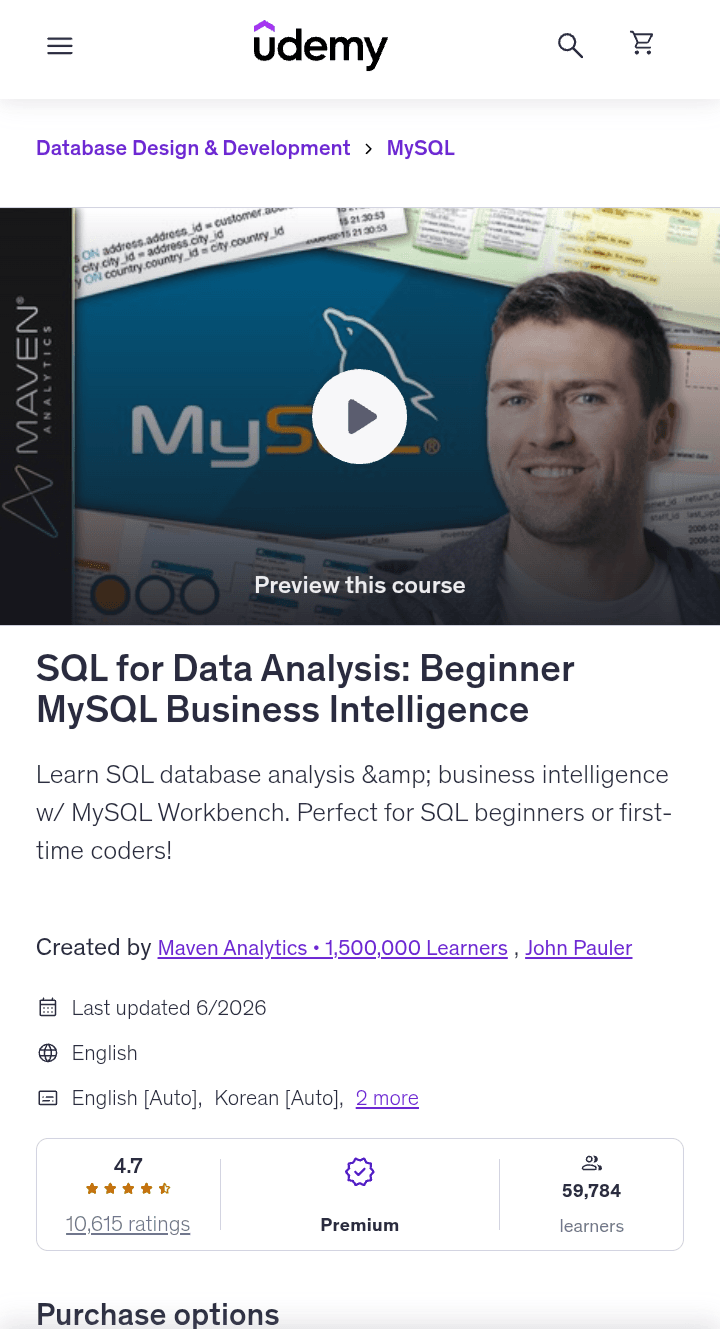
Created by Maven Analytics and taught by John Pauler, this is a genuinely beginner-friendly, project-based course built around a single, memorable scenario: you play the role of a business owner who just acquired Maven Movies, a brick-and-mortar DVD rental shop, and your mission is to learn everything you can about the business, inventory, staff, and customer behavior, using MySQL and MySQL Workbench.
Rather than jumping between random sample datasets, everything ties back to this one running case study.
What You’ll Learn
You’ll start with an introduction to SQL’s different “flavors” (MySQL, SQLite, PostgreSQL) and install MySQL Community Server and MySQL Workbench, then explore the 16 tables inside the Maven Movies database.
The first half covers writing SQL queries to select, filter, sort, and group data from individual tables, while the second half shifts to relational database concepts like primary vs. foreign keys, relationship cardinality, and normalization, along with the most common SQL join types, including INNER, LEFT, RIGHT, and OUTER.
Best For
True beginners who want a single, cohesive real-world scenario rather than disconnected practice exercises.
It’s an especially strong pick for people who want to understand SQL through the lens of business decision-making, not just syntax.
Key Topics Covered
- SQL fundamentals and MySQL setup
- SELECT, WHERE, ORDER BY, GROUP BY
- Single-table querying and filtering
- Relational database concepts (keys, cardinality, normalization)
- JOIN types (INNER, LEFT, RIGHT, OUTER)
- Business intelligence-focused analysis projects
Duration
Self-paced video course; exact runtime varies by platform listing, but it’s structured as a full beginner-to-intermediate progression through single- and multi-table analysis.
Certificate
Yes, a Udemy certificate of completion.
Which SQL Course Should You Choose?
With ten solid options, the real question isn’t “which is best.” It’s “which is best for you.” Here’s how to match your goal to the right pick.
If you’re a complete beginner, start with SQL: A Practical Introduction for Querying Databases (IBM) or SQL for Data Analysis: Beginner MySQL Business Intelligence (Maven Analytics). Both assume zero prior knowledge and get you writing real queries almost immediately, without overwhelming you with database theory upfront.
If you’re a college student, Learn SQL Basics for Data Science (UC Davis) is the natural fit. It’s university-backed, structured like an academic course, and the specialization format mirrors how you’re probably used to learning.
If you’re aiming to become a data analyst, go with SQL for Data Analysis and Business Insights (Coursera) or the Maven Analytics course. Both are built around real business scenarios and analytical thinking, not just syntax memorization.
If you’re headed toward data science, Learn SQL Basics for Data Science (UC Davis) or SQL: A Practical Introduction (IBM) make the most sense, since both plug directly into larger IBM and UC Davis data science tracks.
If you’re a software developer, Introduction to SQL (University of Michigan) is your best bet. It teaches SQL in the context of building actual applications, including database design and multi-table relationships you’ll need for real dev work.
If you’re a business analyst, SQL – MySQL for Data Analytics and Business Intelligence (365 Careers) or the Maven Analytics course are strong choices, since both are built around business decision-making rather than pure technical depth.
If you’re a working professional short on time, The Ultimate MySQL Bootcamp or the 365 Careers course are efficient, self-paced options that respect your schedule without sacrificing depth.
If you’re preparing for interviews, SQL From Beginner to Advanced (LearnKartS) stands out. It’s the only course on this list with a dedicated interview-preparation module covering the exact patterns employers test for.
If you’re a certification seeker, look at Learn SQL Basics for Data Science (UC Davis) or SQL: A Practical Introduction (IBM). Both come from recognized institutions and plug into broader professional certificate tracks that carry more weight on a resume than a standalone certificate.
How to Choose the Right SQL Course
With so many options claiming to be “the best,” it helps to know what actually separates a course worth your time from one that’ll leave you stuck. Here’s what to look for.
Beginner-friendly teaching
Not every course labeled “beginner” actually starts from zero. Some assume you already know basic terminology or are comfortable installing software (looking at you, MAMP/XAMPP setups).
Before enrolling, check the course description for phrases like “no prior experience required” versus “some related experience recommended.” That one line tells you a lot about where the course actually starts.
Hands-on projects
SQL is a skill you learn by doing, not by watching. The best courses on this list, like Maven Analytics’ Maven Movies scenario or IBM’s Chicago dataset project, build your skills around one continuous, realistic business case instead of scattered, disconnected exercises.
Look for courses that let you apply what you just learned immediately, ideally against a real (or realistic) dataset.
Exercises and quizzes
Passive video-watching doesn’t build muscle memory. Courses with frequent quizzes, coding challenges, and graded assignments force you to actually retrieve what you learned, which is what makes it stick.
If a course’s syllabus is mostly video runtime with little mention of practice, be cautious.
Real databases
There’s a real difference between practicing on toy data (a handful of rows in a spreadsheet-like table) and working with an actual relational database containing multiple interconnected tables.
Courses that use real or realistic databases like e-commerce systems, movie rental shops, and city government data teach you to think in joins and relationships, which is what the job actually requires.
Instructor quality
Look for instructors with real-world data experience, not just teaching credentials.
Someone who’s spent years working with data at actual companies (like Colt Steele’s dev bootcamp background or the Complete SQL Bootcamp’s enterprise experience) tends to teach the “why” behind SQL decisions, not just the “how.”
Certificate value
Not all certificates carry the same weight. A certificate from a recognized university (UC Davis, University of Michigan) or major tech company (IBM) tends to hold more credibility with employers than a generic platform completion certificate.
That said, for personal skill-building rather than resume-building, this matters less.
Platform reputation
Coursera courses tend to be more structured and academically rigorous, with fixed modules and assessments.
Udemy courses are typically more flexible and instructor-driven, with a wider range of quality, so check ratings and reviews carefully before buying.
Related: Coursera Vs Udacity: Which Is Better?
Community support
Learning alone is harder than learning with others. Courses with active Q&A sections, discussion forums, or a large existing learner base (some of these courses have over a million students) mean you’re less likely to get stuck without help when you hit a confusing concept.
Frequently Asked Questions
Can I learn SQL with no programming experience?
Yes. SQL reads closer to plain English than most programming languages. Courses like IBM’s practical introduction or Maven Analytics’ beginner course require zero prior coding background to start confidently.
Which SQL course is best for getting a job?
IBM’s SQL: A Practical Introduction and 365 Careers’ Data Analytics course both target job-ready skills directly, covering CRUD operations, joins, and business intelligence use cases employers actively screen for.
Are free SQL courses enough?
For basics, yes. But free courses often lack structured projects, feedback, and depth in joins or database design. Beginners serious about analyst roles usually benefit from a paid, project-based course eventually.
Which SQL dialect should beginners learn?
Start with MySQL or PostgreSQL; both are free, widely taught, and transferable. Core SQL syntax stays consistent across dialects, so switching to SQL Server or Oracle later requires minimal relearning.
Do SQL certificates matter?
Certificates from recognized institutions like IBM or UC Davis carry some resume weight, but employers care more about demonstrated query skills. A strong portfolio project matters more than the certificate itself.
Is SQL enough for data analytics?
No. SQL is foundational but not sufficient alone. Most analyst roles also expect Excel, a visualization tool like Power BI or Tableau, and basic statistics for interpreting results and communicating insights.
Final Verdict
If you only pick one course, choose based on how you learn. Want structure and credibility? Go with SQL: A Practical Introduction for Querying Databases (IBM). It is beginner-friendly, hands-on, and backed by a name employers recognize.
Prefer a real business scenario over dry theory? SQL for Data Analysis (Maven Analytics) delivers that.
Either way, stop researching and start writing queries.
Pick one course from this list today, commit to finishing it within 30 days, and build one small project using your own data before moving on to your next skill.
Related Articles
11 Data Science Mistakes Beginners Make (And How to Avoid Them)
Udemy Courses for Aspiring Data Scientists
10 Best Deep Learning Courses with Hands-On Projects: Learn AI Through Real-World Projects
10 Best Machine Learning Courses for Beginners: Start Learning ML the Right Way

TechnicalStudies was started by Neeladrinath with one simple idea — give Indian students a reliable place to figure out what’s actually worth their time and money. Every recommendation here is backed by careful research, real student feedback, and honest analysis. We cover online courses, laptops, smartwatches, software deals, and learning resources — all looked at from a student’s perspective, so you can spend less time guessing and more time learning.