
Short-form video has taken over. Instagram Reels now drive more reach than any other content format on the platform, and whether you’re a creator, a business owner, or a marketer, showing up consistently with Reels is no longer optional. It’s how you grow.
But here’s the real problem: coming up with fresh, engaging scripts week after week is exhausting.
The hook, the story, the CTA – every Reel demands a structure that holds attention within the first two seconds. Most people either burn out or post content that simply doesn’t perform.
That’s exactly where ChatGPT changes the game. Instead of staring at a blank screen, you can generate scroll-stopping Reel scripts in minutes, tailored to your niche, your tone, and your audience. It’s not about replacing your creativity; it’s about giving it a faster engine.
In this guide, you’ll learn how to use ChatGPT for Reels script writing step by step, including ready-to-use prompts, real script examples, and tips to make every Reel feel native, not robotic.
Let’s get into it.
What Is Reels Script Writing?
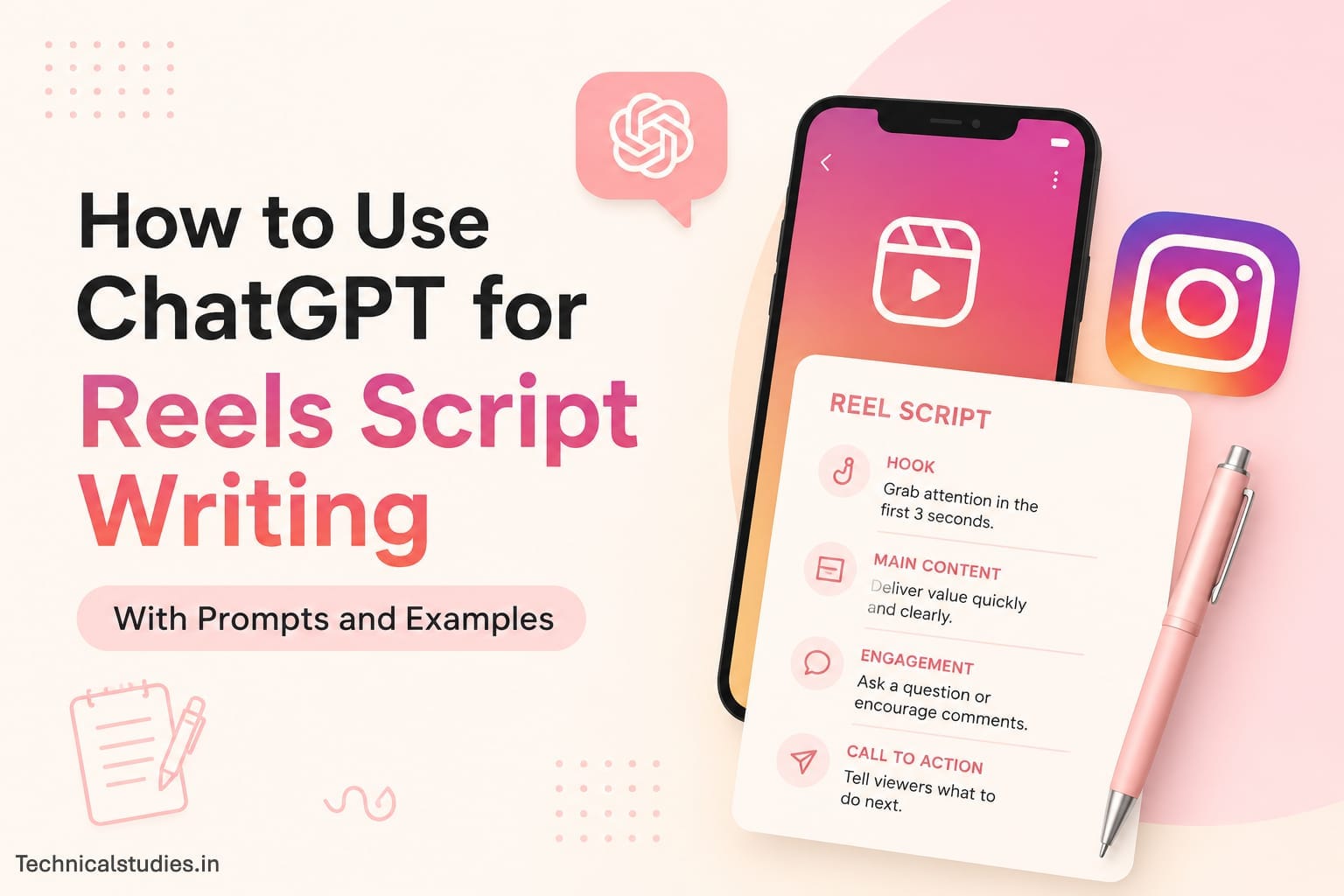
A Reel script isn’t just words on a page; it’s a calculated sequence designed to grab attention, deliver value, and drive action, all within 15 to 60 seconds. Understanding its structure is what separates Reels that get 200 views from ones that get 200,000.
The Anatomy of a High-Performing Reel
Hook (0–3 seconds)
This is everything. If your opening line doesn’t stop the scroll, nothing else matters. A strong hook triggers curiosity, challenges a belief, or makes a bold promise, instantly.
Main Content (4–45 seconds)
This is where you deliver the value. Keep it tight, structured, and easy to follow. One idea per Reel always outperforms trying to say too much.
Engagement Trigger
Plant a reason for viewers to comment, save, or share. This can be a question, a relatable moment, or a controversial take. This is what signals the algorithm that your content is worth pushing.
Call-to-Action (CTA)
Tell your viewer exactly what to do next, such as follow, save, click the link, or watch another video. A Reel without a CTA leaves reach on the table.
Why Scripted Reels Outperform Improvised Videos
Scripting isn’t restrictive; it’s strategic. Scripted Reels hold better retention because every second is intentional. They deliver clearer messaging without rambling.
They maintain consistent branding across every post. And they enable faster content production, so you’re never scrambling for what to say again.
Structure is what turns a good idea into a performing Reel.
Can ChatGPT Write Reels Scripts?
Short answer: yes. But knowing what it’s good at and where you still need to show up will help you get far better results.
What ChatGPT Is Good At
ChatGPT genuinely excels at the mechanical heavy lifting of script writing. Stuck on ideas? It can generate dozens in seconds. Can’t nail the opening line?
It’ll write you ten hook variations to choose from. Need a full script structured with a hook, body, and CTA? Done in under a minute.
It’s also brilliant at repurposing content, turning a blog post, caption, or tweet into a Reel script effortlessly. And if you need to shift from a professional tone to a casual, fun one, it adapts instantly.
Where Human Creativity Still Matters
ChatGPT doesn’t know what’s trending in your niche right now; you do. It can’t pull from a personal story that only you’ve lived through.
It doesn’t automatically carry your brand voice unless you teach it to. And it has no real understanding of your specific audience’s pain points, humor, or language.
The sweet spot? Let ChatGPT handle the structure and speed. You bring the context and personality.
Together, that’s a seriously powerful content workflow.
Benefits of Using ChatGPT for Reels Script Writing
If you’ve ever spent two hours trying to write a 30-second script, you already understand why this matters.
Save Hours on Content Planning
What used to take an afternoon now takes minutes. ChatGPT can plan, draft, and refine a week’s worth of Reel scripts faster than you can finish your coffee.
Overcome Creative Blocks
Every creator hits a wall. Instead of waiting for inspiration to show up, you can prompt ChatGPT and immediately have fresh angles, hooks, and ideas flowing again. The blank page problem essentially disappears.
Generating Endless Content Ideas
Running out of content ideas is one of the biggest reasons creators go quiet. ChatGPT can pull from your niche, your audience’s pain points, and trending formats to keep your content calendar full.
Create Scripts for Multiple Niches
Managing more than one account or brand? ChatGPT switches between niches, tones, and audiences without missing a beat – no extra brain power required from you.
Maintaining a Consistent Posting Schedule
Consistency is what builds audiences. When scripting becomes fast and easy, showing up regularly stops feeling like a burden and starts feeling manageable.
How to Use ChatGPT for Reels Script Writing: Step-by-Step

This is where everything clicks into place. Follow these steps, and you’ll go from a blank page to a ready-to-film Reel script in under 15 minutes.
Step 1: Define Your Audience
Before you type a single prompt, get clear on who you’re talking to. ChatGPT produces dramatically better scripts when you give it specific audience context – age, experience level, interests, and pain points. Vague inputs produce vague outputs.
Example Prompt: “Act as a social media strategist. My audience consists of beginner fitness enthusiasts. Suggest 20 Reel topics they would find valuable.”
The more specific you are about your audience, the more targeted and usable the ideas you get back.
Step 2: Decide the Goal of Your Reel
Not every Reel serves the same purpose. Before writing a single word, decide what you want this Reel to do. Here are the five core Reel types to choose from:
- Educational Reels: Teach your audience something useful or actionable
- Promotional Reels: Highlight a product, service, or offer
- Storytelling Reels: Share an experience, journey, or behind-the-scenes moment
- Personal Branding Reels: Build trust and show who you are beyond your content
- Engagement-Focused Reels: Spark conversations, debates, or saves
Each type needs a different structure, tone, and CTA. Knowing your goal upfront tells ChatGPT exactly what kind of script to write.
Example Prompt: “Generate 10 educational Reel ideas about productivity for remote workers.”
Step 3: Generate Reel Ideas Using ChatGPT
Once you know your audience and goal, use ChatGPT to flood your content calendar with ideas. Don’t just ask for a handful; ask for 20 or 30 at a time. You’ll use the best ones and discard the rest.
Example Prompt: “Generate 30 Instagram Reel ideas for a men’s fashion creator targeting Indian professionals.”
Pro Tip: Don’t stop at one idea dump. Ask ChatGPT to break ideas down by category for a more balanced content mix.
- Beginner topics: for new followers still learning the basics
- Advanced topics: for your loyal audience that wants to go deeper
- Trending topics: for reach and discoverability
- Myth-busting topics: for engagement and shares, these almost always perform well
Step 4: Create a Reel Script Outline
Now take one idea and turn it into an actual script. Give ChatGPT the topic, the format length, and the structure you need.
A 30-second script typically covers one hook, two to three main points, and a CTA, and that’s exactly what you should ask for.
Example Prompt: “Create a 30-second Instagram Reel script about dressing well on a budget. Include a hook, main points, and CTA.”
Review what comes back, tweak it to match your voice, and you’ve got a filmable script in minutes.
Step 5: Improve the Hook
You could have the best content in the world, but if your first three seconds are weak, nobody sees it.
The hook is the single most important line in your entire script. It’s worth spending extra time getting it right.
Ask ChatGPT to generate multiple hook options so you can pick the strongest one, or even test a few across different Reels.
Example Hook Prompt: “Generate 20 attention-grabbing hooks for a Reel about productivity mistakes.”
Look for hooks that create curiosity, challenge a common belief, or make a bold claim. Those three styles consistently outperform generic openers.
Step 6: Add Engagement Elements
A great script doesn’t just inform; it pulls people in and gives them a reason to interact. Ask ChatGPT to layer in engagement elements that boost comments, saves, and shares.
- Curiosity loops: tease something early that you resolve at the end
- Pattern interrupts: say something unexpected that snaps attention back
- Questions: get viewers thinking and responding
- Calls for comments: directly invite people to share their opinion
Example Prompt: “Rewrite this Reel script and add curiosity-driven hooks and engagement triggers.”
Step 7: Generate Multiple Variations
Never settle for the first version. Ask ChatGPT to rewrite the same script in different tones so you can find the one that fits your style, or repurpose the same idea across multiple accounts.
Example Prompt: “Create 5 different versions of this Reel script using different tones: professional, casual, humorous, motivational, and storytelling.”
This is especially powerful if you manage content for multiple brands or clients. One idea, five executions, zero extra research.
25 Best ChatGPT Prompts for Reels Script Writing
These prompts are ready to copy, paste, and customize. Replace the bracketed details with your niche, topic, or brand, and let ChatGPT do the heavy lifting.
Prompts for Reel Ideas
1. Content Idea Generator: “Act as a social media content strategist. Generate 30 Instagram Reel ideas for a [your niche] creator targeting [your audience]. Include educational, entertaining, and promotional ideas.”
2. Trend-Based Reel Ideas: “What are the most engaging Instagram Reel content formats right now for [your niche]? Give me 15 ideas I can film this week using trending structures like ‘POV’, ‘things nobody tells you’, or ‘day in my life’.”
3. Niche-Specific Reel Ideas: “I create content for [specific niche]. Generate 20 Reel ideas across these four categories: beginner tips, advanced strategies, myth-busting, and behind-the-scenes. Make each idea scroll-stopping and specific.”
4. Content Pillar Reel Ideas: “My content pillars are [pillar 1], [pillar 2], and [pillar 3]. Generate 10 Reel ideas for each pillar that would resonate with [target audience].”
5. Problem-Based Idea Generator: “List the top 10 frustrations and struggles of [target audience]. Then turn each frustration into a Reel idea that offers a quick, actionable solution.”
Prompts for Reel Hooks
6. Curiosity Hook Prompt: “Write 15 curiosity-driven hooks for a Reel about [topic]. Each hook should make the viewer feel like they absolutely need to keep watching to get the answer.”
7. Problem-Solution Hook Prompt: “Generate 15 hooks for a Reel about [topic] that open by naming a painful problem my audience faces. Make the viewer feel instantly understood in the first line.”
8. Contrarian Hook Prompt: “Write 10 contrarian hooks for a Reel about [topic]. Challenge a common belief or popular advice that most people in [niche] accept as true.”
9. Statistic Hook Prompt: “Create 10 hooks for a Reel about [topic] that open with a surprising or counterintuitive statistic. The stat should immediately challenge what the viewer thinks they know.”
10. Bold Claim Hook Prompt: “Write 10 bold, declarative hooks for a Reel about [topic]. Each should make a confident, specific claim that stops someone mid-scroll and makes them want proof.”
Prompts for Full Reel Scripts
11. Educational Reel Prompt: “Write a 45-second educational Instagram Reel script about [topic] for [target audience]. Structure it with a strong hook, 3 actionable tips, and a CTA that encourages saves or follows.”
12. Storytelling Reel Prompt: “Write a 60-second storytelling Reel script about [personal experience or case study]. Open with a relatable struggle, walk through what changed, and end with a lesson the audience can apply today.”
13. Promotional Reel Prompt: “Write a 30-second promotional Reel script for [product or service]. Lead with the problem it solves, show the transformation it delivers, and close with a clear, low-pressure CTA. Don’t make it sound like a traditional ad.”
14. Personal Brand Reel Prompt: “Write a 45-second personal brand Reel script where I introduce who I am, who I help, and what makes my approach different. My niche is [niche], and my audience is [audience]. Make it feel authentic, not rehearsed.”
15. Product Review Reel Prompt: “Write a 60-second honest product review Reel script for [product name]. Cover what it is, who it’s for, what I liked, one drawback, and whether I’d recommend it. Keep the tone conversational and trustworthy.”
16. Listicle Reel Prompt: “Write a fast-paced 30-second Reel script in a listicle format – ‘5 things [audience] needs to stop doing.’ Use punchy, one-liner delivery for each point and end with a strong CTA.”
17. Motivational Reel Prompt: “Write a 45-second motivational Reel script for [audience] who feel stuck with [problem]. Open with empathy, shift the perspective in the middle, and close with an energizing call to action.”
Prompts for Rewriting Existing Content
18. Blog-to-Reel Prompt: “Here is a blog post I wrote about [topic]: [paste blog post]. Extract the single most valuable insight from it and rewrite it as a punchy 30-second Instagram Reel script with a hook, key point, and CTA.”
19. YouTube-to-Reel Prompt: “Here is the transcript from my YouTube video about [topic]: [paste transcript]. Condense the best 60 seconds of value into an Instagram Reel script that works as a standalone piece of content and drives viewers to watch the full video.”
20. Podcast-to-Reel Prompt: “Here is a section from my podcast episode on [topic]: [paste excerpt]. Turn this into a 45-second Reel script that captures the most quotable, shareable moment. Keep the conversational tone intact.”
21. LinkedIn Post-to-Reel Prompt: “Here is a LinkedIn post I wrote: [paste post]. Rewrite it as a 30-second Instagram Reel script. Adjust the tone from professional to conversational and add a visual storytelling element that works on camera.”
22. Twitter Thread-to-Reel Prompt: “Here is a Twitter thread I wrote about [topic]: [paste thread]. Turn the best points into a fast-paced 45-second Reel script. Use a listicle or countdown format to maintain energy throughout.”
Bonus Prompts for Refinement
23. Tone Variation Prompt: “Rewrite this Reel script in 5 different tones: professional, casual, humorous, motivational, and storytelling. Keep the core message the same but make each version feel distinctly different.”
24. Audience-Specific Rewrite Prompt: “Rewrite this Reel script for a [new audience – e.g. beginner vs. expert, student vs. professional]. Adjust the language, examples, and assumptions to match where this audience is right now.”
25. CTA Optimization Prompt: “Here is my Reel script: [paste script]. Rewrite the last 10 seconds with 5 different CTA options – one for follows, one for saves, one for comments, one for shares, and one for a link click. Make each feel natural, not pushy.”
Real ChatGPT Reels Script Examples
Prompts are only half the story. Here’s exactly what happens when you put them to work: real prompts, real outputs, and a breakdown of why each script is built to perform.
Example 1: Fitness Coach Reel
Prompt Used: “Write a 45-second educational Instagram Reel script for beginner fitness enthusiasts about why they’re not seeing results despite working out regularly. Include a strong hook, 3 actionable reasons, and a CTA to follow for more tips.”
ChatGPT Output:
🎬 [Hook] “You’re showing up to the gym every day, so why is nothing changing?”
[Main Content] “Here are 3 reasons most beginners stop seeing progress:
Number one: you’re not eating enough protein. Your muscles can’t grow without it. Aim for at least 0.8 grams per pound of bodyweight daily.
Number two: you’re doing too much cardio and not enough strength training. Cardio burns calories. Strength training changes your body composition.
Number three: you’re not sleeping enough. This is where your body actually builds muscle. Less than 7 hours and your results slow down dramatically.
Fix these three things before you change anything else.”
[CTA] “Follow for more beginner fitness tips that actually make sense.”
Why It Works: The hook speaks directly to a frustration every beginner feels, i.e., effort without results. It doesn’t talk at the viewer; it talks to them.
Each of the three points is specific and actionable, not vague advice like “eat better.” The CTA is simple, benefit-driven, and doesn’t feel forced. This script would hold attention from the first frame to the last second.
Example 2: Men’s Fashion Reel
Prompt Used: “Write a 30-second Instagram Reel script for a men’s fashion creator targeting Indian professionals. Topic: how to look sharp at the office without spending a lot of money. Use a contrarian hook and keep the tone practical and confident.”
ChatGPT Output:
🎬 [Hook] “Looking expensive at work has nothing to do with how much you spend.”
[Main Content] “Three things that instantly upgrade any office outfit:
One: fit over brand. A well-fitted shirt from a high street brand beats a baggy designer one every single time. Get your clothes tailored. It costs less than you think.
Two: stick to neutrals. Navy, white, grey, and beige never clash and always look intentional.
Three: clean shoes. Nobody remembers your shirt. Everyone notices dirty shoes.”
[CTA] “Save this and follow for more practical style tips for Indian professionals.”
Why It Works: The contrarian hook immediately challenges a belief most people hold that looking good costs money. That tension earns the watch.
The three tips are punchy and deliver genuine value without padding. Telling viewers to save the video is a smart CTA choice here because style tips are reference content, and people want to come back to them.
The niche-specific language (“Indian professionals”) makes the audience feel like this was made exactly for them.
Example 3: Small Business Promotion Reel
Prompt Used: “Write a 30-second promotional Reel script for a homemade skincare brand targeting women aged 25–35. The product is a natural face serum. Lead with the problem, show the transformation, and close with a soft CTA. Don’t make it sound like an ad.”
ChatGPT Output:
🎬 [Hook] “If your skin feels dull, congested, and just… tired — this might be why.”
[Main Content] “Most skincare products are packed with synthetic fillers that sit on top of your skin without actually doing anything. Our natural face serum uses only cold-pressed ingredients that absorb within seconds — no greasy residue, no harsh chemicals.
Within two weeks, customers are reporting brighter skin, fewer breakouts, and that ‘glass skin’ look everyone’s chasing.
It’s not magic – it’s just ingredients that actually work.”
[CTA] “Link in bio to try it. We only restock once a month — just so you know.”
Why It Works: This script earns trust before it sells. The hook identifies a real feeling the audience already has. It doesn’t open by talking about the product at all.
The middle section explains why other products fail before introducing this one, which makes the solution feel logical rather than pushy.
The CTA is clever; it’s soft but uses scarcity naturally (“we only restock once a month”) without sounding manipulative. This is how product Reels should be written.
Example 4: Tech Content Creator Reel
Prompt Used: “Write a 45-second educational Reel script for a tech content creator. Topic: 3 free AI tools that save hours of work every week. Target audience: freelancers and solopreneurs. Use a curiosity hook and end with a CTA to comment on their favourite AI tool.”
ChatGPT Output:
🎬 [Hook] “Most freelancers are still doing manually what AI can do in 30 seconds.”
[Main Content] “Three free AI tools that are genuinely changing how I work:
Number one: Notion AI. I use it to draft project briefs, meeting notes, and client proposals in minutes. Game changer for anyone drowning in admin.
Number two: Otter.ai. It transcribes every call and meeting automatically so I never have to take notes while trying to stay present in a conversation.
Number three: ChatGPT. From writing emails to brainstorming content ideas to debugging copy, it’s the first thing I open every morning.
These three tools alone have given me back nearly 10 hours a week.”
[CTA] “Drop your favourite AI tool in the comments – I want to know what you’re using.”
Why It Works: The hook creates immediate tension. It makes freelancers feel like they might be behind, which is a powerful motivator to keep watching.
Each tool recommendation feels personal (“I use it”, “I open every morning”) rather than like a list pulled from a blog post. The quantified payoff – “10 hours a week” – gives the content a tangible outcome that viewers remember.
The comment CTA is perfect for this topic because everyone has an opinion on their favourite tools, making engagement almost automatic.
Note: I got these outputs using these prompts. You may get different outputs, as ChatGPT does not give the same answers to everyone.
How to Turn Existing Content Into Reels With ChatGPT
You don’t always need new ideas. You already have a goldmine of content sitting in your blog, your YouTube channel, and your social media archives.
ChatGPT can help you extract the best moments and reshape them into Reels in a fraction of the time it took to create the original content.
This is called content repurposing, and it’s one of the smartest ways to stay consistent without constantly starting from scratch.
Convert Blog Posts Into Reels
A single well-written blog post can fuel five to ten Reels easily. Most blog posts contain multiple insights, tips, and stories, and each one is a potential standalone Reel. You just need to know how to extract them.
Here is an Example Workflow:
Step 1: Paste the article: Copy your full blog post and paste it into ChatGPT. Give it context: “This is a blog post I wrote for [your audience] about [topic].”
Step 2: Extract key points: Prompt ChatGPT to pull out the most valuable, standalone insights.
“Read this blog post and list the 10 most valuable points that would each work as a standalone Reel topic.”
Step 3: Create Reel ideas: Take those extracted points and turn them into Reel concepts.
“Turn each of these 10 points into a specific Reel idea with a working title and a one-line description of what the Reel would cover.”
Step 4: Generate scripts: Pick your best two or three ideas and go deeper.
“Write a 45-second Reel script for [chosen idea]. Include a hook, the core insight, and a CTA to read the full blog post via the link in bio.”
Step 5: Create hooks: Once you have the script, squeeze more out of it by generating hook variations.
“Write 10 different hooks for this Reel script. Try curiosity-based, problem-based, and contrarian angles.”
By the end of this workflow, one blog post has become a full week of Reel content.
Convert YouTube Videos Into Reels
Your YouTube videos are already packed with valuable moments. The challenge is finding them quickly and reshaping them for a short-form audience that wants the insight without the build-up.
Start by copying your video transcript. Most YouTube videos generate automatic captions. Simply open the transcript, copy the full text, and paste it into ChatGPT.
Example Prompt: “Here is the transcript from my YouTube video about [topic]: [paste transcript]. Summarize this YouTube video into five 30-second Reel scripts. Each script should work as a standalone piece of content and end with a CTA that drives viewers to watch the full video.”
What you get back is five ready-to-film scripts pulled directly from content you already made. Each one drives traffic back to the original video, which means your Reels and your YouTube channel grow each other simultaneously.
You can also go a step further and ask ChatGPT to identify the single most quotable or shareable moment in the entire transcript – that one clip that would make someone stop scrolling and want more. That’s your lead Reel.
Convert Long Social Media Posts Into Reels
Long-form captions on Instagram or LinkedIn often contain more value than people realise. They’re just buried in a format that limits reach. Reels give that same content the visibility it deserves.
Example Prompt: “Here is a long Instagram caption I wrote about [topic]: [paste caption]. Rewrite it as a 30-second Reel script. Convert the key insight into a spoken, camera-facing delivery. Adjust the tone from written to conversational and add a hook at the beginning that works on video.”
The key shift here is moving from written language to spoken language. Long captions tend to be structured for reading.
Reels need punchy, natural delivery that sounds like you’re talking to one person, not writing to a thousand. ChatGPT handles that translation extremely well.
You can also reverse-engineer your best-performing posts. Take the caption that got the most saves or shares and ask ChatGPT to turn it into three different Reel scripts; each one approaching the same idea from a slightly different angle.
Advanced ChatGPT Techniques for Better Reel Scripts
Once you’ve got the basics down, it’s time to go deeper. These techniques are what separate creators who get decent results from ChatGPT and creators who get scripts that genuinely sound like them. These are platform-ready, audience-specific, and built to convert.
Ask ChatGPT to Mimic a Specific Tone
The biggest complaint people have about AI-generated scripts is that they sound generic. The fix is simple: tell ChatGPT exactly what tone you want. Don’t leave it to guess.
Here are the four most effective tones for Reels and how to prompt each one:
Professional
Best for B2B creators, consultants, coaches, and anyone building authority in a serious niche.
“Rewrite this Reel script in a professional, authoritative tone. The audience is [target audience]. Keep the language sharp, credible, and confident – no slang, no filler.”
The output should feel like advice from a trusted expert, not a content machine.
Conversational
This is the tone that performs best on Instagram for most niches. It feels like a friend giving you genuinely useful advice, which is relaxed, direct, and easy to follow.
“Rewrite this Reel script in a conversational tone. It should sound like I’m talking to one person, not presenting to an audience. Use short sentences, natural pauses, and everyday language.”
If your audience skews younger or your brand is built on relatability, this is your default tone.
Humorous
Humour drives shares faster than almost any other content style. But it has to feel natural because forced humour is painfully obvious on camera.
“Rewrite this Reel script with a humorous tone. Add wit, a self-aware observation, or a punchline that fits naturally into the content. The humour should feel effortless, not like it’s trying too hard.”
Use this tone for relatable content, myth-busting Reels, and any topic where a little lightness makes the message land better.
Inspirational
Motivational Reels consistently drive saves and shares because people want to come back to content that made them feel something. This tone works brilliantly for personal brand builders, coaches, and wellness creators.
“Rewrite this Reel script in an inspirational tone. Open with empathy, build toward a mindset shift, and close with a line that makes the viewer feel capable and motivated. Avoid clichés.”
The key instruction here is “avoid clichés”; without it, ChatGPT tends to lean on overused phrases that drain the energy out of motivational content.
Create Platform-Specific Scripts
The same script doesn’t work equally well across every platform. Each one has a different audience expectation, ideal length, and content culture. Here’s how to tailor your ChatGPT prompts for each.
Instagram Reels
Instagram rewards trending formats, strong visual hooks, and content that drives saves and comments. The audience expects polished, value-packed content that feels native to the platform.
“Write a 30-second Instagram Reel script about [topic] for [audience]. Use a trending format – either a listicle, myth-bust, or POV opener. Keep the energy high and the pacing tight. End with a CTA that encourages saves.”
Facebook Reels
Facebook’s Reels audience tends to be slightly older and responds better to storytelling, community-driven content, and practical how-to formats. Less trend-chasing, more substance.
“Write a 45-second Facebook Reel script about [topic] for [audience]. Use a storytelling or problem-solution format. The tone should be warm, relatable, and community-focused. End with a CTA that encourages comments or shares.”
YouTube Shorts
YouTube Shorts viewers are already in a discovery mindset. They’re actively looking for content to explore. This platform rewards educational depth, strong retention, and CTAs that drive channel subscriptions.
“Write a 60-second YouTube Shorts script about [topic] for [audience]. Open with a hook that teases a surprising outcome or insight. Deliver one highly specific, actionable tip and close with a CTA to subscribe for more videos like this.”
Tailoring your prompt to the platform takes ten extra seconds and produces a script that feels native rather than copy-pasted across channels.
Use ChatGPT to Generate CTA Variations
Most creators write one CTA and use it on every Reel. That’s a missed opportunity. Different content goals need different CTAs, and testing variations is one of the easiest ways to improve your engagement rate over time.
Here’s how to prompt ChatGPT for each CTA type.
Comment CTA
Comment CTAs work best when you ask a question that has a real, easy answer. The lower the barrier to respond, the more comments you get.
“Write 10 comment CTA variations for a Reel about [topic]. Each should ask a question that’s easy and fun to answer. Avoid yes/no questions – aim for ones that invite a short personal response.”
Follow CTA
Follow CTAs need to sell the value of following, not just ask for it. Tell viewers what they’ll get if they hit follow.
“Write 10 follow CTA variations for a [niche] creator. Each should clearly communicate what new followers will learn or gain. Making them feel like following is an obvious decision.”
Save CTA
Save CTAs perform best on reference content. These are tips, lists, how-tos, and anything viewers will want to come back to. Frame the save as practical, not promotional.
“Write 10 save CTA variations for a Reel with [number] tips about [topic]. Each should remind the viewer they’ll want to refer back to this content later.”
Share CTA
Share CTAs work when the content is relatable, surprising, or useful enough that viewers immediately think of someone else who needs to see it.
“Write 10 share CTA variations for a Reel about [topic]. Each should prompt the viewer to think of a specific person in their life who would benefit from this. Make sharing feel like doing someone a favour.”
Recommended AI Tools for Reel Creators
ChatGPT handles your scripting and ideation.
Canva Magic Write helps generate captions and on-screen text directly inside your design workflow.
CapCut AI Tools automates editing, captions, and transitions, making post-production significantly faster.
Descript lets you edit video by editing text, which pairs perfectly with scripted Reels.
Opus Clip automatically clips your long-form videos into short, highlight-ready Reels.
And Claude is a powerful ChatGPT alternative worth using for nuanced, long-form script writing and content refinement.
Together, these six tools cover every stage of your Reel creation process.
Frequently Asked Questions
Can ChatGPT write Instagram Reel scripts?
Yes, ChatGPT can generate complete Reel scripts including hooks, main content, and CTAs. The more specific your prompt, the better and more usable the output becomes.
What is the best ChatGPT prompt for Reels?
The best prompt includes your niche, target audience, content goal, and desired tone. Specific prompts always outperform vague ones and produce scripts that are closer to ready-to-film.
Can AI-generated Reel scripts go viral?
Absolutely. AI generates the structure and copy, but virality depends on your hook strength, topic relevance, and delivery. ChatGPT gives you the foundation; you bring the execution.
How long should a Reel script be?
Most high-performing Reels run between 15 and 60 seconds. Your script should match that, which is typically 60 to 150 words depending on your speaking pace and content format.
Is ChatGPT free for Reel script writing?
Yes, ChatGPT’s free version works well for script writing. The paid version, ChatGPT Plus, offers faster responses and access to more advanced models for consistently better output quality.
Can ChatGPT create scripts for YouTube Shorts?
Yes, simply specify YouTube Shorts in your prompt along with your topic and audience. ChatGPT adapts the structure, length, and tone to match the platform’s content style effectively.
Conclusion
Most creators are spending hours on something that should take minutes. Now you know exactly how to fix that.
ChatGPT handles the heavy lifting, including the hooks, the structure, the variations, the rewrites.
You bring what it can never replace, such as your niche authority, your audience relationships, and the lived experiences that make content feel real and worth watching.
Don’t overthink the start. Pick one prompt from this guide, generate a script in the next 10 minutes, and film it today. Not tomorrow. Today. The creators winning with Reels right now aren’t the most talented; they’re the most consistent.
Test different hooks. Experiment with tones. Repurpose that blog post you wrote three months ago. Every format you try teaches you something the next script benefits from.
If this guide saved you time, share it with one creator in your network who’s still staring at a blank page every week. They’ll thank you for it.
Related Articles
How to Use ChatGPT for YouTube Script Writing: A Complete Guide With 25 Proven Prompts
Best Prompt Engineering Courses on Udemy
Best Artificial Intelligence Courses Online

TechnicalStudies was started by Neeladrinath with one simple idea — give Indian students a reliable place to figure out what’s actually worth their time and money. Every recommendation here is backed by careful research, real student feedback, and honest analysis. We cover online courses, laptops, smartwatches, software deals, and learning resources — all looked at from a student’s perspective, so you can spend less time guessing and more time learning.