
This CGPA to percentage calculator lets you convert your CGPA using the formula your university follows.
Take a CGPA of 8.5. Multiply by 9.5, and you get 80.75%. Multiply by 10, and you get 85%. Use the VTU rule, and you get 77.5%. Same student, same marksheet, three different percentages, with a gap of almost eight points.
That gap can decide whether you clear a 75% or 80% eligibility cut-off, so choosing the right formula matters more than the arithmetic.
CGPA to Percentage Calculator
For Indian universities. Runs entirely in your browser, nothing is uploaded.
Which formula should I use?
Don't see your university? Tell us your university's formula and we'll consider adding it.
There is no single rule in India. CGPA × 9.5 is the CBSE method and is used by many colleges. CGPA × 10 is used by some universities. (CGPA − 0.75) × 10 is the VTU rule. Others, such as some SPPU and Mumbai University schemes, use a linear formula like a × CGPA + b, which you can enter under Custom. Always confirm with your university's regulations or your result/transcript page, especially for placements, scholarships and government applications.
How is CGPA calculated from SGPA?
CGPA = Σ(SGPA × semester credits) ÷ Σ(semester credits). If every semester has equal credits, this is just the plain average of your SGPAs.
Explore All Free Tools
More Tools for you – Photo & Signature Resizer | Image Compressor | Gadget EMI Calculator | Free QR Code Generator
The calculators above do the arithmetic instantly. What they don’t do is assume a formula for you. You choose the rule that applies to your university, and the tool follows it.
What you can do with this tool
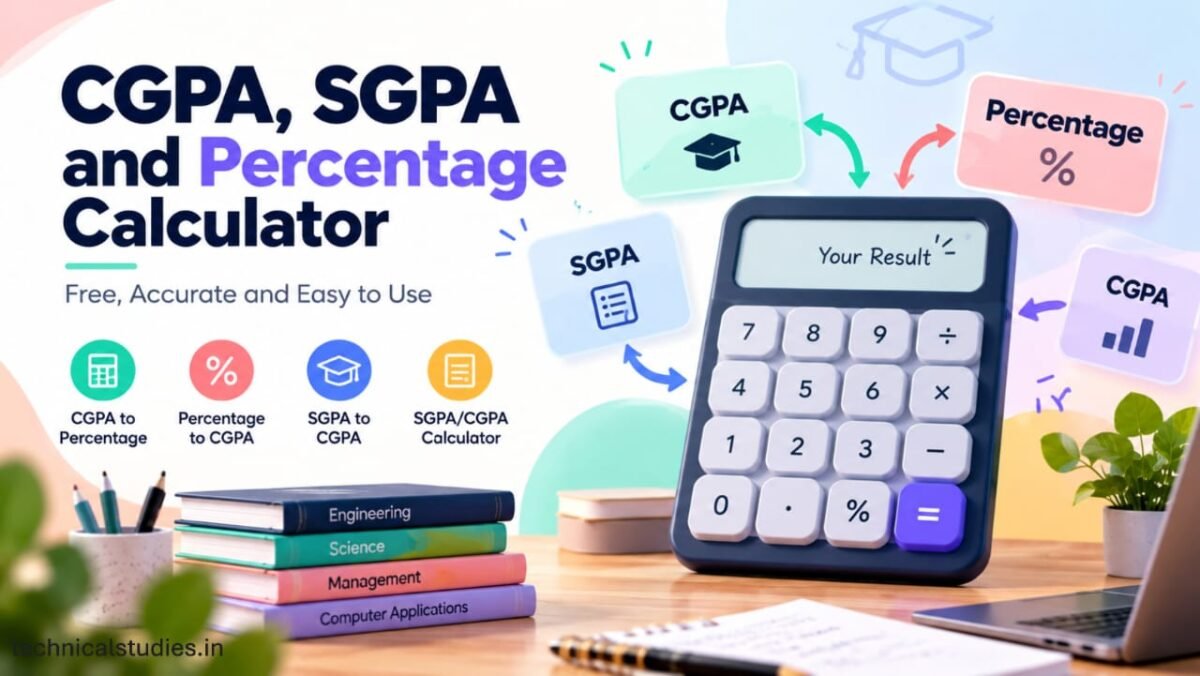
The calculator at the top of this page has four tabs –
– CGPA to Percentage: type your CGPA, pick a formula, and get the percentage.
– Percentage to CGPA: the reverse, for forms that ask for CGPA when your marksheet only shows a percentage.
– SGPA to CGPA: combine your semester SGPAs into one CGPA, either as a plain average or weighted by credits.
– CGPA and SGPA Calculator: enter subject-wise grade points and credits, and get each semester’s SGPA, your overall CGPA, and the percentage equivalent.
The last two tabs update as you type, so there is no button to press. Look at the result box under the inputs.
Why one CGPA gives different percentages
There is no national rule in India for converting CGPA to percentage. Each university or board sets its own, which is why different websites give you different answers for the same number. These are the formulas you will meet most often
| Formula | Typically used by |
|---|---|
| Percentage = CGPA × 9.5 | CBSE, and many colleges that follow it |
| Percentage = CGPA × 10 | Some universities |
| Percentage = (CGPA − 0.75) × 10 | VTU |
| Percentage = a × CGPA + b | Universities with their own linear rule |
The 9.5 multiplier is the best known, so most online calculators quietly assume it. That assumption is exactly how students end up quoting the wrong number.
The ×10 rule is the simplest and gives the highest result of the three. VTU’s rule subtracts 0.75 first, which lands exactly 7.5 points below the ×10 answer.
If your university uses its own linear formula, choose Custom in the dropdown, enter the multiplier (a) and the constant (b), and the tool does the rest.
How to find the formula that applies to you
Don’t guess. Check these, roughly in this order –
1. Your marksheet or transcript. Some universities print the conversion note at the bottom.
2. The examination regulations or grading circular on your university’s website.
3. The exam section or your department office. They can tell you the formula and whether you can get an official equivalence certificate.
4. The requirements of whoever is asking. A company, scholarship body or foreign university may want a certificate rather than your own conversion.
This matters most for placements, scholarships, competitive exams and government forms. A percentage you calculate yourself is fine for planning. For official applications, the figure your university issues wins.
CGPA to percentage, step by step
1. Open the CGPA to Percentage tab.
2. Choose your formula from the dropdown.
3. Enter your CGPA out of 10, for example 8.5.
4. Read the result. The tool also shows the formula it used, so you can note the working.
To see how much the choice matters, here is a quick reference –
| CGPA | × 9.5 | × 10 | VTU |
|---|---|---|---|
| 6.0 | 57.00 | 60 | 52.5 |
| 7.0 | 66.50 | 70 | 62.5 |
| 8.0 | 76.00 | 80 | 72.5 |
| 9.0 | 85.50 | 90 | 82.5 |
| 10 | 95.00 | 100 | 92.5 |
If your CGPA has decimals, such as 7.83, type it exactly as it appears on your result. The tool only rounds the final answer to two decimal places.
Percentage to CGPA
Some applications ask for CGPA when your result only shows a percentage. The Percentage to CGPA tab reverses whichever formula you select. With ×9.5, divide the percentage by 9.5. With ×10, divide by 10. With the VTU rule, divide by 10 and add 0.75.
For example, 76% becomes 8.0 under ×9.5, 7.6 under ×10 and 8.35 under VTU. If the answer falls outside 0 to 10, the tool warns you. That usually means you picked the wrong formula.
SGPA to CGPA: average or weighted?
SGPA covers one semester. CGPA covers everything so far. How you combine them depends on credits.
If every semester carried the same credits, a plain average is enough: add the SGPA and divide by the number of semesters. If credits differ, weight each semester:
CGPA = Σ(SGPA × credits) ÷ Σ(credits)
Here is why it matters. Say Semester 1 had an SGPA of 7.5 over 26 credits, and Semester 2 had 9.0 over 18 credits. A plain average gives 8.25. The weighted result is (7.5 × 26 + 9.0 × 18) ÷ 44 = 8.11. The weaker semester carried more credits, so it pulled the CGPA down more.
In the SGPA to CGPA tab, leave the credits column blank for a plain average, or fill in credits for every semester for a weighted result. If you fill in only some, the tool asks you to complete the rest instead of guessing.
Calculating SGPA from subject grades
Use the CGPA and SGPA Calculator tab when you have grades but no SGPA yet. For each subject you enter:
– Grade point (0 to 10): the number that goes with your grade, not the letter. Letter-to-point tables vary by university. A common scale is O = 10, A+ = 9, A = 8, B+ = 7, B = 6, C = 5, P = 4 and F = 0, but confirm yours before relying on it.
– Credits: printed on your marksheet or in your syllabus, usually between 1 and 4 per subject.
For example, Maths with grade point 9 and 4 credits, Physics with 8 and 3 credits, and English with 10 and 2 credits give (36 + 24 + 20) ÷ 9 = 8.89 as the SGPA.
Use + Subject to add rows and + Add semester to add the next semester. Each semester shows its own SGPA, and below that you get your overall CGPA and its percentage under the formula you selected. A row with a blank grade point or blank credits is ignored. That is the most common reason the result box stays empty.
Mistakes that quietly give wrong results
– Assuming 9.5 applies everywhere. Check your university’s rules first.
– Typing letters instead of grade points. The tool needs numbers.
– Ignoring credits when they differ. A plain average can overstate or understate your CGPA.
– Using a 4-point scale. The tool is built for the 10-point scale most Indian universities use.
– Rounding too early. Round only the final answer, not each SGPA along the way.
– Forgetting the backlog and repeating rules. Universities treat failed and repeated subjects differently. The tool doesn’t apply those rules, so enter the grade points your university actually counts.
Your data stays with you
Everything runs in your browser. Your marks aren’t sent to a server and aren’t stored anywhere.
If your university’s formula isn’t one of the options, use Custom. And if you know the official rule, use the Tell us your university’s formula link under the dropdown and send it along with a source. Formulas get added once they have been checked against official documents, not before.
Frequently Asked Questions
Is CGPA × 9.5 correct for every university?
No. It is the CBSE method and many colleges follow it, but others use ×10, the VTU rule, or their own formula. Check your university’s regulations.
Can I use this for a job or scholarship application?
Use it to estimate. If the employer or scholarship body wants an official figure, ask your university for an equivalence certificate or use the conversion it prescribes.
What is the difference between SGPA and CGPA?
SGPA is your grade point average for one semester. CGPA is the credit-weighted average across all semesters.
Does this work for a 4-point scale?
No. The tool is designed for the 10-point scale and expects grade points and CGPA between 0 and 10.
Why isn’t my result showing?
In the CGPA and SGPA tab, each subject needs both a grade point and credits. In the SGPA to CGPA tab, fill in credits for every semester or for none.
Is the converted percentage the same as my actual marks percentage?
Not necessarily. It is an equivalent calculated from your CGPA, and your university’s own figure always takes priority.