Last updated on June 25th, 2026 at 03:22 pm
If you’ve been searching for the best Python courses for beginners, you’re already one step ahead. Python is one of the most beginner-friendly programming languages in the world, and that’s not just marketing talk.
Its syntax reads almost like plain English, the learning curve is gentle compared to most other languages, and the community support is enormous. Whether you’re a complete newcomer to coding or someone who tried another language and gave up, Python has a way of making things click.
This guide is for you if you’re a student looking to build a technical skill set, a career switcher eyeing roles in data science, web development, or automation, or a working professional who wants to add programming to their toolkit without going back to school.
By the time you finish reading, you’ll know exactly which Python courses are worth your time and money, what to look for in a beginner-friendly course, and how to pick the one that matches your goals and learning style.
So let’s get into it.
Best Python Courses for Beginners – Comparison Table
| Course | Platform | Best For | Duration | Certificate | Rating |
|---|---|---|---|---|---|
| Python for Everybody (Top Pick) | Coursera | Absolute beginners, all backgrounds | ~79 hrs | University of Michigan | 4.8 ★ |
| Python for Data Science, AI & Development | Coursera | Data science & AI career goals | ~25 hrs | IBM | 4.6 ★ |
| Crash Course on Python | Coursera | IT & automation roles | ~21 hrs | 4.8 ★ | |
| Programming in Python | Coursera | Back-end development & database engineering | ~44 hrs | Meta | 4.6 ★ |
| Introduction to Scripting in Python | Coursera | University-grade foundation + projects | ~36 hrs | Rice University | 4.7 ★ |
| Complete Python Bootcamp (CodeWithHarry) | Udemy | Indian learners | ~18 hrs | Udemy / CWH | 4.6 ★ |
| Python for Beginners with Exercises (in28minutes) | Udemy | Hands-on learners, 200+ exercises | ~21 hrs | Udemy | 4.7 ★ |
| Python 4-in-1: Beginner to Job-Ready | Udemy | Multi-track learners (web, GUI, mobile) | ~10 hrs | Udemy | 5.0 ★ |
| Python for Beginners: Learn Python (Jason Cannon) | Udemy | IT professionals & sysadmins, fast learners | ~3 hrs | Udemy | 4.6 ★ |
| Python for Absolute Beginners (Andreas Exadaktylos) | Udemy | True beginners wanting to finish fast | ~13 hrs | Udemy | 4.7 ★ |
Best Python Courses for Beginners
1. Python for Everybody – Coursera
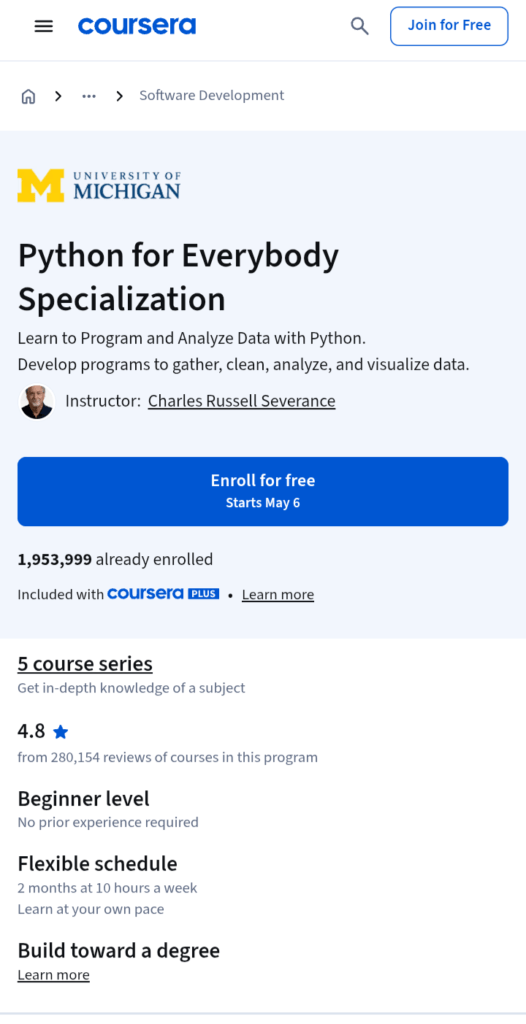
If there’s one Python course that has stood the test of time, it’s Python for Everybody by the University of Michigan on Coursera. Taught by Dr. Charles Russell Severance, affectionately known as “Dr. Chuck,” this specialization has welcomed over 1.9 million learners worldwide, and it’s easy to see why.
It doesn’t just teach you Python syntax; it takes you on a journey from writing your very first line of code all the way to building real applications that retrieve, process, and visualize data. For a complete beginner, that kind of progression is both motivating and deeply practical.
What You’ll Learn
This is a 5-course specialization, and each course builds naturally on the last.
- Course 1 – Programming for Everybody (Getting Started with Python): It teaches the essential building blocks, such as Installing Python and understanding variables, loops, and functions.
- Course 2 – Python Data Structures: This includes the tools you’ll use in almost every real Python project, such as lists, dictionaries, tuples, and file handling.
- Course 3 – Using Python to Access Web Data: Learn web scraping, APIs, JSON, and XML, where Python starts to feel genuinely powerful.
- Course 4 – Using Databases with Python: Work with SQL, relational databases, and object-oriented programming concepts.
- Course 5 – Capstone Project: Pull everything together to build your own data retrieval, processing, and visualization application.
Duration & Structure
The specialization is designed to be completed in roughly 2 months at 10 hours per week. The total content across all five courses runs approximately 79 hours.
Each course is self-paced with flexible deadlines, so life getting in the way won’t derail your progress. Most learners take around 8 months to complete this course at an extended pace.
Certification
Upon completing all five courses, you earn a University of Michigan Specialization Certificate. In my View, this certificate can be added directly to your LinkedIn profile and resume, and it carries genuine weight compared to generic completion badges.
Pros
- Taught by an engaging, world-class instructor who makes complex concepts feel approachable.
- Covers practical, real-world applications like APIs, databases, and data visualization.
- Available in 27 languages.
Cons
- Pacing can feel slow for learners with any prior programming exposure.
2. Python for Data Science, AI & Development – Coursera
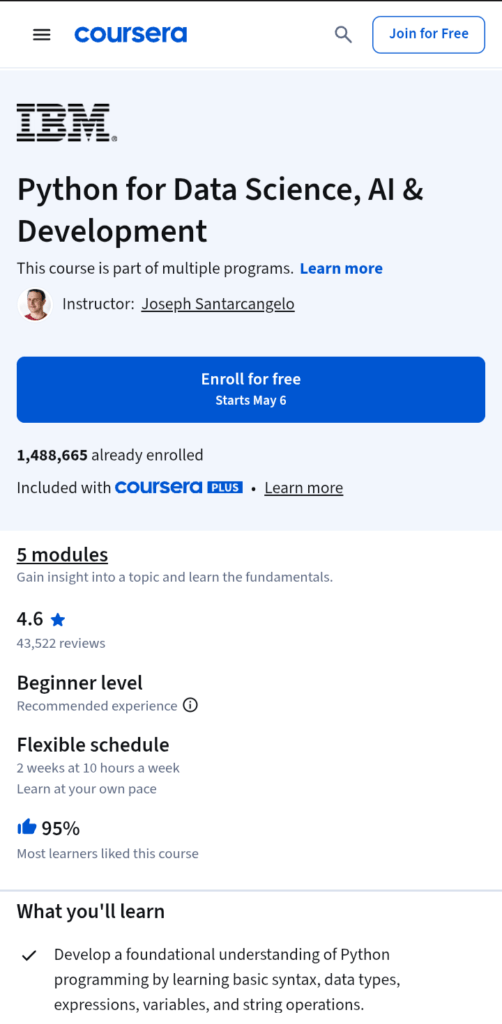
If you already know why you want to learn Python, specifically to break into data science, AI, or software development, then IBM’s Python for Data Science, AI & Development course on Coursera is built with your goals in mind.
Unlike general-purpose Python courses, this one is laser-focused on the tools and skills that actually show up in data-driven job roles.
What makes this course stand out from other beginner options is its intentional blend of Python fundamentals and industry-relevant tools like Pandas, NumPy, REST APIs, and web scraping.
What You’ll Learn
The course is divided into 5 well-structured modules that take you from zero to practically capable. Here is what you will learn in this course.
- Module 1 – Python Basics: Data types, expressions, variables, string operations, and your very first Python program.
- Module 2 – Python Data Structures: The core tools for organizing and manipulating data like Lists, tuples, dictionaries, and sets.
- Module 3 – Python Programming Fundamentals: Conditions, loops, functions, exception handling, and an introduction to object-oriented programming (OOP).
- Module 4 – Working with Data in Python: Reading and writing files (CSV, JSON, TXT), and hands-on work with Pandas and NumPy.
- Module 5 – APIs and Data Collection: Working with REST APIs using the Requests library, web scraping with BeautifulSoup, and handling multiple file formats.
Related: Best Artificial Intelligence Courses Online
Duration & Structure
The course is designed to be completed in roughly 2 weeks at 10 hours per week, making it one of the more compact and focused options on this list.
Each module combines short video lessons, detailed reading materials, cheat sheets, and most importantly, hands-on labs in Jupyter Notebooks where you apply what you’ve just learned in real time. The self-paced format means you can stretch it out over a few weeks if needed without any penalties.
Certification
Upon completion, you earn an IBM-backed course certificate that can be added to your LinkedIn profile and resume.
This course is also part of multiple larger IBM programs, including the IBM Data Science Professional Certificate, IBM AI Developer Professional Certificate, and several others, so completing it can serve as a meaningful stepping stone toward a fuller credential stack.
Pros
- Purpose-built for data science and AI career paths.
- Hands-on Jupyter Notebook labs mirror real professional workflows.
- Covers industry-standard libraries (Pandas, NumPy) from the very beginning.
- Part of multiple IBM professional certificate programs, so it counts toward bigger goals.
- Available in 27 languages.
Cons
- The pace can feel rushed for absolute beginners with no exposure to programming logic.
3. Crash Course on Python by Google – Coursera
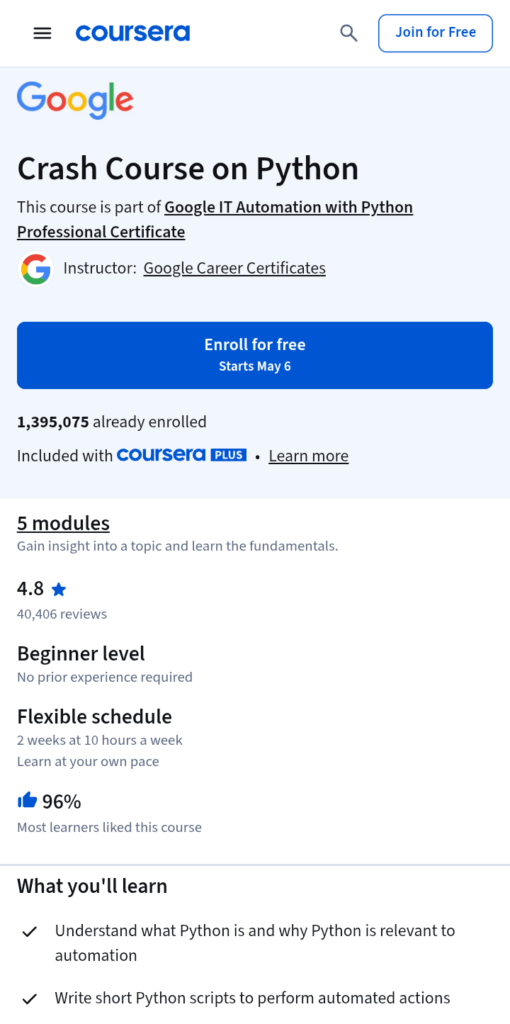
When Google puts its name on a Python course, people pay attention, and for good reason. The Crash Course on Python is the first intro course in Google’s popular IT Automation with Python Professional Certificate, and it delivers exactly what the title promises: a fast, no-nonsense introduction to Python that gets you writing real code quickly.
What sets this course apart from other beginner options is its context.
Google frames every concept of the course around a practical question: how can this help you automate tasks and solve IT problems?
That framing makes the content feel immediately relevant and keeps motivation high, especially for learners who are eyeing careers in IT support, systems administration, or DevOps.
What You’ll Learn
- Module 1 – Hello Python!
An introduction to programming concepts, Python’s role in IT and automation, and a hands-on tour of popular development environments including Jupyter Notebooks, VS Code, and Google Colab.
- Module 2 – Basic Python Syntax
Data types, variables, functions, code reuse, code style, and conditional logic using if, else, and elif statements.
- Module 3 – Loops
Both while and for loops in depth, including how to handle infinite loops, use the range() function, and work with nested loops. There’s even an optional introduction to recursion for curious learners.
- Module 4 – Strings, Lists, and Dictionaries
Advanced string manipulation, list comprehensions, tuples, and dictionaries, plus an optional introduction to Object-Oriented Programming.
- Module 5 – Final Project
A guided, problem-solving framework where you’ll plan and write a complete Python script from scratch, applying everything you’ve learned across the course.
Duration & Structure
This course is designed to be completed in roughly 2 weeks at 10 hours per week.
The content is dense but exceptionally well-organized, with each module combining video lessons, detailed study guides, reading reviews, knowledge checks, and interactive plugins.
Certification
Completing this course earns you a Certificate from Coursera and Google, which is a valuable credential in the entry-level tech job market.
Beyond the certificate itself, the course includes career development resources like resume templates, career guidance materials, and advice on finding your path in tech.
Pros
- Teaches Python with a clear IT and automation context.
- Exceptional variety of learning formats: videos, study guides, interactive plugins, labs.
- Includes career development resources and resume guidance.
- The final project encourages real problem-solving, not just passive learning.
- Part of a broader Google IT Automation certificate for those who want to go deeper.
Cons
- OOP is introduced but kept optional, so learners seeking depth there may need to supplement.
- Primarily focused on IT and automation, not ideal if your goal is data science or web development.
4. Programming in Python – Coursera
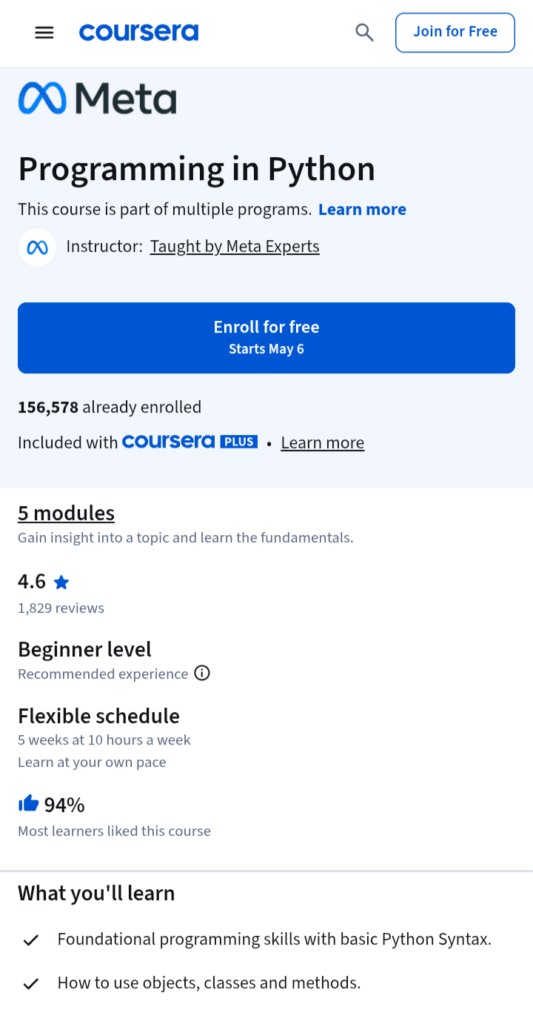
Not all beginner Python courses are created equal, and Programming in Python by Meta is proof that the right instructor and the right framing can make a significant difference.
Developed and taught by Meta experts, this course doesn’t just teach you Python syntax; it teaches you how to think like a programmer.
What You’ll Learn
The course spans 5 modules and goes noticeably deeper into programming concepts than most beginner-level courses.
- Module 1 – Getting Started with Python: Environment setup for both Windows and Mac, Python syntax fundamentals, variables, data types, strings, type casting, user input, math and logical operators, control flow (if/else, match statements), and looping constructs including nested loops and their effect on algorithmic complexity.
- Module 2 – Basic Programming with Python: Functions, variable scope, all major data structures (lists, tuples, sets, dictionaries), kwargs, exception handling, and file handling, including creating and reading files.
- Module 3 – Programming Paradigms: This is where the course really stands out. You’ll explore procedural, functional, and object-oriented programming, dive into algorithms and Big-O complexity, work with recursion, map and filter functions, Python classes and instances, inheritance, abstract classes, and method resolution order.
- Module 4 – Modules, Packages, Libraries and Tools: An introduction to Python’s broader ecosystem, including NumPy, Pandas, Matplotlib, PyTorch, TensorFlow, popular web frameworks, and most impressively, a dedicated section on software testing including PyTest, test-driven development (TDD), and test automation packages.
- Module 5 – End-of-Course Graded Assessment: A comprehensive final assessment that tests everything covered across all four modules.
Related: Best JavaScript Courses For Beginners
Duration & Structure
This course is designed to be completed in roughly 5 weeks at 10 hours per week. The pacing gives concepts room to breathe, and the content depth, particularly around programming paradigms, OOP, and software testing, genuinely justifies the investment.
Each module combines videos, detailed reading materials, knowledge checks, self-review exercises, and hands-on programming assignments coded directly in VS Code on Coursera.
Certification
Completing this course earns you a Meta-backed course certificate shareable on LinkedIn and your resume.
More significantly, it counts as the first step toward Meta’s full Back-End Developer or Database Engineer Professional Certificates. Both of which are increasingly recognized by employers in the software development space.
For learners who are serious about building a career in back-end development, completing this course as part of the larger program is a meaningful investment.
Pros
- Dedicated module on software testing and TDD.
- Covers OOP, abstract classes, inheritance, and method resolution in real depth.
- Part of Meta’s Back-End Developer and Database Engineer professional certificates.
- Hands-on programming assignments using VS Code.
Cons
- Programming assignments are time-heavy (each estimated at 3 hours), which demands serious commitment.
5. Introduction to Scripting in Python – Coursera
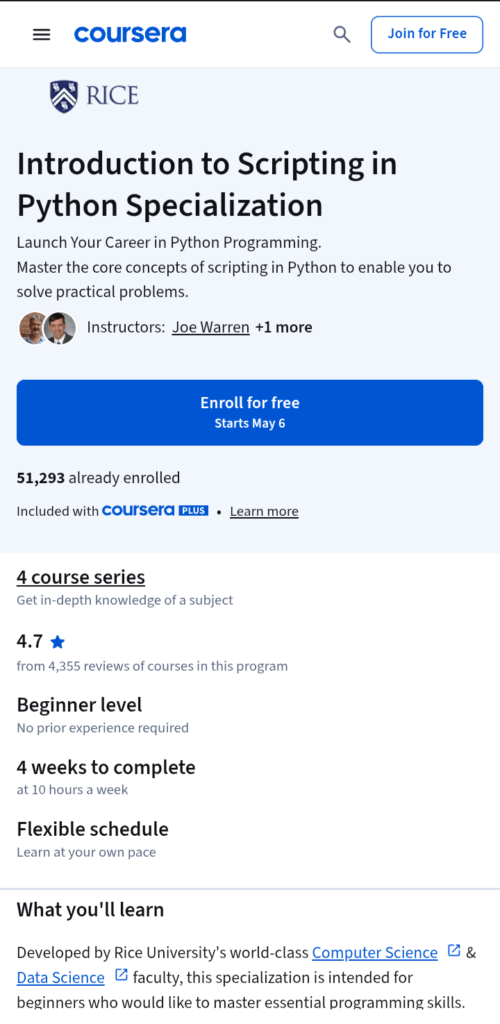
Designed and taught by Professors Joe Warren and Scott Rixner from Rice’s highly respected Computer Science department, the Introduction to Scripting in Python specialization on Coursera takes a thoughtful, academically rigorous approach to teaching Python, without ever feeling dry or overly theoretical.
What makes this specialization genuinely stand out is its project-first philosophy.
Every single course ends with a practical applied project, and the cumulative arc of those projects is impressive: you start with processing dates and comparing files, progress to sports analytics using real baseball data, and finish by importing live economic data from the World Bank, processing it, and visualizing it overlaid on an interactive world map.
What You’ll Learn
The specialization is structured as a clean, sequential 4-course journey. Here is what each course covers.
- Course 1 – Python Programming Essentials (9 hours): The fundamentals such as expressions, variables, functions, logic, conditionals, and Python modules. Critically, this course uses CodeSkulptor, a browser-based Python environment developed at Rice that requires zero installation. You can start writing and running code within minutes of enrolling, which removes the friction that trips up so many absolute beginners.
- Course 2 – Python Data Representations (9 hours): Strings, lists, tuples, and file access. You’ll learn how to read from and write to files, which opens the door to working with real data. This course also transitions you from the browser-based environment to proper desktop Python development, a natural and well-paced progression.
- Course 3 – Python Data Analysis (9 hours): Tabular data, CSV files, data manipulation, wrangling, and processing. By this point, you’re working with real datasets, including historical baseball statistics, and applying Python to solve genuine analytical problems.
- Course 4 – Python Data Visualization (9 hours): Installing external Python packages, acquiring data from the web, cleaning and processing it, and generating visualizations. The capstone project here is genuinely impressive: you’ll pull World Bank economic data, process it, and display it on an interactive world map.
Duration & Structure
Each of the four courses is designed to be completed in roughly one month, making the full specialization a 4-month journey at approximately 10 hours per week.
The pacing is gentle enough for true beginners but purposeful enough that you’re never spinning your wheels.
Certification
Upon completing all four courses, you earn a Rice University Specialization Certificate, backed by one of the most respected universities in the United States, consistently ranked among the top 20 nationally.
Pros
- Outstanding applied project arc: from file processing to sports analytics to World Bank data visualization.
- The browser-based CodeSkulptor environment eliminates setup friction for absolute beginners.
- Covers data visualization with real external datasets.
Cons
- Does not cover OOP, machine learning libraries, or software testing in depth.
6. Complete Python Bootcamp: Learn Python from Scratch – Udemy (CodeWithHarry)
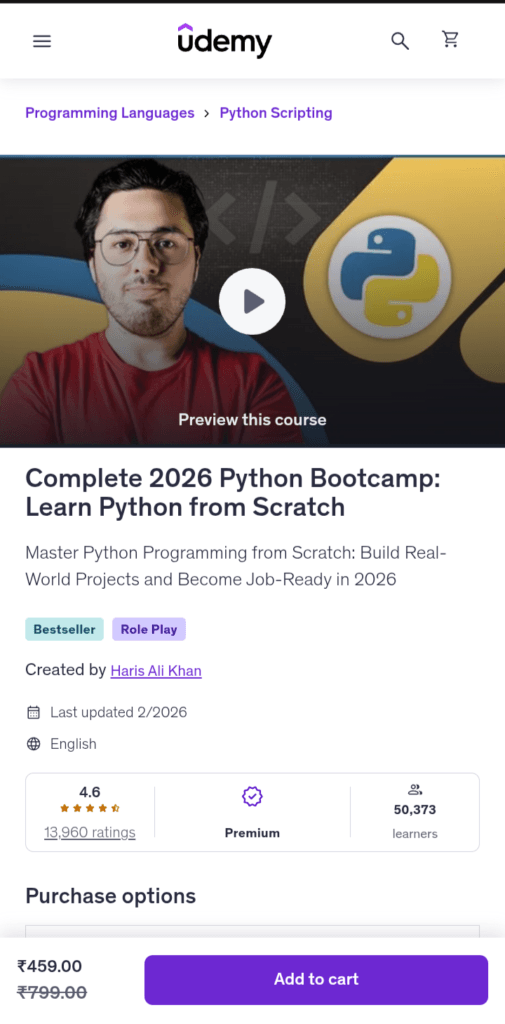
If you’ve spent any time in Indian programming communities, on YouTube, Telegram, or Reddit, you’ve almost certainly come across CodeWithHarry.
Behind the name is Haris Ali Khan, one of India’s most beloved coding educators, who built a massive following of over 9 million learners across platforms by offering free, high-quality programming content for years before ever charging a single rupee.
His Complete Python Bootcamp on Udemy is the natural evolution of that mission, a structured, paid course that packages his signature teaching style into a single, comprehensive learning path.
What You’ll Learn
The course is structured across 16 sections and 110 lectures, covering an impressive breadth of ground for a beginner course.
- Introduction to Programming & Python: The very basics, including what programming is, why Python, and how to set up your environment.
- Python Fundamentals: Variables, data types, expressions, and the building blocks of any Python program.
- Control Flow and Loops: if/else logic, while loops, for loops, and how to control the flow of your code.
- Strings: Deep dive into string manipulation, indexing, slicing, and formatting.
- Functions and Modules: Defining functions, using built-in modules, and understanding code reusability.
- Data Structures in Python: Lists, tuples, sets, and dictionaries.
- Object-Oriented Programming (OOP): Classes, objects, and inheritance explained clearly and practically.
- Advanced Python Concepts: Decorators, generators, comprehensions, and more.
- File I/O: Reading, writing, and working with files and related modules.
- Working with External Libraries: Using popular third-party libraries to extend Python’s capabilities, including Requests and Shutil.
- Using AI as a Developer: A genuinely forward-thinking module that teaches you how to leverage AI tools in your coding workflow.
- Hands-On Python Projects: Build calculators, games, automation scripts, and more.
- Building Web Applications with Flask: A practical introduction to Flask, covering 12 dedicated lectures.
- VidSnapAI Project: Build an AI-powered video reel generator, a capstone project that demonstrates real-world, modern Python development.
- Version Control with Git: 16 dedicated lectures on Git.
Duration & Structure
The course contains 110 lectures totalling 17 hours and 43 minutes of video content. That’s a well-balanced length.
Each section follows a logical progression, and Harry’s pacing is consistently praised by learners for being neither too fast nor too slow.
The hands-on projects and the AI and Flask modules add significant practical depth that stretches the course well beyond a typical “Python basics” offering.
Certification
Upon completing the course, you receive a CodeWithHarry / Udemy certificate of completion. While this carries strong recognition within the Indian tech community and among learners familiar with Harry’s platform, it doesn’t carry the same institutional weight as certificates from Google, IBM, or a university.
The certificate is shareable on LinkedIn and can be added to your resume. For Indian learners specifically, this is one of the more credible certifications available at this price point.
Pros
- One of the very few beginner courses that includes Flask web development and Git version control.
- Forward-thinking AI integration module that teaches you to use AI tools as a developer.
- Hands-on projects throughout, including a capstone AI-powered application.
- Covers advanced concepts like decorators and generators that most beginner courses avoid.
Cons
- Certificate carries strong local recognition but less global institutional weight compared to Google, IBM, or university-backed credentials.
7. Python Bootcamp: Beginner to Master Programming – Udemy (in28minutes / Ranga Karanam)
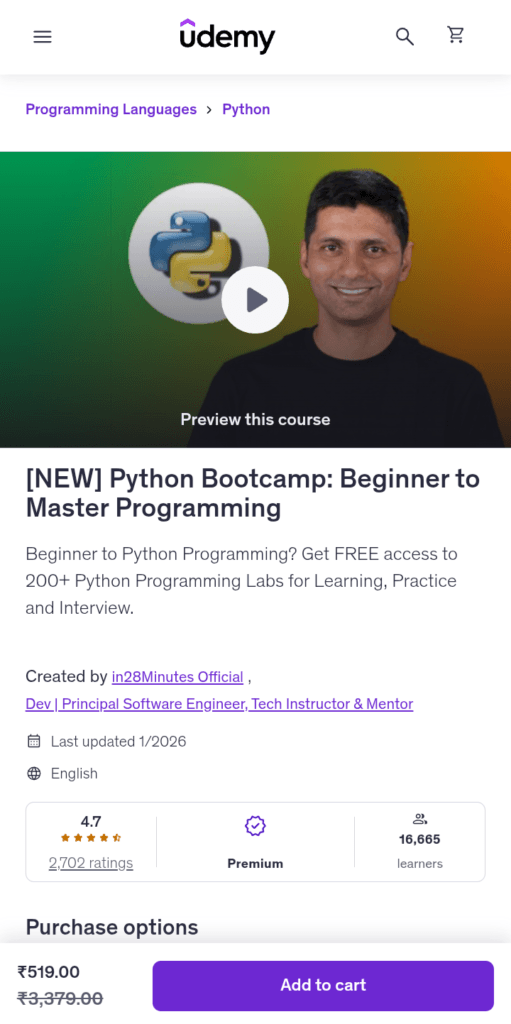
Python Bootcamp: Beginner to Master Programming by Ranga Karanam and the in28minutes team focuses on relentless, hands-on practice instead of simply watching videos, making notes, and taking quizzes.
With over 200 coding labs, puzzles, and exercises all completed directly in your browser, this course is designed around a single philosophy: the only way to truly learn programming is to actually write code.
What You’ll Learn
The course is structured across 27 sections and 250 lectures totalling 21+ hours of content, covering Python from absolute zero through to confident, practical programming.
- Getting Started: What programming is, why Python, and how the Udemy coding platform works.
- Python Fundamentals: Variables, data types, expressions, and the core building blocks every programmer needs.
- Operators and Expressions: Arithmetic, comparison, logical, and bitwise operators with hands-on lab practice throughout.
- Control Flow: if/else conditions, elif chains, and decision-making logic reinforced with puzzles and coding challenges.
- Loops: while loops, for loops, loop control with break and continue, and nested loops.
- Functions: Defining functions, parameters, return values, variable scope, and building reusable code blocks.
- Data Structures: Lists, tuples, sets, and dictionaries.
- Strings: String methods, slicing, formatting, and manipulation in depth.
- Object-Oriented Programming: Classes, objects, constructors, methods, and inheritance explained step by step.
- Exception Handling: Writing error-tolerant programs that fail gracefully.
- File Handling: Reading from and writing to files.
- Python Modules & Libraries: Working with Python’s standard library and extending your programs with external tools.
- Practice Labs Throughout: Hundreds of puzzles, exercises, and coding challenges woven into every section.
Duration & Structure
At 27 sections, 250 lectures, and over 21 hours of total content, this is one of the more comprehensive beginner courses on Udemy.
The course is entirely self-paced with lifetime access, and the browser-based coding environment means you can study from any device without any local setup.
Certification
Upon completing the course, you receive a Udemy certificate of completion from in28minutes. While Udemy certificates are not universally recognized as institutional credentials, in28minutes has an exceptionally strong reputation in the global developer community, particularly among professionals in tech, cloud, and DevOps.
Pros
- Covers OOP, exception handling, and file I/O.
- Exceptionally exercise-heavy, with 200+ coding labs and puzzles, means you’re always actively learning, never just passively watching.
- Coding challenges and puzzles make learning genuinely engaging rather than monotonous.
Cons
- Doesn’t cover data science libraries (Pandas, NumPy, Matplotlib).
8. Python: Python Programming (From Zero to Your First Job) – Udemy
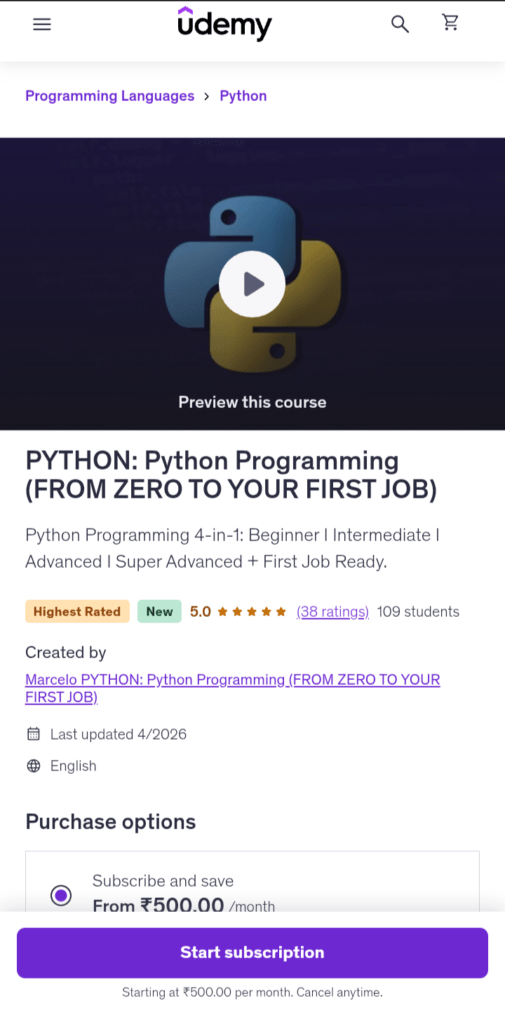
PYTHON: Python Programming (From Zero to Your First Job) by instructor Marcelo takes a genuinely different approach.
Structured as a true 4-in-1 progression – Beginner, Intermediate, Advanced, and Super Advanced – it maps out a complete learning arc that doesn’t just teach you Python syntax, but walks you through the exact skills, tools, and project experience that a first job in tech actually demands.
What You’ll Learn
The course is built across four distinct but connected levels, taking you from writing your very first line of Python all the way through to deploying real-world applications.
Level 1 – Beginner: Python installation and environment setup, core programming principles, variables, data types, operators, control flow (if/else), loops, functions, and the foundational logic every programmer needs to internalize before moving forward.
Level 2 – Intermediate: File handling, error management and exception handling, and Object-Oriented Programming (OOP). This level includes a real-world Contact Manager project that bridges theory and practice in a meaningful, tangible way.
Level 3 – Advanced: Working with APIs, task automation, SQLite database integration, and structuring code the way professional developers do.
Level 4 – Super Advanced + Job Ready: Full project deployment, portfolio-building guidance, and preparation for the real world of professional Python development. By this point, you’re not just learning Python; you’re learning how to present yourself as someone who can use it professionally.
Duration & Structure
With over 10 hours of hands-on, straight-to-the-point content, the course is carefully designed to guide students from the basics to advanced applications, covering everything from initial concepts to real-world solutions like automation, web development, database integration, and full project deployment.
Certification
Completing the course earns you a Udemy certificate of completion, shareable on LinkedIn and your resume.
A certificate backed by hands-on projects in API integration, database work, automation, and full deployment is a far more compelling conversation piece in a job interview than a certificate from a course that only covered the basics.
Pros
- True 4-level structure (Beginner → Intermediate → Advanced → Super Advanced) provides a clear, motivating progression.
- Taught by a working data analyst who uses Python professionally.
- Covers API integration, SQLite databases, automation, and full deployment.
- Real-world Contact Manager project in the intermediate module bridges theory and practice meaningfully.
Cons
- No dedicated coverage of data science libraries (Pandas, NumPy, Matplotlib) for learners targeting data roles specifically.
9. Python for Beginners: Learn Python Programming (Python 3) – Udemy (Jason Cannon)
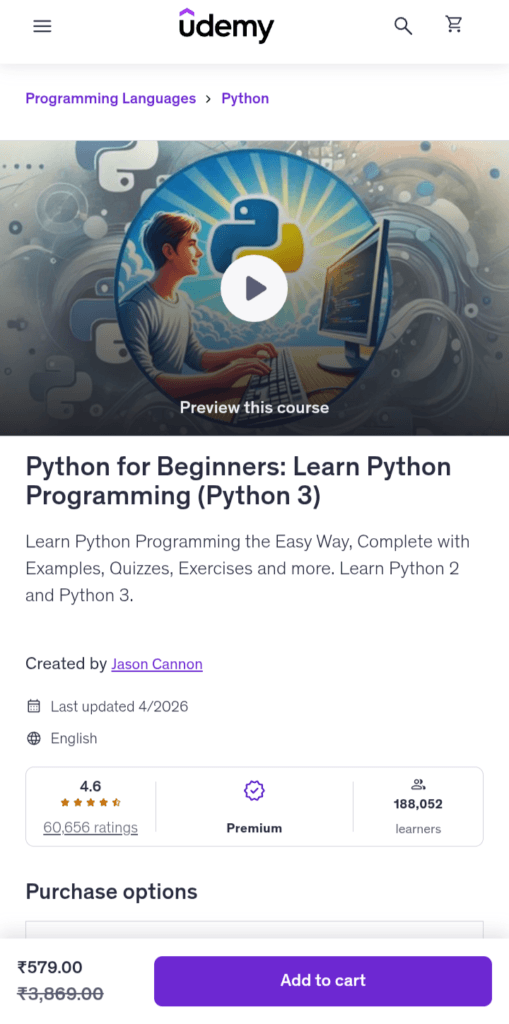
Jason Cannon’s Python for Beginners: Learn Python Programming is a short course on Python.
At just around 2.5 focused hours, this course strips Python down to its most essential, practical core and delivers it with the precision of someone who has spent decades writing real scripts in real environments.
What You’ll Learn
Across 78 focused lectures, the course covers everything a true beginner needs to write real, working Python scripts.
- Environment Setup: When to use Python 2 vs Python 3, how to install Python on Windows, Mac, and Linux, and the various ways to run a Python program across all three operating systems.
- Python Fundamentals: Variables, data types, strings, numbers, booleans, and how Python handles different kinds of information.
- Control Flow: if/else statements, conditional logic, and how to make your programs make decisions.
- Loops: while and for loops.
- Functions: Writing reusable functions, passing arguments, and structuring code for clarity and efficiency.
- Data Structures: Lists, tuples, and dictionaries.
- File Handling: Reading from and writing to files.
- Modules: Using Python’s built-in modules to extend your programs without reinventing the wheel.
- Automation Mindset: Throughout the course, Jason frames every concept through the lens of real-world scripting.
Related: Best Swift Courses on Udemy to Learn iOS App Development
Duration & Structure
At 78 lectures and approximately 2.5 hours of total content, this is deliberately the most concise course in this entire roundup.
The course is self-paced with lifetime access, and the downloadable resources mean you can revisit any concept quickly without hunting through hours of footage.
Certification
Completing the course earns you a standard Udemy certificate of completion, shareable on LinkedIn and your resume.
For career switchers coming from IT backgrounds, this recognition can matter more than it might appear on paper.
Pros
- Taught by a seasoned IT professional with real-world Unix, Linux, and Python experience at top companies.
- Perfect for IT pros and sysadmins who want to add Python scripting to their existing skill set.
- Covers both Python 2 and Python 3.
Cons
- Not ideal for learners who prefer extensive project-based learning.
10. Python for Absolute Beginners: Learn Python in a Week! – Udemy (Andreas Exadaktylos)
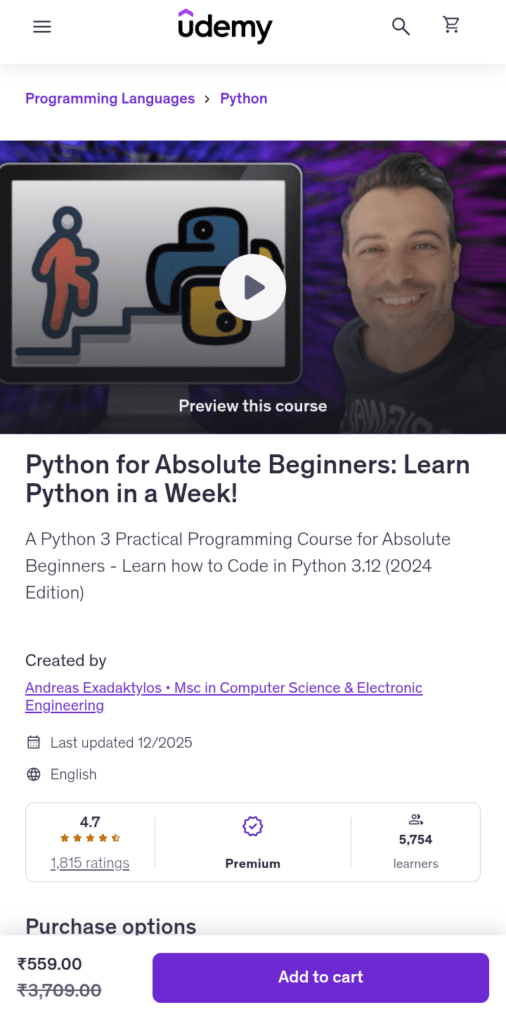
Python for Absolute Beginners: Learn Python in a Week! by Andreas Exadaktylos is designed for learners who want a short but detailed course to learn Python programming.
The course is built for people who have never written a single line of code in their lives. No programming vocabulary is assumed, and no background knowledge is required.
What Andreas brings to the table is a clean, example-heavy teaching style where every concept is immediately illustrated with a working Python program, and the course is shot in full HD to make code easy to read on any screen.
What You’ll Learn
Across 17 well-organized sections, the course takes a logical, step-by-step journey through Python’s most essential foundations.
- Setting Up Python: Getting Python installed and your development environment configured correctly from the very start.
- Your First Python Program: Writing and running code immediately.
- Strings and String Methods: Working with text data, slicing, formatting, and Python’s built-in string toolkit.
- Numbers and Math: Integer and float operations, arithmetic, and Python’s math capabilities.
- Functions and Loops: Defining reusable functions, understanding scope, and mastering both while and for loops.
- Scopes: A dedicated section on variable scope.
- Conditional Logic: if, elif, and else statements for building decision-making programs.
- Data Structures: Lists, tuples, dictionaries, and sets.
- Advanced Methods of Lists and Dictionaries: Going deeper into the most commonly used data structures with practical techniques.
- Dealing with Errors: Understanding exceptions, debugging your code, and writing programs that handle unexpected input gracefully.
- PROJECT: Rock, Paper, Scissors: A full command-line game built entirely in Python.
- Object-Oriented Programming (OOP), Modules and Packages: Classes, objects, importing modules, and organizing code professionally.
- Working with Files and Directories: Reading and writing files.
- Milestone Project: Interactive Math Game: A capstone project that brings together functions, loops, conditionals, and user interaction into a complete, working Python application.
- Bonus Section: Additional content to extend your skills beyond the core curriculum.
Duration & Structure
17 sections, 177 lectures, and 13 hours and 23 minutes that’s the sweet spot this course occupies. It’s comprehensive enough to cover all the Python fundamentals a beginner needs, but focused enough to be complete in a week of dedicated study.
Certification
Completing the course earns you a Udemy certificate of completion, shareable on LinkedIn and your resume.
For learners primarily focused on building skills rather than chasing institutional credentials, the certificate is a respectable proof of completion.
Pros
- Two hands-on projects embedded mid-course and at the end.
- Taught by a credentialed computer scientist (MSc) with a genuinely clear teaching style.
- Dedicated section on variable scope.
- Covers OOP, file handling, error handling, and modules.
Cons
- Does not cover data science libraries (Pandas, NumPy), web development frameworks, or automation tools.
Best Python Course Based on Your Goal (My Recommendations)
Best Python Course to Get a Job
Crash Course on Python – Google Career Certificates (Coursera)
Why this course stands out
Google designed this course specifically for IT and automation roles. It focuses on practical Python skills that employers actually look for in entry-level tech positions. The Google certificate also adds credibility for job seekers.
Best Python Course for Data Science & AI
Python for Data Science, AI & Development – IBM (Coursera)
Why this course stands out
This course is tailored for aspiring data analysts and data scientists. It includes hands-on work with Pandas, NumPy, APIs, and Jupyter Notebooks.
Best Python Course for Absolute Beginners
Python for Everybody – University of Michigan (Coursera)
Why this course stands out
This is one of the most beginner-friendly Python specializations online. The teaching style is slow-paced, simple, and designed for people with zero coding experience.
Best Python Course to Learn Fast
Python for Beginners: Learn Python (Python 3) – Jason Cannon (Udemy)
Why this course stands out
This is one of the fastest beginner Python courses available online. It delivers the fundamentals quickly without unnecessary theory.
Best Python Course for Indian Learners
Complete Python Bootcamp – CodeWithHarry (Udemy)
Why this course stands out
This course is affordable, beginner-friendly, and designed with Indian learners in mind. It covers Python fundamentals, Flask, Git, and practical projects at a very accessible price point.
Frequently Asked Questions About Learning Python
Is Python easy to learn for beginners?
How long does it take to learn Python?
The exact duration to learn Python depends on your goal. Most beginners learn the fundamentals in 1 to 2 months by studying 1 hour per day. If you study and build projects consistently for 3 to 6 months, you can secure a job.
Do I need a computer science degree to learn Python?
No, a degree is not required to learn Python or get hired as a Python developer. The courses in this guide are designed for complete beginners with no technical background.
Who and when invented Python?
Guido van Rossum invented Python, which saw its initial release in 1991.
How can I write Python comments?
Python comments begin with the hash symbol (#) and go on until the end of the line. They are employed in the code to offer clarifications or annotations.
Is using Python free?
Yes, both commercial and non-commercial usage of Python is permitted as it is an open-source software.
Which data types exist in Python?
A variety of data types, such as integers, floats, strings, booleans, lists, tuples, dictionaries, and sets, are supported by Python.
Final Verdict
It is hard for me to point to a single course and say it is the best Python course for everyone. Each course is designed for a specific goal, and you need to choose courses based on that.
So the perfect Python course for you is the one that matches your career goal and helps you grow.
So choose a course and start learning today.
Related Articles
How To Install Python On Windows
Top 10 Udemy Courses for Aspiring Data Scientists
11 Best Machine Learning Courses Online
14 Best Deep Learning Courses Online
Best Prompt Engineering Courses on Udemy

TechnicalStudies was started by Neeladrinath with one simple idea — give Indian students a reliable place to figure out what’s actually worth their time and money. Every recommendation here is backed by careful research, real student feedback, and honest analysis. We cover online courses, laptops, smartwatches, software deals, and learning resources — all looked at from a student’s perspective, so you can spend less time guessing and more time learning.